A Linen Belt – Ruined and Completely Useless

OLYMPUS DIGITAL CAMERA

OLYMPUS DIGITAL CAMERA

This is what the Lord said to me: “Go and buy a linen belt and put it around your waist, but do not let it touch water.” So I bought a belt, as the Lord directed, and put it around my waist.   Then the word of the Lord came to me a second time: “Take the belt you bought and are wearing around your waist, and go now to Perath and hide it there in a crevice in the rocks.” So I went and hid it at Perath, as the Lord told me.   Many days later the Lord said to me, “Go now to Perath and get the belt I told you to hide there.” So I went to Perath and dug up the belt and took it from the place where I had hidden it, but now it was ruined and completely useless.   Then the word of the Lord came to me: “This is what the Lord says: ‘In the same way I will ruin the pride of Judah and the great pride of Jerusalem. These wicked people, who refuse to listen to my words, who follow the stubbornness of their hearts and go after other gods to serve and worship them, will be like this belt—completely useless! For as a belt is bound around the waist, so I bound all the people of Israel and all the people of Judah to me,’ declares the Lord , ‘to be my people for my renown and praise and honor. But they have not listened.’ – Jeremiah 13:1-11

This passage contains interesting  imagery.  God instructs someone, presumably Jeremiah, to purchase a linen belt and put it around their waist.  The interesting twist here is that the belt wearer is to “not let it touch water”.  A belt, at least in modern times, is a devise for holding up one’s pants.  In the time this passage was written it may have had a slightly different purpose but it is probably accurate to say that it was a clothing accessory designed for a specific purpose.

The reason why it was not to touch water is not clear to me.  Perhaps it was part of the metaphor that God was building.  It seems as though the linen belt is intended to represent the people of Judah and Jerusalem.  So if that is the case then the fact that they were not to touch water may have been an allusion to the estrangement they were experiencing from God – the Living Water.

God then directs the belt-wearer to travel to Perath and stash the belt in a crevice in the rocks.  Apparently the town or region or Pareth was near where Jeremiah was born.  God directs Jeremiah to return to the hiding place many days later only to find that the linen belt is “ruined and completely useless”.

God then makes it clear that the belt is in fact meant to symbolize the people of Judah and Jerusalem “In the same way I will ruin the pride of Judah and the great pride of Jerusalem. These wicked people, who refuse to listen to my words, who follow the stubbornness of their hearts and go after other gods to serve and worship them, will be like this belt—completely useless”.  It cannot feel very good for the God you follow to liken you to a useless belt, but in a way that is the way the people of Judah and Jerusalem were treating God.

Not only were they treating God like a useless belt, but as if He had gone “out of style” and it was much more stylish to follow idols fashioned of wood and stone.  God’s people were bound to Him like a belt – just like all those who follow God today voluntarily bind themselves to follow God through His son Jesus.  God was trying to get the attention of these people and help them see the important role they were to play.  The people of Judah and Jerusalem, and modern-day God followers, are “accessories” to God’s wardrobe, but the amazing thing is that God loves us and needs us none the less.  He has accepted all of us imperfect linen belts, despite our soiled and sometimes useless behavior.

Prayer: God thank You for loving us and allowing us to play a part in Your kingdom despite our flaws useless behavior.

Posted in Discernment, Forgiveness, Free Will, God's Love for Us, grace, Jeremiah, Obedience, The Nature of God | Tagged , , , , , | Leave a comment

Just be Held…

Tree_LodgepolePine_325x220_2

You are always righteous, Lord , when I bring a case before you. Yet I would speak with you about your justice: Why does the way of the wicked prosper? Why do all the faithless live at ease? You have planted them, and they have taken root; they grow and bear fruit. You are always on their lips but far from their hearts. Yet you know me, Lord ; you see me and test my thoughts about you. Drag them off like sheep to be butchered! Set them apart for the day of slaughter! How long will the land lie parched and the grass in every field be withered? Because those who live in it are wicked, the animals and birds have perished. Moreover, the people are saying, “He will not see what happens to us.” “If you have raced with men on foot and they have worn you out, how can you compete with horses? If you stumble in safe country, how will you manage in the thickets by the Jordan? Your relatives, members of your own family— even they have betrayed you; they have raised a loud cry against you. Do not trust them, though they speak well of you. – Jeremiah 12:1-6

Jeremiah is engaged in a philosophical debate with God about an important question: “Why does the way of the wicked prosper? Why do all the faithless live at ease?” Jeremiah is wondering why people who seem bent on walking apart from God seem to prosper, at least from an earthly perspective. This is something that I think many God followers wonder at times. I think the answer lies in how we measure success and what should be the ultimate goal of our lives. The world would say the goal is to take care of our physical bodies and have long lives. God has a different goal for us.

Jeremiah would like there to be more justice from his perspective for the wayward ways of the people and the consequences of their disobedience on the land. There seems to be a corruption of nature itself as a result of the actions of the people who are choosing idols over God. These people feel like they are getting away with it in a sense. They think that God “will not see what happens to us.”

The passage then passes into a metaphor that remains a bit murky to me. I think God is responding to the pride of the people by saying “If you have raced with men on foot and they have worn you out, how can you compete with horses?” If I have this straight God seems to be saying that those who fail in following Him with their bodies (racing with men on foot) have no hope of achieving the more difficult task of following God with their spirit (competing with horses). I may have this totally wrong, but that is the only way it makes sense to me at the moment.

God continues with this theme by using another analogy, “If you stumble in safe country, how will you manage in the thickets by the Jordan?” This is the reference to water, albeit tangential, to the Jordan River. The idea seems to be that if you cannot walk a straight path in “safe country” how will you ever find your way in the murky depths of the soul, “the thickets by the Jordan”.

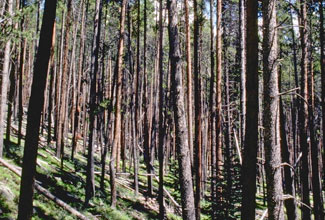
The closest thing I have experienced to the “thickets of the Jordan” is stands of young Lodge Pole pines in northern Montana. The locals refer to these “forests” as dog hair. I will say that ones feels very much like a frustrated flee on a dog’s back trying to navigate these thickets of pine. The way forward is very non-linear and one can become disoriented, discouraged, and downright crazy with the constant whipping meted out by the young pines.

I think the take home message for me is that as hard as it seems to faithfully follow God through this “land of oblivion” the voyage to the “undiscovered country” with our soul is much harder, more confusing, and sometimes frustrating. Maybe the efforts we make to obey God on a daily basis are actually just practice for the much harder task of spiritual obedience. It puts things in a new perspective for me as I struggle to follow God.

God wants us to allow our lives and our spirits to be held by Him. He wants to carry us like a son or Daughter, but we often insist on walking on our own. This reminds me of a song by one of my favorite musical groups Casting Crowns called “Just be Held”. Here are some of the lyrics that seem to come right out of this passage:

Hold it all together
Everybody needs you strong
But life hits you out of nowhere
And barely leaves you holding on
And when you’re tired of fighting
Chained by your control
There’s freedom in surrender
Lay it down and let it go
So when you’re on your knees and answers seem so far away
You’re not alone, stop holding on and just be held
Your world’s not falling apart, it’s falling into place
I’m on the throne, stop holding on and just be held
Just be held, just be held
– “Just be Held” by Casting Crowns

Prayer: God help us to prayerfully practice obedience with our bodies so that our spirits can follow.

Posted in Conflict, Discernment, Discipleship, Faith, Following God, Free Will, Jeremiah, Obedience, reconciliation, Redemption, The Earthly Realm, The Nature of God, The Spiritual Realm, Trusting God | Tagged , , , , , | 1 Comment

The waters in the Heavens Roar

NOAA Photo Library

NOAA Photo Library

Hear what the Lord says to you, people of Israel. This is what the Lord says: “Do not learn the ways of the nations or be terrified by signs in the heavens, though the nations are terrified by them.   For the practices of the peoples are worthless; they cut a tree out of the forest, and a craftsman shapes it with his chisel.   They adorn it with silver and gold; they fasten it with hammer and nails so it will not totter.   Like a scarecrow in a cucumber field, their idols cannot speak; they must be carried because they cannot walk. Do not fear them; they can do no harm nor can they do any good.”   No one is like you, Lord ; you are great, and your name is mighty in power.   Who should not fear you, King of the nations? This is your due. Among all the wise leaders of the nations and in all their kingdoms, there is no one like you.   They are all senseless and foolish; they are taught by worthless wooden idols.   Hammered silver is brought from Tarshish and gold from Uphaz. What the craftsman and goldsmith have made is then dressed in blue and purple— all made by skilled workers.   But the Lord is the true God; he is the living God, the eternal King. When he is angry, the earth trembles; the nations cannot endure his wrath.   “Tell them this: ‘These gods, who did not make the heavens and the earth, will perish from the earth and from under the heavens.’ ”    But God made the earth by his power; he founded the world by his wisdom and stretched out the heavens by his understanding.   When he thunders, the waters in the heavens roar; he makes clouds rise from the ends of the earth. He sends lightning with the rain and brings out the wind from his storehouses.   Everyone is senseless and without knowledge; every goldsmith is shamed by his idols. The images he makes are a fraud; they have no breath in them.   They are worthless, the objects of mockery; when their judgment comes, they will perish.   He who is the Portion of Jacob is not like these, for he is the Maker of all things, including Israel, the people of his inheritance— the Lord Almighty is his name. – Jeremiah 10:1-16

Well, I have taken an extended Eddy out for the last several days.  The semester just began and it is a time of frenzied planning and preparations.  It is also a time of new beginnings so it seems appropriate to launch my boat anew and continue my float “down the river” through the book of Jeremiah.

God begins this passage with some sound advice: “Do not learn the ways of the nations or be terrified by signs in the heavens, though the nations are terrified by them”.  He is reassuring those who will listen in this passage that He is much more real and present than any idol that can be created by human hands.  If we are going to fear something it would serve us well to fear Him, not because He wishes to harm us, but because He is the ultimate originator of all the heavens and us.

He compares idols to a “scarecrow in a cucumber field”, an inanimate imitation that cannot walk, speak, or even hold itself upright.  These idols are something to be ignored rather than revered or feared.  They do not have power.  Jeremiah agrees with God that He is the only one worth following and the other nations who follow idols are “senseless and foolish; they are taught by worthless wooden idols.”  God is “the true God; he is the living God, the eternal King.”

Jeremiah makes a clear distinction between worshipping and revering created idols and the God who “made the earth by his power; he founded the world by his wisdom and stretched out the heavens by his understanding.”  God rules over His creation.  Both humans and parts of the physical world that often inspire awe in us.

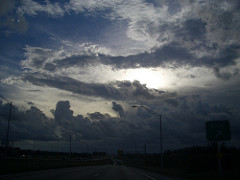
He “thunders, the waters in the heavens roar; he makes clouds rise from the ends of the earth. He sends lightning with the rain and brings out the wind from his storehouses.”  No doubt this has been interpreted by some readers to argue that God is in the business of tossing thunderbolts when it suits Him.  I think this is a caricature of what Jeremiah is saying and the creation account in the book of Genesis (Genesis 1:1-2;Genesis 1:6-7 ).

Although I am confident God is the “Father of the Rain” I do not think that He exerts His rule over every drop.  He created a “logos” or underlying spiritual and physical order that we experience as part of the spiritual cycle.  He also created the hydrologic cycle by which water rises to form clouds and returns to the earth as rain.  He is ruler and creator of both the spiritual and the physical — “the maker of all things”.

Prayer: God You are the maker of all things, the Living God.  Help us to the faithfully follow You rather than the lifeless idols made by human hands.  


Posted in Covenant, Discernment, Faith, Following God, God's Love for Us, Jeremiah, Nature, The Earthly Realm, The Nature of God, The Spiritual Realm | Tagged , , , , , , , | 1 Comment

Water Streams from Our Eyelids

“I will make Jerusalem a heap of ruins, a haunt of jackals; and I will lay waste the towns of Judah so no one can live there.” Who is wise enough to understand this? Who has been instructed by the Lord and can explain it? Why has the land been ruined and laid waste like a desert that no one can cross? The Lord said, “It is because they have forsaken my law, which I set before them; they have not obeyed me or followed my law. Instead, they have followed the stubbornness of their hearts; they have followed the Baals, as their ancestors taught them.” Therefore this is what the Lord Almighty, the God of Israel, says: “See, I will make this people eat bitter food and drink poisoned water. I will scatter them among nations that neither they nor their ancestors have known, and I will pursue them with the sword until I have made an end of them.” This is what the Lord Almighty says: “Consider now! Call for the wailing women to come; send for the most skillful of them. Let them come quickly and wail over us till our eyes overflow with tears and water streams from our eyelids. The sound of wailing is heard from Zion: ‘How ruined we are! How great is our shame! We must leave our land because our houses are in ruins.’ ” Now, you women, hear the word of the Lord ; open your ears to the words of his mouth. Teach your daughters how to wail; teach one another a lament. Death has climbed in through our windows and has entered our fortresses; it has removed the children from the streets and the young men from the public squares. Say, “This is what the Lord declares: “ ‘Dead bodies will lie like dung on the open field, like cut grain behind the reaper, with no one to gather them.’ ” This is what the Lord says: “Let not the wise boast of their wisdom or the strong boast of their strength or the rich boast of their riches, but let the one who boasts boast about this: that they have the understanding to know me, that I am the Lord , who exercises kindness, justice and righteousness on earth, for in these I delight,” declares the Lord . “The days are coming,” declares the Lord , “when I will punish all who are circumcised only in the flesh— Egypt, Judah, Edom, Ammon, Moab and all who live in the wilderness in distant places. For all these nations are really uncircumcised, and even the whole house of Israel is uncircumcised in heart.” – Jeremiah 9:11-26

I took an extended “eddy out” the last couple of days. I am finding Jeremiah challenging, but in a different way than the book of Isaiah. It does not have the multi-layered complexity in time and space that I found in Isaiah, but it does paint a very complex picture of the nature of God, and how He was relating to the people of Judah and Jerusalem at this time. After some days of reflection and prayer I am ready get back on the water and navigate these sometimes perplexing waters.

This passage actually addresses my lack of understanding of what is going on here. In referring to the destruction and death being heaped on the people of Judah and Jerusalem it asks, “Who is wise enough to understand this? Who has been instructed by the Lord and can explain it?” I am pretty sure I am not wise enough yet to understand most of this but I will try my best. Luckily God answers His own question.

The answer is not always what we want to hear. The reason for all this devastation comes down to a lack of obedience and a stubborn heart: “It is because they have forsaken my law, which I set before them; they have not obeyed me or followed my law. Instead, they have followed the stubbornness of their hearts; they have followed the Baals, as their ancestors taught them.” I think this conversation applies to more than just the immediate issue of burned buildings and crushed cities. It is a philosophical discussion about good and evil. Why is there evil in the world? Why do bad things happen? C. S. Lewis took on this complex philosophical water in his book Mere Christianity:

If you do not take the distinction between good and bad very seriously, then it is easy to say that anything you find in this world is a part of God. But, of course, if you think some things really bad, and God really good, then you cannot talk like that. You must believe that God is separate from the world and that some of the things we see in it are contrary to His will. Confronted with a cancer or a slum the Pantheist can say, ‘If you could only see it from the divine point of view, you would realise that this also is God.’ The Christian replies, ‘Don’t talk damned nonsense.’ For Christianity is a fighting religion. It thinks God made the world—that space and time, heat and cold, and all the colours and tastes, and all the animals and vegetables, are things that God ‘made up out of His head’ as a man makes up a story. But it also thinks that a great many things have gone wrong with the world that God made and that God insists, and insists very loudly, on our putting them right again. – C. S. Lewis in Mere Christianity

So in order for God to set things right He must allow some things to look very wrong from our earthly perspective. One cannot make an incorrect math problem right by ignoring the fault. One must go back to the spot where the error was made and work from there. God is making it clear that the fundamental fault here is one of obedience and who we choose to love and follow.

Then the passage begins to enter “funny water“. God says “See, I will make this people eat bitter food and drink poisoned water. I will scatter them among nations that neither they nor their ancestors have known, and I will pursue them with the sword until I have made an end of them.” God referred to poisoned water a few passages ago in Jeremiah 8:8-16. What has me a bit flummoxed (I have always wanted a good excuse to use that word 🙂 is that God seems to be just fed up and not really interested in extending grace to these stubborn people. Perhaps in scattering the people to other nations God was putting the ball in their courts again, it was up to the remnant to return to Him.

God is making it clear for those who have ears to hear that the coming judgement will be very sad and heart wrenching, “Call for the wailing women to come; send for the most skillful of them. Let them come quickly and wail over us till our eyes overflow with tears and water streams from our eyelids.” The pronouns here are interesting. God seems to be making it clear that the sadness and weeping is mutual. He is not happy with this path, but He apparently is left with no other option.

God again provides a way to avoid, or at least understand the coming calamity. He says “Let not the wise boast of their wisdom or the strong boast of their strength or the rich boast of their riches, but let the one who boasts boast about this: that they have the understanding to know me, that I am the Lord , who exercises kindness, justice and righteousness on earth, for in these I delight.” God wants people whose hearts know Him. A people whose hearts live for Him and are alive in Him.

The final sentence really explains the fundamental problem “For all these nations are really uncircumcised, and even the whole house of Israel is uncircumcised in heart.” So circumcision was a choice that parents made to physically alter their male children. It is a spiritual metaphor for a fundamental change in spirit that God is asking the people of Israel, and all those who would follow Him, to make. He wants us to allow our hearts to be channeled so that they flow toward Him and no other. The “heart circumcision” process is to alter our spirit so that it conforms to God’s spirit and will for us. It is sometimes painful and often something we try to avoid.

Prayer: God help us all to be willing to have our hearts and souls channeled toward You.

Posted in Covenant, Discernment, Discipleship, Following God, Free Will, God's Love for Us, grace, Jeremiah, Love for the Lost, Obedience, Prophecy, religion, Sin, The Earthly Realm, The Nature of God, Trusting God | Tagged , , , , , , , | 1 Comment

A Fountain of Tears

Jesus Wept (Jésus pleura) by James Tissot

Jesus Wept (Jésus pleura)
by James Tissot

Oh, that my head were a spring of water and my eyes a fountain of tears! I would weep day and night for the slain of my people.   Oh, that I had in the desert a lodging place for travelers, so that I might leave my people and go away from them; for they are all adulterers, a crowd of unfaithful people.   “They make ready their tongue like a bow, to shoot lies; it is not by truth that they triumph in the land. They go from one sin to another; they do not acknowledge me,” declares the Lord .   “Beware of your friends; do not trust anyone in your clan. For every one of them is a deceiver,  and every friend a slanderer.   Friend deceives friend, and no one speaks the truth. They have taught their tongues to lie; they weary themselves with sinning.   You live in the midst of deception; in their deceit they refuse to acknowledge me,” declares the Lord .   Therefore this is what the Lord Almighty says: “See, I will refine and test them, for what else can I do because of the sin of my people?   Their tongue is a deadly arrow; it speaks deceitfully. With their mouths they all speak cordially to their neighbors, but in their hearts they set traps for them.   Should I not punish them for this?” declares the Lord . “Should I not avenge myself on such a nation as this?”   I will weep and wail for the mountains and take up a lament concerning the wilderness grasslands. They are desolate and untraveled, and the lowing of cattle is not heard. The birds have all fled and the animals are gone. – Jeremiah 9:1-10

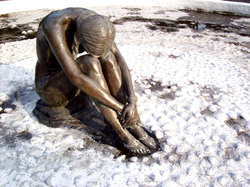
The opening sentence of this passage has me confused.  It reads: “Oh, that my head were a spring of water and my eyes a fountain of tears!”  The person talking here is God and He is reacting to the recalcitrance of His people in Judah and Jerusalem.  I am not sure what to make of the metaphor God is using here. He is comparing His head to a spring of water and His eyes to a fountain  of tears.  It almost sounds like someone who is lamenting their inability to have emotions or weep for a lost loved one.

I suppose God could feel like this in relation to the loss of His people.  From a human perspective it is understandable to become so frustrated with someone that you cease to feel compassion for them.  This is especially true when you feel like that person’s choices are the reason for their hardship and troubles. One has a desire to simply cutoff that person and prevent further heartache.  It seems almost like God has reached this stage with the people of Judah and Jerusalem.  He is ready to take off into the desert rather than continue to deal with these perplexing people.

“They go from one sin to another; they do not acknowledge me,” declares the Lord.  He really just seems fed up and ready to give up on the whole lot of them.  What he decides to do is “refine and test them”.  God does not seem to know what else He can do about the sin of His people.  Of course we know the “rest of the story”.  God does find a way to extend His arm to save all those who acknowledge Him, but not before they endure many hardships and challenges as a result of their choices.  Even Jesus, when He comes will weep over Jerusalem and the people who remain lost there (Luke 19:41).

It seems as though one of the most damming on the list of accusations is that “with their mouths they all speak cordially to their neighbors, but in their hearts they set traps for them.”  The people appear to be saying one thing and doing another.  They are “speaking deceitfully” about God and their neighbors.  It is interesting that the sin that God is focused on here is one of speaking and what comes out of our mouths rather than specific sins we might do with our bodies.  It speaks to the power of our words and how important it is to reign in our tongues so that we do not contaminate or corrupt the truth.

Prayer: God You show great restraint in loving us even when we behave like spoiled children toward You and our neighbors.

Posted in Covenant, Discernment, Discipleship, Following God, Free Will, God's Love for Us, grace, Jeremiah, Obedience, The Nature of God | Tagged , , , , , , , | Leave a comment

Poisoned water to drink

DCIM100SPORTHow can you say, “We are wise, for we have the law of the Lord ,” when actually the lying pen of the scribes has handled it falsely?   The wise will be put to shame; they will be dismayed and trapped. Since they have rejected the word of the Lord , what kind of wisdom do they have?   Therefore I will give their wives to other men and their fields to new owners. From the least to the greatest, all are greedy for gain; prophets and priests alike, all practice deceit.   They dress the wound of my people as though it were not serious. “Peace, peace,” they say, when there is no peace.   Are they ashamed of their detestable conduct? No, they have no shame at all; they do not even know how to blush. So they will fall among the fallen; they will be brought down when they are punished, says the Lord .   “ ‘I will take away their harvest, declares the Lord . There will be no grapes on the vine. There will be no figs on the tree, and their leaves will wither. What I have given them will be taken from them. ’ ”   Why are we sitting here? Gather together! Let us flee to the fortified cities and perish there! For the Lord our God has doomed us to perish and given us poisoned water to drink, because we have sinned against him.   We hoped for peace but no good has come, for a time of healing but there is only terror.   The snorting of the enemy’s horses is heard from Dan; at the neighing of their stallions the whole land trembles. They have come to devour the land and everything in it, the city and all who live there. – Jeremiah 8:8-16
God is really speaking His mind through Jeremiah in this passage, and He is not holding back.  God is accusing the people of misinterpreting the law of the Lord.  This passage suggests that it is the scribes who are “handling it falsely”.  This sounds to me like the scribes are not accurately conveying the word of God and the result is a contamination of God’s commands.

The consequences of the misinterpreting God’s commands is that “The wise will be put to shame; they will be dismayed and trapped.”  The wise are misleading the people they are supposed to be leading.  They are failing the “Meribah Test” miserably by leading those that are following them away from God rather than toward Him.  They “wise” are probably dismayed because they think, with their brains, that they are following God’s commands.  They are trapped because they are creating an artificial edifice of their own construction rather than serving as a conduit for God’s truth.

God’s condemnation seems to fall on everyone even “prophets and priests alike, all practice deceit”.  What is going on here?  God seems to be really fed up with not only the stubborn rebellion of His people but also those who are supposed to be leading while following God. They “dress the wound of my people as though it were not serious. “Peace, peace,” they say, when there is no peace.”  It seems like the priests and the prophets are trying to heal the people on their own without relying on God’s grace and healing.  The underestimate the harm they can do by their actions.

They do not have peace because they are rejecting the one who promises peace like a river and springs of living water.  God will make their efforts barren, “I will take away their harvest, declares the Lord . There will be no grapes on the vine. There will be no figs on the tree, and their leaves will wither.”  God planted a vineyard and it is simply not bearing the fruit for which it was planted.  The people are given a chance to respond with repentance, but instead they choose to run from God.

The people accuse God of giving them “poisoned water to drink”, because they have sinned against him.  God has in fact offered living water for all who choose to partake of it, but to all who reject the spring of living water the alternative is bitter water that is not fit to drink.  This is what it looks like for those who choose to separate themselves from God’s will and commands.  It is not a pleasant picture.  Even in the midst of the wave upon wave of calamity that is besetting the people they still have the choice of turning to God, but they also have the choice of being free of God if they choose.  They do not seem to be choosing wisely.

There is a warning here for all who seek to follow God, especially those entrusted to lead others.  We need to be so connected to the spring that we have a constant supply of living water.  Even when times get hard and we feel like we are under siege.  It is these times, when we feel like we are in a furnace being refined, that God needs our souls to remain strong and courageous.

Prayer: God You give us every opportunity to turn and follow You.  Help us to be strong and courageous, setting aside the things that keep us from You.

e

Posted in Christian Community, Christian Leadership, Christianity, Conflict, Discernment, Following God, Free Will, God's Love for Us, Jeremiah, Love for the Lost, Obedience, Peace, Redemption, The Nature of God | Tagged , , , , , | 2 Comments

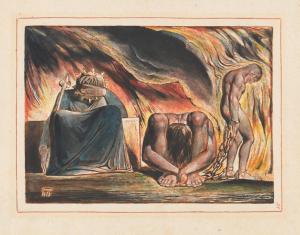
Bronze and Iron

Ff109865

Vala, Hyle and Skofeld by William Blake

This is what the Lord says: “Look, an army is coming from the land of the north; a great nation is being stirred up from the ends of the earth.   They are armed with bow and spear; they are cruel and show no mercy. They sound like the roaring sea as they ride on their horses; they come like men in battle formation to attack you, Daughter Zion.”   We have heard reports about them, and our hands hang limp. Anguish has gripped us, pain like that of a woman in labor.   Do not go out to the fields or walk on the roads, for the enemy has a sword, and there is terror on every side.   Put on sackcloth, my people, and roll in ashes; mourn with bitter wailing as for an only son, for suddenly the destroyer will come upon us.   “I have made you a tester of metals and my people the ore, that you may observe and test their ways.   They are all hardened rebels, going about to slander. They are bronze and iron; they all act corruptly.   The bellows blow fiercely to burn away the lead with fire, but the refining goes on in vain; the wicked are not purged out.   They are called rejected silver, because the Lord has rejected them.” – Jeremiah 6:22-30

The book of Jeremiah continues to intrigue me and provide many interesting riffles and eddies.  This passage starts out with what sounds like a relatively straightforward prophecy about an invader from the north.  This invader is cruel and shows now mercy.  They “sound like the roaring sea as they ride on their horses”.   Then it starts to get a little weird.  The men come “like men in battle formation to attack you”.  This would seem to be a statement of the obvious, how else would they come?  Is this enemy something more  than “men in battle formation”?

The reputation of this army from the north instills in God’s people great fear, “We have heard reports about them, and our hands hang limp.”  The word picture I get is that of a people petrified into inaction.  It sounds like they have lost the battle without taking a swing at anyone.  It is their internal fears and lack of faith in God that makes them cower in the corners of Jerusalem awaiting their fate.

In the midst of this desperate situation God is calling the people to repent in a dramatic way.  They are to “Put on sackcloth, my people, and roll in ashes; mourn with bitter wailing as for an only son, for suddenly the destroyer will come upon us.”  I wonder whether there is more to this “destroyer” than an earthly army from the north wielding bows and spears.

It seems like there is a spiritual dimension to this prophecy.  God is allowing a trial of sorts to determine which of His people will turn to Him rather than turn and run.  The aggressor from the north is serving the role of a “tester” to determine which of God’s people will remain true under pressure, “I have made you a tester of metals and my people the ore, that you may observe and test their ways.”  The people have become alloyed with the cultures and idols that they have allowed to pollute their spirits.  This conflict will perform an assay of their souls.

God compares the people of Israel and Jerusalem to bronze or iron.  When faced with a “furnace” they will be refined whether they like it or not. “The bellows blow fiercely to burn away the lead with fire, but the refining goes on in vain; the wicked are not purged out.”  Bronze is an alloy of copper and other metals that was a revolutionary discovery that changed the world.  It allowed weapons to be much harder and able to break other things and people more effectively.  In order to separate the various metals in an alloy like bronze you can heat it in a furnace with bellows to get it really hot.  Since different metals have different melting temperatures they can be separated in this way.

So this conflict and destruction from the north is to refine the people of Jerusalem to separate the valuable metals that are pure (the people willing to follow God’s commands) from the impurities and other metals that have alloyed with it (idols and other gods).  This process will undoubtedly hurt and produce many sparks and flames that will cause great pain.  The surest way to avoid a similar fate is to avoid becoming alloyed with modern-day idols and gods like money, power, etc.

Prayer: God help us to follow your commands and be like pure silver so that refining is not needed.


Posted in Conflict, Covenant, Death and Dying, Following God, Free Will, Jeremiah, Obedience, Prophecy, The Nature of God, The Spiritual Realm | Tagged , , , , , , , , , | 2 Comments

She Pours Out Her Wickedness

IMG_2578_newThis is what the Lord Almighty says: “Cut down the trees and build siege ramps against Jerusalem. This city must be punished; it is filled with oppression.   As a well pours out its water, so she pours out her wickedness. Violence and destruction resound in her; her sickness and wounds are ever before me.   Take warning, Jerusalem, or I will turn away from you and make your land desolate so no one can live in it.”   This is what the Lord Almighty says: “Let them glean the remnant of Israel as thoroughly as a vine; pass your hand over the branches again, like one gathering grapes.” – Jeremiah 6:6-9
God is desperately trying to get the attention of the remnant of His people that have eyes to see and ears to hear. God is actually directing those faithful to Him, perhaps in Judah, to cut down “the trees” to build siege ramps to invade Jerusalem. God is holding Jerusalem accountable for the ways they are oppressing the people and nations around them.  God made the City of David a well-watered garden, but it seems to be producing only bad fruit.

In a post about Ecclesiastes 4:1-3 called the “tears of the oppressed” I explored the meaning of oppression.  I came to the conclusion that it means someone in a position of power imposing their will on someone “below them” on the social or economic ladder.  So for God to say that Jerusalem is filled with Oppression means that it is filled with people abusing the power they have to impose their will on those “below them”.  In a sense this is what King David did when he abused his “view from the top” to steal Uriah’s wife and have him killed to cover it up (2 Samuel 11:1-17).

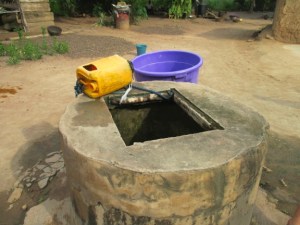
The metaphor used to describe Jerusalem in this passage is a bit murky.  She, Jerusalem, is described as “a well pours out its water, so she pours out her wickedness. Violence and destruction resound in her.”  This metaphor is somewhat confusing in that wells do not typically “pour out” their water.  They usually require buckets or a pump to bring water to the surface.  In a sense this would be a malfunctioning well, or at least one that is not functioning like a “normal” well.  So to compare Jerusalem to this type of well would be to say that Jerusalem is not functioning as designed, and the result is violence and destruction.

Wells are also typically a community resource that serves many families.  They also tend to be a focal point for community activities and communication.  Sort of like a farmer’s market, shopping mall, or church in modern times.  So for God to say that this focal point of the community is pouring out violence and destruction is to say that the entire community is being poisoned by bad water due to the people’s failure to follow God.

Prayer: God help us to be communities and people that share good water that serves to bring peace and encouragement rather than violence and destruction.


Posted in Christian Community, Christianity, Conflict, Following God, Jeremiah, Life Together, Obedience, Peace, The Earthly Realm | Tagged , , , , , | Leave a comment

A Boundary for the Sea

DSCN4951

Announce this to the descendants of Jacob and proclaim it in Judah: Hear this, you foolish and senseless people, who have eyes but do not see, who have ears but do not hear: Should you not fear me?” declares the Lord . “Should you not tremble in my presence? I made the sand a boundary for the sea, an everlasting barrier it cannot cross. The waves may roll, but they cannot prevail; they may roar, but they cannot cross it. But these people have stubborn and rebellious hearts; they have turned aside and gone away. They do not say to themselves, ‘Let us fear the Lord our God, who gives autumn and spring rains in season, who assures us of the regular weeks of harvest.’ Your wrongdoings have kept these away; your sins have deprived you of good. – Jeremiah 5:20-25

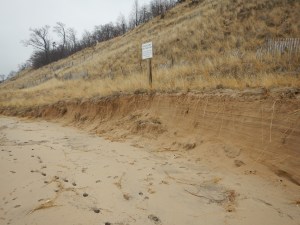
This passage holds particular interest for me as a water scientist and geologist. Coasts and beaches are some of the most dynamic places on the planet, but the passage is correct in saying that the boundary between the sea and the land is generally a fixed point of reference, at least within the time span of a human life. Beaches definitely move but the range of their movement is quite limited over short periods of time.

The descendants of Jacob are deaf and blind. They “have eyes but do not see, who have ears but do not hear”. This was a common refrain from Jesus to His disciples when he was discussing their amazing ability to miss what seems clear from our perspective today (Mark 8:17-21). I think both the people of this passage and modern-day God followers have selective sight and hearing. We hear and see what we want to hear and see sometimes. God makes it clear that the deafness and blindness we experience originate from a lack of respect — a healthy “fear of the Lord”.

Then comes some “deep water” that I am still struggling to understand, “I made the sand a boundary for the sea, an everlasting barrier it cannot cross. The waves may roll, but they cannot prevail; they may roar, but they cannot cross it.” This is clearly intended to be a metaphor so lets try to unpack it piece by piece. This seems to be alluding to beaches, or the boundary between two very different places, the sea and the land.

After I finished the book of 2 Kings I wrote a post about this concept (almost a year ago on January 18, 2015). I wondered at that time if the “meeting” place between us and God is like a beach. This passage seems to be alluding to the same kind of spiritual boundary between us and God. Our spirits are bound to a body while we inhabit this world and thus are not free to set out on the “sea”. We must choose where to dwell on the “land”. We are free to dwell far inland away from the “surging seas“, or we can dwell near the “beach” where it can get downright scary at times. This passage seems to be saying that God is at the beach and that is where we must meet Him.

The “sand” at the boundary of the sea is an interesting detail. Sand on the beach is derived from a long process of erosion and weathering that takes place on time scales that are far beyond a human life. God is alluding to this same tapestry of time in this passage. The sand on the beach seems to us infinite and almost beyond comprehension. Both God and the spiritual realm are like this. God sees both the expanse of the beach and individual sand grains at the same time. Humans do not have the ability to do this so we focus on the sea from far away and end up viewing it like clouds high up in the sky, or we focus on the sand grains and miss the bigger picture.

God describes the meeting place between land and sea as a tumultuous and turbulent place, “The waves may roll, but they cannot prevail; they may roar, but they cannot cross it”. This is an accurate metaphorical description of the meeting place between God and humans. It is also a tumultuous and turbulent place full of waves and raging seas, but it can also be a place of profound peace. I think this is like how we can both love God and fear Him at the same time. The same “sea” can be a serene ocean on a calm day, but can also be a scary roaring sea that resounds with great power, the lion and the lamb.

The people fail to articulate a recognition of this dual nature of God, “Let us fear the Lord our God, who gives autumn and spring rains in season, who assures us of the regular weeks of harvest”. I do not think that “Fear of the Lord” means to cower in the grass along the shore for fear we will be destroyed. Nor does it mean that we should stand boldly on the shore and deny the existence of the sea. What God is asking us to do is acknowledge that a boundary exists between us and Him. This boundary is like where the sea meets the land. It is a dynamic place but the nature and location of this boundary does not change.

The good news is that God has come ashore to be with us. He has navigated the turbulent beach and tossing sea to bring us peace and living water. God is both the source of peace like a river and pounding waves.

Prayer: God our view from the “beach” is sometimes confusing and unclear. We have eyes but we fail to see and ears but fail to hear. Help us to boldly dwell on the beach where we can see You clearly.

Posted in Christianity, Discipleship, Following God, Free Will, God's Love for Us, Jeremiah, Obedience, Peace, reconciliation, Redemption | Tagged , , , , , , , | 4 Comments

Eddying Out – Happy New Year!

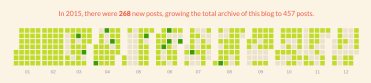
DSCN0884Welcome to the year 2016!  Last year, 2015, was the first complete year of my “walk on water”.  I have been blessed by this journey and it has taught me much about the bible, myself, and the role that regular rumination can play in our journey to discover God here on earth.


Your 2015 year in blogging - Google Chrome_002

In looking back over the year I managed to post 268 out of 365 days which is not too bad, considering what else has been going on in my life over the last year.  I definitely got bogged down in Isaiah over the last several months.  I feel like Isaiah could be the subject of an entire lifetime of study and I still would not understand it.

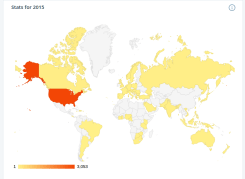
Stats ‹ Walking on Water — WordPress.com - Google Chrome_003I have been humbled an amazed by the number of different countries that have visited the blog.  About 2,130 people from 74 different countries have visited the walking on water blog and viewed about 3,686 pages.

The most viewed pages are not the ones I would have predicted.  I tried to find a common theme to which ones were viewed most and the only common denominator I could find is the passages tend to be ones that are confusing, strange, or difficult to interpret.  I guess everyone is curious about a car wreck 🙂  Below are the top ten posts not counting the home page or my page of favorite quotes.

  1. Apes and Baboons
  2. Senseless Sacrifice
  3. Floating Axe Heads
  4. Sprinkling Bowls
  5. Three Kings – No Water
  6. Drought
  7. Undiscovered Country
  8. A Valley Filled with Water
  9. The One River
  10. Ahab Crosses Over – Incognito

I look forward to another year on my voyage of discovery.  It will likely lead me through many more perplexing passages and prophets on my way to the new testament.  I am not sure if I will make it to the new testament in 2016, but I will enjoy the journey wherever it leads.

May God bless you in the coming year!

Posted in Eddying Out | Leave a comment