
Boiling Water

wp-1449632690154.jpgOh, that you would rend the heavens and come down, that the mountains would tremble before you!   As when fire sets twigs ablaze and causes water to boil, come down to make your name known to your enemies and cause the nations to quake before you!   For when you did awesome things that we did not expect, you came down, and the mountains trembled before you.   Since ancient times no one has heard, no ear has perceived, no eye has seen any God besides you, who acts on behalf of those who wait for him.   You come to the help of those who gladly do right, who remember your ways. But when we continued to sin against them, you were angry. How then can we be saved?   All of us have become like one who is unclean, and all our righteous acts are like filthy rags; we all shrivel up like a leaf, and like the wind our sins sweep us away.   No one calls on your name or strives to lay hold of you; for you have hidden your face from us and have given us over to our sins. – Isaiah 64:1-7

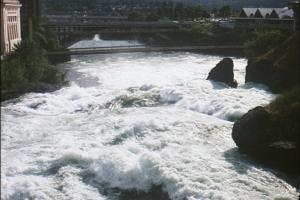
This is the first reference to boiling water that I can remember.  Boiling water is interesting in that it is water present in two different states at the same time.  I boiled some water while I was preparing this post and it was actually fascinating to watch.  It is the process of water changing states from liquid to vapor.  This reference to boiling is used as a metaphor for God’s arrival on earth, when He will “rend the heavens and come down”.  This could be read as a prophetic description of the coming of the Messiah on earth, or it could be read as another event in the history of Israel.

In either case, upon the arrival of God will set “twigs ablaze and causes water to boil”.  God will “come down to make your name known to your enemies and cause the nations to quake before you!”  So God’s arrival will cause a change in state of “water”, hmmm sounds familiar.  In a spiritual sense that is what Jesus, the godly condensate, was describing when He came and made statements like “Whoever believes in me, as Scripture has said, rivers of living water will flow from within them” (John 7:38).

I wonder if God may be alluding to a spiritual “boiling” of our souls — a necessary “change of state” and a separation of the body and soul that is to occur.  In a way this is similar to the distress, or stretching apart, that was described in yesterday’s passage.  Boiling is a chaotic and raucous process – similar to the process of trying to faithfully follow God with a soul bound to a body.  The spiritual separation process is bound to be chaotic and raucous as well.

The character of the people awaiting God’s arrival is described this way, “Since ancient times no one has heard, no ear has perceived, no eye has seen any God besides you, who acts on behalf of those who wait for him.”  God has been waiting for people who are waiting for Him, a cosmic game of tag between us and God.

The last part of the passage seems to be describing a people doing more “hiding” than “seeking”.  The people know that they are “like one who is unclean, and all our righteous acts are like filthy rags; we all shrivel up like a leaf, and like the wind our sins sweep us away.”  They even ask the question that is asked by most of us who realize we are flawed followers, “How then can we be saved?”

The answer to this question is found throughout the book of Isaiah, God extended His Arm and was pierced for our transgressions because of His unfailing love for us.  Rather than fear that we will “shrivel up like a leaf” and the “wind” will “sweep us away”, perhaps we should welcome the wind and allow our souls to “boil” in God’s presence.

Prayer: God You came to save those who wait for You.  Help us to embrace the wind of your Spirit.

Posted in Christianity, Covenant, Discernment, Discipleship, Following God, Forgiveness, God's Love for Us, Isaiah, Jesus, Obedience, reconciliation, Redemption, religion, Sin, The Earthly Realm, The Nature of God, The Spiritual Realm, Trusting God | Tagged , , , , , , , , , | 1 Comment

Distressed

Christian-persecution-620x318I will tell of the kindnesses of the Lord , the deeds for which he is to be praised, according to all the Lord has done for us— yes, the many good things he has done for Israel, according to his compassion and many kindnesses.   He said, “Surely they are my people, children who will be true to me”; and so he became their Savior.   In all their distress he too was distressed, and the angel of his presence saved them.  In his love and mercy he redeemed them; he lifted them up and carried them all the days of old.   Yet they rebelled and grieved his Holy Spirit. So he turned and became their enemy and he himself fought against them.   Then his people recalled the days of old, the days of Moses and his people— where is he who brought them through the sea, with the shepherd of his flock? Where is he who set his Holy Spirit among them,   who sent his glorious arm of power to be at Moses’ right hand, who divided the waters before them, to gain for himself everlasting renown,   who led them through the depths? Like a horse in open country, they did not stumble;   like cattle that go down to the plain, they were given rest by the Spirit of the Lord . This is how you guided your people to make for yourself a glorious name. – Isaiah 63:7-14

This passage begins in a relatively straightforward way with the author praising God and all “his compassion and many kindnesses”.  God responds to this praise by saying “Surely they are my people, children who will be true to me”; and so he became their Savior.”  God became their savior and their redeemer….the Gospel of John says it this way “For God so loved the world that he gave his one and only Son, that whoever believes in him shall not perish but have eternal life.” (John 3:16).

The passage gets a little confusing in the next sentence when it says “In all their distress he too was distressed, and the angel of his presence saved them.”  How can god be distressed?  In what sense were the people distressed?  What were they distressed about?  I looked up the term “distressed” and found an interesting history and meaning.  Apparently the word is based on the Latin word distringere which means ‘stretch apart’.  This meaning sheds light on the the situation being described here.  God is feeling stretched apart from His people and His people are feeling the same way.

“In his love and mercy he redeemed them; he lifted them up and carried them all the days of old”.  This is the God who has said he wants to carry us like a son or daughter, but the people seem to have a hard time seeing this redeemer God.  They want to look back to the Mad Max God who parted the Red Sea for them and was a more tangible leader for them.  They seem to to be torn between a God who protects them like Iron Man and the Son of the Man.  They are looking for the “glorious arm of power” that was at Moses’ right hand, rather than the arm of God who came to die for us on the cross.

Prayer: God help us to see beyond the seas you have parted to see the savior You have sent to redeem us.

Posted in Covenant, Discernment, Discipleship, Faith, Following God, God's Love for Us, Isaiah, Jesus, Obedience, reconciliation, Redemption, The Nature of God, Trusting God | Tagged , , , , , , | 1 Comment

Fly Along Like Clouds

IMGP4927

Lift up your eyes and look about you: All assemble and come to you; your sons come from afar, and your daughters are carried on the hip. Then you will look and be radiant, your heart will throb and swell with joy; the wealth on the seas will be brought to you, to you the riches of the nations will come. Herds of camels will cover your land, young camels of Midian and Ephah. And all from Sheba will come, bearing gold and incense and proclaiming the praise of the Lord . All Kedar’s flocks will be gathered to you, the rams of Nebaioth will serve you; they will be accepted as offerings on my altar, and I will adorn my glorious temple. “Who are these that fly along like clouds, like doves to their nests? Surely the islands look to me; in the lead are the ships of Tarshish, bringing your children from afar, with their silver and gold, to the honor of the Lord your God, the Holy One of Israel, for he has endowed you with splendor. – Isaiah 60:4-9

Today was a tumultuous day of tests, tasks, and teaching. I am coming up for air tonight as I ponder this passage and the meaning it holds. God begins the passage talking with the people of Israel and specifically the people of Jerusalem. The people in the City of David are to lift up their eyes and look about them. What does God want them to see? I assume He wants them to see and appreciate the well-watered garden He has provided.

“The wealth on the seas will be brought to you, to you the riches of the nations will come.” This statement could be take a couple of ways. The literal interpretation would be that goods and trade will come via ships to dock in Israel and trade with the people of Jerusalem. This was certainly the case during the time of Solomon when He created all sorts of trade with far flung nations (1 Kings 9:26-28).

If one thinks of this statement metaphorically the “wealth of the seas” could be thought of as the “islands” that God attracts to himself, people who are attracted to God, His people, and the land where they live. The riches of the nations would actually be the human “capital”, the scraps of cloth that God assembles into a beautiful new quilt of many colors.

Then the passage take a somewhat confusing bend when it says “Who are these that fly along like clouds, like doves to their nests?” It is unclear to me who is meant by “these” in the passage. Whoever it is they “fly along like clouds, like doves to their nests”.

Hasn’t everyone dreamed of flying at least one time in their lives? I know I have many times. The idea of moving effortlessly through the air is somehow the epitome of freedom. If we take for a moment that the people flying signify those with freedom then the second part of the above statement suggests that the freedom is used to “return to the nest” rather than soar aimlessly along.

This idea is somewhat confirmed by the statement “Surely the islands look to me”. Islands have been used metaphorically in the past to refer to rebellious and independent people, i.e. all of us at times. So God is saying that we all have this freedom to choose (flying), and we can choose to fly around aimlessly or we can choose to return to Him (the nest) who taught us how to fly in the first place. We are to fly like clouds, like God in fact, the godly condensate, but we are supposed to have a destination in mind.

Prayer: God you teach us how to fly and give us the freedom to do so. Help us to use this freedom wisely to fly toward You.

Posted in Covenant, Discernment, Following God, Forgiveness, Free Will, Isaiah, Obedience, reconciliation, The Nature of God, The Spiritual Realm, Trusting God | Tagged , , , , , , , | Leave a comment

A Pent-up Flood

57256_03

For our offenses are many in your sight, and our sins testify against us. Our offenses are ever with us, and we acknowledge our iniquities: rebellion and treachery against the Lord , turning our backs on our God, inciting revolt and oppression, uttering lies our hearts have conceived. So justice is driven back, and righteousness stands at a distance; truth has stumbled in the streets, honesty cannot enter. Truth is nowhere to be found, and whoever shuns evil becomes a prey. The Lord looked and was displeased that there was no justice. He saw that there was no one, he was appalled that there was no one to intervene; so his own arm achieved salvation for him, and his own righteousness sustained him. He put on righteousness as his breastplate, and the helmet of salvation on his head; he put on the garments of vengeance and wrapped himself in zeal as in a cloak. According to what they have done, so will he repay wrath to his enemies and retribution to his foes; he will repay the islands their due. From the west, people will fear the name of the Lord , and from the rising of the sun, they will revere his glory. For he will come like a pent-up flood that the breath of the Lord drives along. “The Redeemer will come to Zion, to those in Jacob who repent of their sins,” declares the Lord . “As for me, this is my covenant with them,” says the Lord . “My Spirit, who is on you, will not depart from you, and my words that I have put in your mouth will always be on your lips, on the lips of your children and on the lips of their descendants—from this time on and forever,” says the Lord. -Isaiah 59:12-21

This passage is another hidden gem of prophecy that I did not know was present in the book of Isaiah. Several times before God has referred to his “arm”. Back in Isaiah 50:1-3 God asked the rhetorical question “Was my arm too short to deliver you?“. The answer I came to upon reflection was, “He is strong enough to rescue us by enduring the cross; and His arms are long enough to stretch around the world.” I think God is alluding to the same answer here.

“The Lord looked and was displeased that there was no justice. He saw that there was no one, he was appalled that there was no one to intervene; so his own arm achieved salvation for him, and his own righteousness sustained him.” In this most mysterious of ways God intervened for us with his own arm to achieve the salvation we all require. This coming will be different than the ways that God has shown up in the past for the people of Israel.

He will repay those who have failed to faithfully follow Him or produced bad fruit from the well-watered garden He provided. “According to what they have done, so will he repay wrath to his enemies and retribution to his foes; he will repay the islands their due.” This concept of islands showed up back in Isaiah 42:10-17 when God spoke of turning rivers into islands. In that reference, I wondered whether “islands” was metaphorical and meant “something or someone isolated and separated”. It may mean the same thing here.

God goes on to say “he will come like a pent-up flood that the breath of the Lord drives along”. This is an apt description of the tumultuous arrival of Jesus. In what ways was Jesus like a “pent-up flood”? There was certainly a pent-up anticipation for the coming of the Messiah among the Jewish people of Jesus’ time. So much so that people wanted to see the messiah in every prophet, including John the Baptist who had to assure people that he was not the one but was merely making straight paths for Him (originally from Isaiah 40:3-14).

Jesus washed over the Judea countryside like a flood of Living Water to transform all those who were willing to listen. He was in contact with the Father and driven along by “God’s Breath”, the Holy Spirit or the spirit of God on earth. This coming flood effects and attracts all people, not just the people of Israel, “From the west, people will fear the name of the Lord , and from the rising of the sun, they will revere his glory.” and “The Redeemer will come to Zion, to those in Jacob who repent of their sins”.

So God will come to redeem all those who repent, I believe this offer extends beyond just those “in Jacob” based on previous passages where God seems to be making it clear that “He Will Sprinkle Many Nations” with His redeeming blood (Isaiah 52:5-15). I am blown away once again at the clarity of the Gospel shared here in Isaiah. God could not have been clearer about the New Song that He was sharing with the people of Israel.

Prayer: God thank You for extending your Arm to redeem all those who are willing to repent and believe.

Posted in Christianity, Covenant, Discernment, Discipleship, Following God, Isaiah, reconciliation, Redemption, The Nature of God, The Spiritual Realm | 3 Comments

A Well-Watered Garden

wp-1449277920193.jpgIs not this the kind of fasting I have chosen: to loose the chains of injustice and untie the cords of the yoke, to set the oppressed free and break every yoke?   Is it not to share your food with the hungry and to provide the poor wanderer with shelter— when you see the naked, to clothe them, and not to turn away from your own flesh and blood?   Then your light will break forth like the dawn, and your healing will quickly appear; then your righteousness will go before you, and the glory of the Lord will be your rear guard.   Then you will call, and the Lord will answer; you will cry for help, and he will say: Here am I. “If you do away with the yoke of oppression, with the pointing finger and malicious talk,   and if you spend yourselves in behalf of the hungry and satisfy the needs of the oppressed, then your light will rise in the darkness, and your night will become like the noonday.   The Lord will guide you always; he will satisfy your needs in a sun-scorched land and will strengthen your frame. You will be like a well-watered garden, like a spring whose waters never fail.   Your people will rebuild the ancient ruins and will raise up the age-old foundations; you will be called Repairer of Broken Walls, Restorer of Streets with Dwellings. – Isaiah 58:6-12

I am an avid gardener so in the winter time I move my gardening indoors and tend a covey of house plants, including three large banana plants that remind me of the tropics when the winds and snows of Michigan get too deep.  This passage continues on a theme introduced yesterday about what we are to be doing while we are pursuing God.  We are to be like well watered gardens producing abundant fruit from the water supply God is providing.

We clearly are not to lock ourselves up in a monastery or live isolated on an island somewhere.  We are to share “food with the hungry and to provide the poor wanderer with shelter— when you see the naked, to clothe them.”  So our faith is supposed to create changes in our behavior.  We are to feel a profound dissonance in our lives when we see hungry, poor, and naked people that drives us to respond.

The result of our responding to the needs of those around us is that our “light will break forth like the dawn, and your healing will quickly appear; then your righteousness will go before you, and the glory of the Lord will be your rear guard.”  We are to take the lead while following God with the knowledge that God has our backs.  We are to bring God’s light into dark places and make them different and brighter.  God will guide us and carry us like a son or daughter when we grow too weary with our burden, “The Lord will guide you always; he will satisfy your needs in a sun-scorched land and will strengthen your frame.”

Then comes the amazing water reference “You will be like a well-watered garden, like a spring whose waters never fail”.  What does a well watered garden do?  It produces good and abundant fruit to feed both those who tend it and all those around them who benefit from the careful tending.  A spring that never fails gives life and can be relied upon when droughts or pounding waves buffet our lives and the lives of those around us.  We are to actually be this perpetual spring, something that up to this point has been mainly God’s role.  This passage is part of the new song that God is singing for the people of Israel and the new part they will be called to play in bringing about a new kind of kingdom for God and His people here on earth.

Prayer: God You are the light of the world.  Help us to boldly carry Your light to those who need it and care for those who are hungry, poor, and naked along the way.


Posted in Christianity, Discipleship, Following God, God's Love for Us, Isaiah, Life Together, Love for the Lost, Obedience, Redemption, religion, The Earthly Realm, The Nature of God, Trusting God | Tagged , , , , , , | 4 Comments

The Tossing Sea

cropped-pa060087.jpgAnd it will be said: “Build up, build up, prepare the road! Remove the obstacles out of the way of my people.”   For this is what the high and exalted One says— he who lives forever, whose name is holy: “I live in a high and holy place, but also with the one who is contrite and lowly in spirit, to revive the spirit of the lowly and to revive the heart of the contrite.   I will not accuse them forever, nor will I always be angry, for then they would faint away because of me— the very people I have created.   I was enraged by their sinful greed; I punished them, and hid my face in anger, yet they kept on in their willful ways.   I have seen their ways, but I will heal them; I will guide them and restore comfort to Israel’s mourners,   creating praise on their lips. Peace, peace, to those far and near,” says the Lord . “And I will heal them.”   But the wicked are like the tossing sea, which cannot rest, whose waves cast up mire and mud.   “There is no peace,” says my God, “for the wicked.” – Isaiah 57:14-21

Well the last week or so has felt very much like a tossing sea.  It is the end of the term and projects and papers pile up for professors as well as students.  I have been hanging on by my fingernails trying to keep up with the pace, but alas I have had insufficient bandwidth to get on the water.  I have been pondering this passage as I have been running from task to task.

God is addressing the people of Israel (and I believe all God followers).  The message distilled into a single nugget would be something like “stick to the road I have prepared for you or it will be a rough ride”; and “if you see someone off struggling through the weeds help them to find the road I have prepared”.

The passage starts  with God saying ““Build up, build up, prepare the road! Remove the obstacles out of the way of my people.”  Although in this specific passage God may be speaking to the people of Israel I think God is actually speaking to all of His people, including all modern followers of the Way.  This is a call to encourage on another, and lead while following God.

We are supposed to be removing obstacles and building roads to God rather than placing them in people’s paths so that finding Him is difficult.  Both the people of Israel, and many modern God followers, are pretty good at obscuring the road and placing obstacles.  Some of the obstacles we place are subtle like the traditions and forms that we all find comfort in during worship or gatherings.  All of these “altar decorations” are not in themselves bad.  They are an important part of our life together, but that they can make a curious God-seeker feel lost and alone.

So how can we “build the road” and “remove obstacles” while still providing a spiritually rich experience for those who are already “on the road”.  This is a very important question that gets to the core of our identity as God-followers.  I wish I had a good answer.  The passage does provide some help.  The answer is God in us and with us: “I live in a high and holy place, but also with the one who is contrite and lowly in spirit, to revive the spirit of the lowly and to revive the heart of the contrite”

God wants to us be contrite and lowly in spirit.  I had to look up the word contrite to try to understand what God is getting at here.  One of the most interesting definitions I found was that contrite means a “crushed heart”.  So apparently we have to allow our souls to be “broken” by God, almost as if we were a wild stallion that was being trained and “broken”.  Being the rebellious sheep that we are we tend to chafe at this idea that our spirit or soul could be “trained”, but that is exactly what God seems to be saying.

God does not leave us to struggle alone with our “broken heart”, He says He “will heal them; I will guide them and restore comfort to Israel’s mourners, creating praise on their lips. Peace, peace, to those far and near”.  So God needs, as AW Tozer puts it, “children of the burning heart”, but all of these working together to build roads and remove obstacles must first be broken to work correctly.  This is one of the many paradoxes in the bible.  We must acknowledge we are broken to work correctly, admit we are lost to be found, and see the bars of our jail cell to be set free.

Those who refuse to be broken, what God refers to as the “wicked”, they “are like the tossing sea, which cannot rest, whose waves cast up mire and mud….There is no peace…for the wicked.”  So it is our choice, we can run free and choose our own will over God’s will, but we will eventually grow tired and weary of treading water in a tossing sea full of mire and mud.

Prayer: God help us to allow our hearts to be broken for You so that we can be effective road builders and obstacle removers for those seeking to find You.

Posted in Christian Community, Christian Leadership, Christianity, Discernment, Discipleship, Following God, Free Will, God's Love for Us, Isaiah, Life Together, Love for the Lost, Obedience, Peace, reconciliation, Redemption, religion, The Nature of God, The Spiritual Realm, Trusting God | Tagged , , , , , , | 2 Comments

Filled with Beer

TCAWHieroglyphCome, all you beasts of the field, come and devour, all you beasts of the forest!   Israel’s watchmen are blind, they all lack knowledge; they are all mute dogs, they cannot bark; they lie around and dream, they love to sleep.   They are dogs with mighty appetites; they never have enough. They are shepherds who lack understanding; they all turn to their own way, they seek their own gain.   “Come,” each one cries, “let me get wine! Let us drink our fill of beer! And tomorrow will be like today, or even far better.” – Isaiah 56:9-12

Okay so one could argue that beer is not actually water but it does contain water.  Since I am a beer fan and this is the first biblical reference to beer that I’ve noticed I thought it would be worth reflecting on today. Of course beer in excess can lead to all sorts problems, but I think beer taken in moderation is not a bad thing any more than wine in moderation is a bad thing.

God is talking generally about the people of Israel and the ways that they have “missed the boat”. The “watchman” of Israel are blind because they lack knowledge of the living God. I think the “watchmen” are the spiritual leaders of the people of Israel. They are the ones who were to know the signs of the coming Messiah, the new song that God has been alluding to in Isaiah.

This reminds me of the beginning of the book The Silver Chair by C.S. Lewis.  Two young people, Eustace and Polly are wisked out of our world into Narnia.  Polly has never been to Narnia, but Eustace is returning after being transformed by his adventure in the Voyage of the Dawn Treader which included being stripped down to the soul by Aslan the Christ figure in the books.

Polly and Eustace find themselves in Aslan’s country overlooking a daunting precipice.  Polly get’s cheeky and overconfident near the cliff and ends up sending Eustace over the edge.  Alsan prevents Polly’s poor choice from being fatal for Eustace, but she is left alone to talk with Aslan and receive important signs that she is to look for to guide them on the mission for which they were sent to Narnia:

“Are you not thirsty?” said the Lion.
“I am dying of thirst,” said Jill.
“Then drink,” said the Lion.
“May I — could I — would you mind going away while I do?” said Jill.
The Lion answered this only by a look and a very low growl. And as Jill gazed at its motionless bulk, she realized that she might as well have asked the whole mountain to move aside for her convenience.
The delicious rippling noise of the stream was driving her nearly frantic.
“Will you promise not to — do anything to me, if I do come?” said Jill.
“I make no promise,” said the Lion.
Jill was so thirsty now that, without noticing it, she had come a step nearer.
“Do you eat girls?” she said.
“I have swallowed up girls and boys, women and men, kings and emperors, cities and realms,” said the Lion. It didn’t say this as if it were boasting, nor as if it were sorry, nor as if it were angry. It just said it.
“I daren’t come and drink,” said Jill.
“Then you will die of thirst,” said the Lion.
“Oh dear!” said Jill, coming another step nearer. “I suppose I must go and look for another stream then.”
“There is no other stream,” said the Lion.” – C.S. Lewis, The Silver Chair

Polly does not want to admit she has a thirst that needs quenching and I fear so are the leaders of Israel in this passage, and to be honest many followers of Christ like myself.  The leaders of Israel are not good shepherds — they are asleep at the wheel.  They seem to have missed the point of much of what God has been trying to do for them.

The people seem to be more interested in daily pleasures and satisfying their thirst with wine and beer — wine and beer taken for the sake of getting drunk or pleasure.  I do not think God is saying that wine and beer are bad, but they can be very bad if they are used as a substitute for God, or the peace like a river that flows from Him.

There is a call here to be something different than the people described in this passage.  We are called to be shepherds who have understanding of the wonder of God’s love and are willing to point others toward Him.  We are to be “watchers” with knowledge of the signs that God is near so that we can lead by following and help others to faithfully follow Him.

Prayer: God help us to be good shepherds and show others the signs of Your presence and love so that they too many know You.

Posted in Christian Leadership, Christianity, Discernment, Discipleship, Following God, Isaiah, Redemption, The Nature of God, Trusting God | Tagged , , , , , , | Leave a comment

Come to the waters…You who have no money

OLYMPUS DIGITAL CAMERA“Come, all you who are thirsty, come to the waters; and you who have no money, come, buy and eat! Come, buy wine and milk without money and without cost.   Why spend money on what is not bread, and your labor on what does not satisfy? Listen, listen to me, and eat what is good, and you will delight in the richest of fare.   Give ear and come to me; listen, that you may live. I will make an everlasting covenant with you, my faithful love promised to David.   See, I have made him a witness to the peoples, a ruler and commander of the peoples.   Surely you will summon nations you know not, and nations you do not know will come running to you, because of the Lord your God, the Holy One of Israel, for he has endowed you with splendor.”   Seek the Lord while he may be found; call on him while he is near.   Let the wicked forsake their ways and the unrighteous their thoughts. Let them turn to the Lord , and he will have mercy on them, and to our God, for he will freely pardon.   “For my thoughts are not your thoughts, neither are your ways my ways,” declares the Lord. – Isaiah 55:1-8

The problem with missing a few days on the water is that I loose track of where I am on the river…somehow I missed this passage when I was preparing yesterday’s post about the Lord’s renown.  So I am portaging my boat back up stream to pick up this passage.  It has some intriguing water imagery with deep meanings.  We had better plumb these depths before proceeding down the river.

The passage starts with a statement that sounds like something that Jesus could have said “Come, all you who are thirsty, come to the waters; and you who have no money, come, buy and eat!”  This statement sounds a lot like Matthew 11:28-29 “Come to me, all you who are weary and burdened, and I will give you rest. Take my yoke upon you and learn from me, for I am gentle and humble in heart, and you will find rest for your souls.”

The interesting twist here in Isaiah is that there is a hint of the grace that will come much later.  The grace being alluded to will be for all, even those who “have no money”.  The waters being offered by God, and later by Jesus, are free for those who are willing to take them to satisfy their thirsty souls.  Those that choose to be fed by something other than God are wasting their “money”: “Why spend money on what is not bread, and your labor on what does not satisfy?

God alludes to the new song He is sharing with the people of Israel when He says “I will make an everlasting covenant with you, my faithful love promised to David”.  The promise is “a witness to the peoples, a ruler and commander of the peoples”.  This could be referring to an earthly king, but I think based on the context and the rest of the passage it refers to a different king, the Messiah, Jesus.  This new King will call all people, Jew and gentile, “nations you do not know will come running to you, because of the Lord your God, the Holy One of Israel, for he has endowed you with splendor.”

All of us who see the “splendor” God is referring to are to “Seek the Lord while he may be found; call on him while he is near”.  We are to seek and knock, but those who God is speaking to and their close descendants will have a “close encounter” with God like nothing they have experienced before.  A God who “will have mercy on them” and “freely pardon”.  This sounds like the “God with us” who will come to set the captives free and provide forgiveness for our sins.

God even acknowledges here that this work that He has planned will be mysterious and foreign to us humans, “my thoughts are not your thoughts, neither are your ways my ways”.  God has a plan that we can choose to accept or reject, but He has warned us ahead of time that He is in a different league and we will have difficulty understanding it.

Prayer: God thank You for sending us Your Son to pardon us and provide the spiritual food and water we need. 


Posted in Christianity, Covenant, Faith, Following God, Free Will, God's Love for Us, Isaiah, Jesus, Obedience, reconciliation, Redemption, religion, Sin, The Earthly Realm, The Nature of God, The Spiritual Realm, Trusting God | Tagged , , , , | Leave a comment

The Lord’s Renown

DSCN3437“As the heavens are higher than the earth, so are my ways higher than your ways and my thoughts than your thoughts.   As the rain and the snow come down from heaven, and do not return to it without watering the earth and making it bud and flourish, so that it yields seed for the sower and bread for the eater,   so is my word that goes out from my mouth: It will not return to me empty, but will accomplish what I desire and achieve the purpose for which I sent it.   You will go out in joy and be led forth in peace; the mountains and hills will burst into song before you, and all the trees of the field will clap their hands.   Instead of the thornbush will grow the juniper, and instead of briers the myrtle will grow. This will be for the Lord ’s renown, for an everlasting sign, that will endure forever.” – Isaiah 55:9-13

Happy Thanksgiving!  I have taken an extended break from my “walk on water” to shuttle family, prepare holiday meals, and spend time with family and friends.  I am recovering from the thanksgiving meal today and trying to avoid the pile of grading that awaits me, but it is time to put the boat back in the water and float on down the river.

In this verse God is reminding the people of Israel, and all those who are reading this passage, that He is in a different league in terms of His actions and thoughts.  We are fundamentally different and unable to act or think on the same level as God.  We may at times get a glimpse of the undiscovered country where He dwells, but it is fleeting and brief.

The metaphor that God uses reflects this dual nature to God’s interactions with us, they are both mysterious and mundane at the same time:  “As the rain and the snow come down from heaven, and do not return to it without watering the earth and making it bud and flourish, so that it yields seed for the sower and bread for the eater, so is my word that goes out from my mouth: It will not return to me empty, but will accomplish what I desire and achieve the purpose for which I sent it”.

God is comparing His “word” to rain.  The meaning of “word” is generally interpreted to be the voice or word of God, or perhaps the Breath God used to “breath” things into existence.  The latter has interesting implications for this passage.  Rain in a sense “breaths” life into things on the earth as it is used to grow leaves and sustain our bodies.  God’s rain will fall and accomplish what God desires here on earth, i.e. it will not “return to Him empty”.

This would seem to suggest that although we have some choice whether we heed God’s rain, in the end God wins.  There are not many of us that would desire either constant rain or a total lack of rain.  Most of us prefer rain to come often enough to keep things green, provide us with water to drink, make plants to grow, and allow rivers to run.  I suspect we prefer the rain to come on our schedule and our terms, but God is asking us to revel in the rain regardless of whether we see God’s clear purpose or not, “You will go out in joy and be led forth in peace; the mountains and hills will burst into song before you, and all the trees of the field will clap their hands”.

Prayer: God help us to revel in the rains that you send and proceed with confidence that You are providing the rains we need to grow and thrive.

Posted in Faith, Following God, Isaiah, Nature, The Earthly Realm, The Nature of God | Tagged , , , , | 1 Comment

Unfailing Love

OLYMPUS DIGITAL CAMERA

In a surge of anger I hid my face from you for a moment, but with everlasting kindness I will have compassion on you,” says the LORD your Redeemer.  “To me this is like the days of Noah, when I swore that the waters of Noah would never again cover the earth. So now I have sworn not to be angry with you, never to rebuke you again. Though the mountains be shaken and the hills be removed, yet my unfailing love for you will not be shaken nor my covenant of peace be removed,” says the LORD, who has compassion on you.  – Isaiah 54:8-10

This passage “remembers” when God sent rain on His people to get their attention, “the waters of Noah”.  In this passage God is making an oath not to be angry or rebuke the people of Israel again.  This could be taken two ways, God will stop caring for the people enough to rebuke or be angry with them, or He will love them despite his anger and frustration.  I think the rest of the passage makes it clear that God means the latter.

God is basically affirming that He is “all in” for the people of Israel and for us.  He says “Though the mountains be shaken and the hills be removed, yet my unfailing love for you will not be shaken nor my covenant of peace be removed”  God is promising to provide peace like a river in the middle of our earthly conflict and calamity.

God then goes on to talk directly to what seems to be the city of Jerusalem, City of David when he says “Afflicted city, lashed by storms and not comforted”.  I think God is probably referring to the Assyrian siege of Jerusalem from the north, but it could be a multi-layered reference that is outside of this time and even outside of the specific location we call Jerusalem.  If the reference is taken metaphorically it could actually refer to all those who God is reaching out to with his “arm“.  We are all buffeted by wave upon wave while we toil here in this land of oblivion here on earth.

God is basically saying that He is the one who “created the blacksmith who fans the coals into flame and forges a weapon fit for its work. And it is I who have created the destroyer to wreak havoc.”  God created both the means of rescue and the destroyer who is wreaking the havoc.  This is rather deep water philosophically.  Why would god create the destroyer in the first place?  I think it comes down to the kind of creation God desires.

He wants children who choose Him rather than slaves required to do so.  If we have the freedom to choose we also have the freedom to choose to be separate from God and destroy what He has made (thus the destroyer).  To put it in the words from this passage “This is the heritage of the servants of the Lord , and this is their vindication from me.”  So we are in fact God’s “heritage” (property that is or may be inherited).  Those who seek after Him and volunteer to be called His children will be vindicated (proven right) in the end, because in the end God wins. C.S. Lewis in the book the Great Divorce put it this way:

There are only two kinds of people in the end: those who say to God, “Thy will be done,” and those to whom God says, in the end, “Thy will be done.” All that are in Hell, choose it. Without that self-choice there could be no Hell. No soul that seriously and constantly desires joy will ever miss it. Those who seek find. To those who knock it is opened.” – C.S. Lewis, The Great Divorce

Prayer: God Thank You for making us Your children and proving us right in following You.

Posted in Christianity, Conflict, Covenant, Faith, Following God, Free Will, Isaiah, Love for the Lost, Obedience, Peace, reconciliation, Redemption, The Earthly Realm, The Nature of God, The Spiritual Realm, Truth | Tagged , , , , , , , | 3 Comments