No Water to Drink!

Now there was no water for the community, and the people gathered in opposition to Moses and Aaron. They quarreled with Moses and said, “If only we had died when our brothers fell dead before the Lord ! Why did you bring the Lord ’s community into this wilderness, that we and our livestock should die here? Why did you bring us up out of Egypt to this terrible place? It has no grain or figs, grapevines or pomegranates. And there is no water to drink!” – Numbers 20:2-5

There are times when I can empathize with the Israelites.  I think most Christians would admit that it sometimes feels like God has led us into a desert, either spiritually or in a fleshly way.  Mother Teresa admitted to experiencing these “dry times” in her faith journey.   I know I am guilty of a “where is the water” attitude at times.  How do we keep our eyes on the kingdom of God when all we feel is thirst?  Perhaps we need to practice satisfying our spiritual thirst so often that it becomes part our spiritual DNA.

I think the spiritual disciplines of prayer, study, reflection, and service go a long way toward altering our spiritual DNA.  To be honest I feel like the process of writing this blog is altering my spiritual DNA.  It has been a journey of trying to keep God at the Center as my life has experienced the eddies and whitewater of travel, funerals, the marriage of my daughter, and many other life “rapids”.

Keeping God at the center has provided a rudder to help me keep from getting off track and rudderless.  It has helped me distinguish between being a sailor and my savior.  My brother worked in the fishing industry in Alaska when he was in college.  I think they were working in the gulf of Alaska when something went wrong with their rudder and they were stranded for days unable to move in rough seas.  He describes a time of being very seasick, discouraged, and hopeless.  I think we can feel this way along our Christian journey and that is OK.  God does not promise a journey without adversity and challenge.  He just promises to be with us.

Prayer:  God help me to drink deeply from the cool clear spring of your love for me daily so that when the inevitable spiritual desert patches come there will be no doubt in me about where the water to sustain me will come from.

Posted in Following God, God's Love for Us, Numbers | Tagged , , , , , , , | Leave a comment

Cleansing Water

IMGP1606A man who is clean shall gather up the ashes of the heifer and put them in a ceremonially clean place outside the camp. They are to be kept by the Israelite community for use in the water of cleansing; it is for purification from sin. – Numbers 19:9

This passage is one of the first I can remember where water is associated with the forgiveness, or purification, from sin.  There is much discussion about being made clean and cleaning with water in leviticus, but this is the first specific mention of its ability to purify us from sin.  I am not sure that purify is the same as forgiveness, but it is close.

The mixture of ashes and water to make the water of cleansing is vaguely reminiscent of Jesus making a paste of saliva and mud to heal the blind man (John 9:6-7).  It is interesting that the water used in Jesus’ healing was actually his saliva, condensate of God.  What does this look like for us today?  How can we accept the water’s of purification that God through Jesus still offers?

The Catholic church has Holy Water which is used for healing I believe, but I am not sure that one requires Holy Water to assist in healing or conveying God’s grace to someone who needs healing (physical or spiritual).  I don’t think we need to find and burn a cow so that we can use the ashes to make water for cleansing.  The practice of confession has been used by some to serve the same purpose as the cleansing water.  The elements of communion are in a sense cleansing.  As we take the bread and drink the cup we are accepting the sacrifice Jesus made for us for the forgiveness of sins.

It seems like there is something else here though.  How many of us feel like we are still sinners even after we have been made clean by accepting Jesus’ sacrifice for our sins?  How often do we mess up and feel like we have disappointed God?  How do we receive the “cleansing water” that is offered by Jesus for the purification from sin?  Maybe the answer lies in not expecting or pretending to be “clean” all the time.  Perhaps simply acknowledging that we need the “cleansing water” of God daily is enough.

Prayer: God help me to seek, and accept, your cleansing water daily.

Posted in Forgiveness, Numbers | Tagged , , , , , , , | Leave a comment

Full on or Full off?

gear-shift_100302467_lOn the day the tabernacle, the tent of the covenant law, was set up, the cloud covered it. From evening till morning the cloud above the tabernacle looked like fire. That is how it continued to be; the cloud covered it, and at night it looked like fire. Whenever the cloud lifted from above the tent, the Israelites set out; wherever the cloud settled, the Israelites encamped. At the Lord ’s command the Israelites set out, and at his command they encamped. As long as the cloud stayed over the tabernacle, they remained in camp. When the cloud remained over the tabernacle a long time, the Israelites obeyed the Lord ’s order and did not set out. Sometimes the cloud was over the tabernacle only a few days; at the Lord ’s command they would encamp, and then at his command they would set out. Sometimes the cloud stayed only from evening till morning, and when it lifted in the morning, they set out. Whether by day or by night, whenever the cloud lifted, they set out. Whether the cloud stayed over the tabernacle for two days or a month or a year, the Israelites would remain in camp and not set out; but when it lifted, they would set out. At the Lord ’s command they encamped, and at the Lord ’s command they set out. They obeyed the Lord ’s order, in accordance with his command through Moses. – Numbers 9:15-23

When was the last time you saw a cloud stand still.  This “condensate” of God was present for the Israelites in a way that required immediate obedience… the cloud moves you pick up camp and move.  The cloud stays for a month, a year, you settle in and hang out.  This level of obedience is a stark contrast to the more legalistic obedience and rules described in Leviticus.  This kind of obedience feels a lot more like when Jesus said to the fisherman “leave your nets and follow me”.  In some ways Jesus was as ethereal as a cloud in the ways he healed, spoke, and loved those around him.

I think God’s spirit still does this in our lives.  Although we do not see a visible cloud, His spirit settles on certain areas of our life.  I think He intends for us to dwell with him at these times and places, but be ready to pull up our tent stakes and move on when he needs us elsewhere.  This can be hard.  I tend to be a “doer”.  Sometimes I feel like a “human doing” rather than a “human being”.  If something needs to get done my tendency is to do it right away.

I went for a job interview once in Montana in the middle of winter.  I drove all the way from Salmon, Idaho where I was living at the time.  When I got to the interview one of the people who I was talking to had me pegged within the first 5 minutes.  He said “Peter you have only two speeds, full on and full off”.  I am not sure how he was able to see into my heart and soul so quickly but he got it right.  I do have only two speeds.

I got the job by the way, apparently they needed someone with only two gears.  On my way home after the interview I stayed in Butte, Montana and it got to about 20 degrees below zero.  I woke up to find out my heater core had frozen.  There was no damage to my car, but also no heat on my drive from Butte, Montana to Salmon, Idaho.  I have never been so cold.  I was driving in my sleeping bag and wearing all the clothes I had brought.  Finally within the last 30 minutes of my drive my heater core thawed and I had heat again.

Now having only two gears can be good if one needs to get something done, but it can make waiting on God more challenging.  It is hard to sit still when your engine is revving and you want to do something.  I am increasingly convinced as I get older (and hopefully wiser) that there are times when God needs us to do nothing (full off), so that we can be observant and participate in what He is doing.  How does one know when to move on and when to camp out with God in a place where he needs us?  I don’t have a great answer to this other than to say I think it comes from experience and practice.  How does someone get really good at a sport — practice and making mistakes.  Maybe getting really good at following God’s is like this — full of practice and mistakes.

I made many mistakes as a new Christian in college.  I often charged ahead without looking to see if I was following God or not.  I am still learning, but I would like to believe that I am making fewer mistakes.  The “walking on water” blog has been very good for me in that regard.  I have been forced to slow down and rely on God daily for my Omer of blog post.  I cannot rush ahead, although there were times when I wanted to when I was in Leviticus.  Waiting on God as he daily reveals ways that he is using water to communicate through the bible is helping me to find additional gears.  Perhaps someday I will be a 5-speed with overdrive 🙂

Prayer: God help me to see where your spirit is resting and give me contentment in resting in you.  When your spirit moves on and you need me elsewhere, give me the boldness and faith to follow you.


Posted in Discernment, Discipleship, Numbers, Obedience | Tagged , , , , , , , , | Leave a comment

Barnacle Encrusted Blessings

The priest shall bring her and have her stand before the Lord.  Then he shall take some holy water in a clay jar and put some dust from the tabernacle floor into the water. After the priest has had the woman stand before the Lord, he shall loosen her hair and place in her hands the reminder-offering, the grain offering for jealousy, while he himself holds the bitter water that brings a curse.  Then the priest shall put the woman under oath and say to her, “If no other man has had sexual relations with you and you have not gone astray and become impure while married to your husband, may this bitter water that brings a curse not harm you.  But if you have gone astray while married to your husband and you have made yourself impure by having sexual relations with a man other than your husband”— here the priest is to put the woman under this curse—“may the Lord cause you to become a cursed among your people when he makes your womb miscarry and your abdomen swell.  May this water that brings a curse enter your body so that your abdomen swells or your womb miscarries.” Then the woman is to say, “Amen. So be it.”  “‘The priest is to write these curses on a scroll and then wash them off into the bitter water.  He shall make the woman drink the bitter water that brings a curse, and this water that brings a curse and causes bitter suffering will enter her.   The priest is to take from her hands the grain offering for jealousy, wave it before the Lord and bring it to the altar.  The priest is then to take a handful of the grain offering as a memorial offering and burn it on the altar; after that, he is to have the woman drink the water.  If she has made herself impure and been unfaithful to her husband, this will be the result: When she is made to drink the water that brings a curse and causes bitter suffering, it will enter her, her abdomen will swell and her womb will miscarry, and she will become a curse.  If, however, the woman has not made herself impure, but is clean, she will be cleared of guilt and will be able to have children.  – Numbers 5:16-28 NIV

I have been delivered from the desert of Leviticus!  Seriously, that was a rough bit of “walking on water” through Leviticus.  I am glad to have new ground to cover here in numbers.  This is the first mention of water after a long discourse in the end of Leviticus about the temple and all the rules governing offerings, sexual behavior, and how the priests are to atone for sins.  Water made bitter is used in this passage to test a wife’s fidelity.  I cannot escape the feeling that this use of water must have made God sad.  We see such a different use of water when Jesus comes.  It is used for cleansing and healing rather than judgement and retribution.  Why the dissonance?

The contrast between the priest’s treatment of this woman who was not even caught in the act of adultery and Jesus’ treatment of the woman caught in the act of adultery is striking (John 8:1-11).  How could the same God ask Aaron to use water as a curse and provide forgiveness to an adulteress?  I can think of a couple possibilities: 1) Aaron and the priests have gotten lost, they are no longer able to listen and hear God accurately — the message has gotten garbled; or 2) God has changed between the God of Numbers and Jesus.  The idea of God changing does not ring true to me so I am left with option number one.  Aaron and the priests are misinterpreting or missing God’s desires for his people.  They may have been well-intentioned Godly men, but they seem to have gotten wax in their ears.  This is the essence of what Jesus said about the Pharisees when he came.

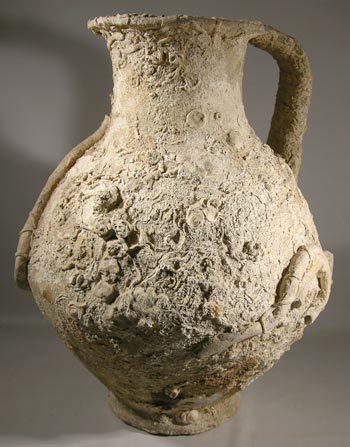
The priests in this passage are taking something that is intended to be pure and life-giving, the “living water” that Jesus talks about and they are making it bitter by adding things to it.  It becomes something that is not good to drink, does not quench thirst, does not refresh.  It in fact becomes the opposite of living water — it is deadly water for some.  It still looks like water but it’s essence and elemental nature have been crusted over by barnacles of tradition and rules growing on the kernel of love and truth given to Moses.

Unfortunately, I do not think Christian churches are immune from this type of crusting over of the kernel of God’s love and truth.  Some Christian leaders have taken the love, acceptance, and grace which were fundamental to Jesus on earth and they have added the dust from the church floor to make His living water bitter.  This may be done with the best of intentions as I am sure the priests were well intentioned in their ceremonies to deal with infidelity in marriage.  The end result is the same — living water made bitter.

In previous passages in Exodus the Israelites have encountered bitter water, but God always provided a way to make it drinkable or he provided something better.  What this suggests to me is that God does not guarantee that we will not have “bitter water” at times, but what is interesting is that I see no indication that God is the one making it bitter as the priests are doing in this passage.  I still think that the God of grace and love that is embodied in Jesus is a God who makes bitter water sweet, provides hope for the hopeless, and loves the unlovable.  We should be wary of those who would do the opposite.

Prayer: God help us to discern the kernel of your love for us through all the external traditions that encrust it.  May we continually ask whether our actions and practices are consistent with the kernel of Your love and grace.

Posted in Christian Community, Christian Leadership, Following God, Life Together, Love for the Lost, Numbers | Tagged , , , , , , , , , , | Leave a comment

Don’t eat or touch road kill

Any Israelite or any foreigner residing among you who hunts any animal or bird that may be eaten must drain out the blood and cover it with earth, because the life of every creature is its blood. That is why I have said to the Israelites, “You must not eat the blood of any creature, because the life of every creature is its blood; anyone who eats it must be cut off.”   Anyone, whether native-born or foreigner, who eats anything found dead or torn by wild animals must wash their clothes and bathe with water, and they will be ceremonially unclean till evening; then they will be clean.  But if they do not wash their clothes and bathe themselves, they will be held responsible.  Leviticus 17:13-16

The preceding verses and this verse explain why blood is important “for the life of a creature is in its blood”.  We know now that this is in fact true from a biophysical perspective — without blood our bodies would not be able to process oxygen and release carbon dioxide.  Blood allows the cells of our bodies to be “fed”.  Clearly there was a prohibition against eating the blood of animals.  This seems to be because aside from the physical purpose of blood it has a spiritual purpose for atonement.  Eating blood would be like touching the ark of the covenant or entering the Most Holy Place without the proper linen garments.  As we explored in yesterday’s post we do not need special linens to receive God’s grace.

The directive to wash after encountering a dead animal seems prudent.  Dead animals harbor all kinds of bacteria and other gross things.  My dad used to tell a story about a time he was walking down to a river in Kansas to go catfish fishing.  Apparently catfish like smelly chicken guts and parts.  Well as my dad tells it he was walking down the river bank with a container full of chicken parts which had maggots all over them and he slipped and the entire mess fell all over him.  This would truly call for a thorough washing, perhaps a clorox bath!  Our cat Meryl likes to bring chipmunks onto our deck where she proceeds to eat most of them.  She seems to dislike the entrails and tails.   So we often find little presents on our deck  — this can be really unpleasant when one is walking on the deck at night with bare feet.  I am all about thorough washing in this case also.

This verse makes the  same distinction which has been made in previous verses about being ceremonially unclean versus just unclean.  I do not understand it any better here than I did in previous passages.  I am struggling to find a deeper meaning of this passage…maybe there is no deeper meaning…maybe it just means “don’t eat or touch road kill and if you touch it wash up after words.”…but then again maybe there is something.

How do people treat Jesus’ blood — the atonement for us through the shedding of his blood?  In my experience this is not something that many people take on when they choose to consider Jesus.  They may think of him as a great moral teacher or a good man. That is much less confusing and threatening than a God-man who died on a cross for us by shedding his own blood for our sins.  Jesus himself instructs us to eat of his flesh and drink of his blood ( Mark 14:22-25) during the meal with his disciples.  What does it mean that God himself instructs us to do something that in this passage would make us unclean?  It probably means that the disciples did not need to be “ceremonially clean” to be in God’s presence…he was right in front of them washing their feet.

Prayer: God help me to understand the atonement that the shedding of your blood accomplished.

Posted in Forgiveness, Leviticus | Tagged , , , , , , , , , | Leave a comment

Garment of God’s Grace

Then Aaron is to go into the tent of meeting and take off the linen garments he put on before he entered the Most Holy Place, and he is to leave them there.  He shall bathe himself with water in the sanctuary area and put on his regular garments. Then he shall come out and sacrifice the burnt offering for himself and the burnt offering for the people, to make atonement for himself and for the people.  He shall also burn the fat of the sin offering on the altar.  The man who releases the goat as a scapegoat must wash his clothes and bathe himself with water; afterward he may come into the camp.  The bull and the goat for the sin offerings, whose blood was brought into the Most Holy Place to make atonement, must be taken outside the camp; their hides, flesh and intestines are to be burned up.  The man who burns them must wash his clothes and bathe himself with water; afterward he may come into the camp. – Leviticus 16:23-28

This passage follows some very important passages about atonement, confessing sins, and placing the sins of the nation of Israel on the head of a goat to be sent into the wilderness.  Clearly there are parallels here with Jesus, His being sent into the wilderness, and His atonement for our sins.  The term scapegoat has become synonymous with someone blamed for something when they do not deserve it.  In a sense Jesus was the ultimate scapegoat for our sins.  God himself placed the sins of the world on His own shoulders and gave himself for us.  This is an amazing thing.  One of the things about Christianity that attracted me and is so different from many other religions — a God who serves.

There is a lot of washing up going on which makes sense given the amount of sacrificing, burning of animal parts, and blood being shed and splashed about.  It just occured to me that we “wash up” through the act of baptism in response to accepting that Jesus’ blood was shed on our behalf for atonement.  I am not sure that this is connected in any way but it is an interesting parallel.

I am not sure I understand the whole linen garment thing.  What is difference between “regular garments” and the linen garments that are to be worn in the tent of meeting and Most Holy Place?  Come to think of it why does superman need a special suit to do his thing?  or spiderman?  It seems like the reason for the “super suits” is that they help the person wearing them and us identify the person wearing them and their role.  It is hard to believe God would need any such thing for Aaron….maybe it was not for God but actually for Aaron.

Perhaps some of the trappings and more liturgical and ceremonial things we do which are ostensibly for God are in fact partly for ourselves.  God knows we need these things.  I am thinking about hymns, songs, worship, creeds, and the like.  Perhaps God appreciates these things but they are actually in part to give us confidence that we are really “super heros” or in the case of Aaron a “super priest”.  Super christians — faster than a session meeting, more powerful than a local committee; able to lead tall church buildings without being crowned.  I suspect we can do all these things without the special underwear.  What we really need is the ability to listen really well to each other and to God.  This would go a long way toward resolving some of the division and strife that can infect our churches and relationships.

Prayer: God help us to put on the garment of your grace and receive your forgiveness so that we may forgive others.

Posted in Christian Community, Following God, Forgiveness, Leviticus, Life Together | Tagged , , , , , , , , , , , , , , | Leave a comment

Soot on Our Souls

IMGP3621The Lord spoke to Moses after the death of the two sons of Aaron who died when they approached the Lord . The Lord said to Moses: “Tell your brother Aaron that he is not to come whenever he chooses into the Most Holy Place behind the curtain in front of the atonement cover on the ark, or else he will die. For I will appear in the cloud over the atonement cover.   This is how Aaron is to enter the Most Holy Place: He must first bring a young bull for a sin offering and a ram for a burnt offering. He is to put on the sacred linen tunic, with linen undergarments next to his body; he is to tie the linen sash around him and put on the linen turban. These are sacred garments; so he must bathe himself with water before he puts them on. From the Israelite community he is to take two male goats for a sin offering and a ram for a burnt offering.  – Leviticus 16:1-5

It is back to Leviticus today…sometimes I feel like Leviticus should have a subtitle (or a warning label)…burned, bloody, and blasted.  Aaron’s sons discover, the hard way, that the most holy place and approaching God in a way that is not according to God’s timing or rules can be deadly.  I am so thankful that the relationship we have with God can be different.  This brings up a question which I have discussed with more than one non-christian.  How can the Leviticus God of blood, burning, and blasting be the God of blessings, baptism, and love we find in Jesus?  I have thought and prayed a lot about this and I cannot pretend to fully understand the answer to this most important of questions, but here is what I am learning.

I think part of the answer can be found in the territory we explored a couple of weeks ago in “how God is like water“.  I believe there is a spiritual “cycle” which operates on earth and beyond and the “condensate of God” exists on earth as God the Father, the Holy Spirit, and Jesus.  This is a bit like the hydrologic cycle on earth.  Water takes many forms –gentle rains, fog, clouds, etc., and it is always in motion.  In order for there to be “gentle” forms of God like the Holy Spirit and Jesus, perhaps there must be the possibility of the more extreme form of God the Father that was present in the The Most Holy Place.

Extreme forms of weather like hurricanes, thunderstorms, and tornadoes are not pleasant and can be deadly, but they are a necessary part of the same hydrologic cycle that gives us a life-giving rain.  So the same God who offered the Samaritan woman living water at the well (John 4:10), and provided Hagar Hidden wells in the desert, can show up as a “hurricane” and blast Aaron’s Sons out of existence.  It seems there cannot be one without the other, just like we cannot have gentle rains and fog without the possibility for tornadoes and thunderstorms.

What is clear from the Gospel accounts of Jesus on earth is that we can approach Him any time and place — no special underwear required.  We have access to God in a way that the Israelites did not have through the Most Holy Place and the Tent of Meeting.  As Christians we could take this to mean that we need not be concerned with how “clean” we are when entering God’s presence.  On one level this is true.  I believe we are able to come as we are to Jesus, but does this mean we need not be thoughtful about “coming clean” to be in God’s presence?

Aaron was directed to wash with water before entering God’s presence.  Christians symbolically wash when they undergo baptism.  Perhaps, the practice of Catholic confession is a sort of “washing” before entering God’s presence.  I am not a Catholic so I plead ignorance on this point.  What seems clear is that God wants us to reflect on our behavior toward Him, other people, and even how we treat his creation before we meet with Him or enter His presence. Does this mean that He will not show up if we do not do this?  I don’t know.  I think He will show up regardless of our state of cleanliness, but we may have difficulty seeing and hearing Him through the buildup of “soot” on our souls.

So it seems that the most logical way to proceed before entering God’s presence is to begin by “washing up” before we pray by reflecting on ways that we have not honored God, our neighbors, and God’s creation.  Clear away the soot so we can hear and see God.  Does this mean we should not approach God covered in “soot” for fear of being blasted?  I do not think so…a thunderstorm can clean off a whole lot of soot.

Prayer: Thank you God that you accept us just as we are, soot and all.  Help us to be washed clean before we enter your presence so we can see and hear You clearly.

SDG
Posted in Discernment, Forgiveness, God's Love for Us, Leviticus | Tagged , , , , , , , , , , , , , , , | Leave a comment

Eddying Out

image

When one is rafting whitewater, the journey is comprised of periods of frenzied paddling interspersed with periods of rest and recovery, referred to as “eddying out”.  I just experienced a turbulent and exhilarating “rapid” — the wedding of my oldest daughter.   I needed today to “eddy out”.  I will continue my daily walk with water tomorrow.

Posted in Eddying Out | Leave a comment

Rabbit Trail#2 – An Omer of Blog Post

IMG_2273This day marks the two month anniversary of the day I began this journey with God, the bible, and water.  So it is time for another Rabbit trail…This day also marks the day my daughter is getting married.  Which is eminently more important than this blog…so I am writing this blog early…so I can focus on other things on August 22nd.

God has faithfully provided me with daily Manna to write this blog.  Just enough for one day, an Omer of blog post.  I thought when I started this blog that trying to post something daily would be really hard — don’t get me wrong there are days that are harder than others to be creative and faithful in my posts, but God has been faithful to me.  Even when the water provided seemed a bit bitter, I have had the water I needed.

I wanted to take a moment and reflect on what I am learning through the experience of writing this blog.  I am learning to trust God, just like the Israelites were learning to trust him as he provided manna for them in the desert.  I have felt at times like I wanted to return to Egypt and the comfortable “slavery” that awaits me there.  I have also been amazed by the response of my friends, family, and blog followers to my journey.  They have been very encouraging through their “likes” of some of my posts and this has helped me when the climbing got difficult.

I am also delighted by the diversity of the people following my blog and reading my posts.  I figure that if my blog followers look like Jesus’ followers I might be doing something right.  My hope and constant prayer is that I am listening to God with sufficient care and reflection to get His message right as revealed through water in the bible.  I also hope and pray that God will use what he has inspired me to create to reach those who are spiritually curious God seekers, especially those who may need to hear about God and the bible from a little different perspective.

Prayer: God thank you for providing for me daily and walking with me as I try to “Walk on Water”.

SDG
Posted in Discernment, Following God, Obedience, Rabbit Trails | Tagged , , , , , , , , , | Leave a comment

Limburger Cheese on Your Nose

The Lord said to Moses and Aaron,  “Speak to the Israelites and say to them: ‘When any man has an unusual bodily discharge, such a discharge is unclean.  Whether it continues flowing from his body or is blocked, it will make him unclean. This is how his discharge will bring about uncleanness:  “‘Any bed the man with a discharge lies on will be unclean, and anything he sits on will be unclean.  Anyone who touches his bed must wash their clothes and bathe with water, and they will be unclean till evening.  Whoever sits on anything that the man with a discharge sat on must wash their clothes and bathe with water, and they will be unclean till evening.  “‘Whoever touches the man who has a discharge must wash their clothes and bathe with water, and they will be unclean till evening.  “‘If the man with the discharge spits on anyone who is clean, they must wash their clothes and bathe with water, and they will be unclean till evening.  “‘Everything the man sits on when riding will be unclean, 10 and whoever touches any of the things that were under him will be unclean till evening; whoever picks up those things must wash their clothes and bathe with water, and they will be unclean till evening.  “‘Anyone the man with a discharge touches without rinsing his hands with water must wash their clothes and bathe with water, and they will be unclean till evening.  “‘A clay pot that the man touches must be broken, and any wooden article is to be rinsed with water.  “‘When a man is cleansed from his discharge, he is to count off seven days for his ceremonial cleansing; he must wash his clothes and bathe himself with fresh water, and he will be clean.  On the eighth day he must take two doves or two young pigeons and come before the Lord to the entrance to the tent of meeting and give them to the priest.  The priest is to sacrifice them, the one for a sin offering and the other for a burnt offering. In this way he will make atonement before the Lord for the man because of his discharge.  “‘When a man has an emission of semen, he must bathe his whole body with water, and he will be unclean till evening.  Any clothing or leather that has semen on it must be washed with water, and it will be unclean till evening.  When a man has sexual relations with a woman and there is an emission of semen, both of them must bathe with water, and they will be unclean till evening.  “‘When a woman has her regular flow of blood, the impurity of her monthly period will last seven days, and anyone who touches her will be unclean till evening.  “‘Anything she lies on during her period will be unclean, and anything she sits on will be unclean.  Anyone who touches her bed will be unclean; they must wash their clothes and bathe with water, and they will be unclean till evening.  Anyone who touches anything she sits on will be unclean; they must wash their clothes and bathe with water, and they will be unclean till evening.  Whether it is the bed or anything she was sitting on, when anyone touches it, they will be unclean till evening. – Leviticus 15:1-23

OK I am officially ready to be done with my sojourn in Leviticus…The passage today is clearly “R” rated on several levels and has to be one of the most challenging I have encountered in my “walk on water” so far.  How does one make sense of bodily secretions in light of eternity?  Excellent question!  Bodily secretions are not typical dinner conversation (or a typical blog topic either!), but I have committed to walking with water through the bible wherever it leads….so here goes.

First the easier part…the connection to water is clear in this passage…in a nutshell when secreting bodily fluids wash body profusely…I wholeheartedly agree with this concept.  There are sound medical reasons why washing when one is secreting fluids is a good practice.  Modern medicine has learned that fluids are often carriers of contagious diseases like leprosy and Ebola. Washing away these disease carrying fluids is one of the most important practices in modern hospitals to keep them clean.  “Washing up” before going into the operation room is also necessary to prevent spreading contagious diseases.

Now for the harder part — the larger meaning of being unclean, the connection to the secretion of bodily fluids, and how those fluids can infect others and thus make others unclean.  Is there something equivalent to spiritual “bodily fluids” that are not supposed to issue forth from our souls to “infect” others?  I am reminded of people with bitter or negative spirits that seem to infect the souls of those around them.  We have a saying in our family that these people have “limburger cheese on the their nose”.  Limburger cheese is a very smelly, strong, cheese that gets caught in one’s nose and can make the finest rose smell bad.  If you have “limburger cheese on your nose” it means that everyone and everything you touch is infected with your bitter and negative spirit.

Jesus had a remedy for people with “limburger cheese on the their nose”.  He loved them.

Prayer: God help us to come near to those with bitter and negative spirits so we can infect them with the Good News of Jesus Christ and his love.


Posted in Christian Community, Following God, Leviticus, Life Together, Love for the Lost | Tagged , , , , , , , , , , , , | Leave a comment