Like Carmel by the Sea

Screenshot from 2016-02-26 01:17:48

Carmel by the Sea and Jerusalem

As surely as I live,” declares the King, whose name is the Lord Almighty, “one will come who is like Tabor among the mountains, like Carmel by the sea.   Pack your belongings for exile, you who live in Egypt, for Memphis will be laid waste and lie in ruins without inhabitant.   “Egypt is a beautiful heifer, but a gadfly is coming against her from the north.   The mercenaries in her ranks are like fattened calves. They too will turn and flee together, they will not stand their ground, for the day of disaster is coming upon them, the time for them to be punished.   Egypt will hiss like a fleeing serpent as the enemy advances in force; they will come against her with axes, like men who cut down trees.   They will chop down her forest,” declares the Lord , “dense though it be. They are more numerous than locusts, they cannot be counted.   Daughter Egypt will be put to shame, given into the hands of the people of the north. The Lord Almighty, the God of Israel, says: “I am about to bring punishment on Amon god of Thebes, on Pharaoh, on Egypt and her gods and her kings, and on those who rely on Pharaoh. I will give them into the hands of those who want to kill them—Nebuchadnezzar king of Babylon and his officers. Later, however, Egypt will be inhabited as in times past,” declares the Lord. “Do not be afraid, Jacob my servant; do not be dismayed, Israel. I will surely save you out of a distant place, your descendants from the land of their exile. Jacob will again have peace and security, and no one will make him afraid. Do not be afraid, Jacob my servant, for I am with you,” declares the Lord. “Though I completely destroy all the nations among which I scatter you, I will not completely destroy you. I will discipline you but only in due measure; I will not let you go entirely unpunished.” – Jeremiah 46:18-28
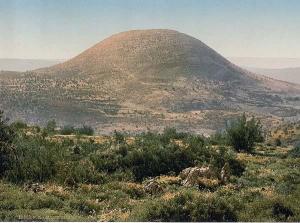
tabor

Mount Tabor

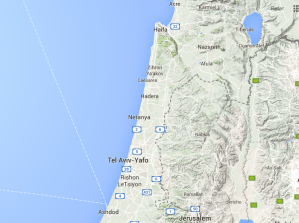
The water reference in this passage is a little tangential, but there is an interesting simile about “Mount Tabor” and “Carmel by the sea” that I thought worth exploring.  I had to pull out Google Maps and figure out the geography of this passage.  “Carmel by the Sea” refers to a rocky promontory located along the Mediterranean about 30 miles north northwest of Jerusalem.  Mount Tabor is located just to the east of Carmel by the Sea in the mountains surrounded to the south by a flat plain.

There are those who interpret verses in the new testament about the transfiguration of Christ to have occurred at Mount Tabor (Matthew 17:1-3).  Some have been so convinced as to build an entire church to commemorate this event on Mount Tabor.  My reading of Matthew would suggest that the transfiguration occurred on Mount Herman rather than on Mount Tabor, but I am no biblical scholar so I could be in error.  My logic for favoring Mount Herman over Mount Tabor is based on two details from the Gospel of Matthew: 1) the disciples and Jesus were said to be in “the region of Caesarea Philippi” which is located about 25 miles north of the Sea of Galilee and at the base of Mt. Hermon; and 2) the mountain is described as being a “high mountain”.  Mount Herman would certainly qualify as a “high mountain” at an elevation of 9,232 feet (2,814 m) above sea level.

Irrespective of whether the transfiguration occurred on Mount Herman, Mount Tabor, or some other mountain I think the somewhat odd simile in this passage may be a reference to the coming Messiah, a reflection of Him.  The passage says “one will come who is like Tabor among the mountains, like Carmel by the sea.”  It seems to me what these two locations have in common is that they stand out from their surroundings, Carmel by the sea because it juts into the Mediterranean, and Mount Tabor because it rises from a relatively flat plain.  This is certainly an apt description of Jesus, the One who came to settle the matter of our estrangement with God.

Jesus stood out among the people He came to serve and heal.  He was clearly different – in a good way.  His shoulders reached into the clouds high above us, even while he was kneeling down to wash the disciple’s feet.  The moment when Peter, James and John got to see this duality clearly,  “the Mountain” on the mountain, we refer to as the transfiguration (Matthew 17:1-3).

It is of course possible I am reaching way beyond the meaning of this passage and pulling out a rabbit that is of my own making, but the end of the passage would seem to indicate that a convent relationship is also on God’s mind: “Jacob will again have peace and security, and no one will make him afraid. Do not be afraid, Jacob my servant, for I am with you”.  So at some point Jacob, the nation of Israel, will have peace like a river.

God is promising to extend His Mighty Arm of Peace to all of the exiles and prisoners in the midst of this confusing and scary time where it seems there is terror on every side.  God does the same for all of us willing to confess our role as exiles and prisoners here in the “land of oblivion“.  I am reminded of a song by Natalie Grant called “held”.  In the chorus is a line that speaks to this tension of feeling like everything around us is falling apart in the midst of acknowledging God’s promise to catch us as we fall:

“This is what it means to be held
How it feels, when the sacred is torn from your life
And you survive
This is what it is to be loved and to know
That the promise was that when everything fell – We’d be held”

– “Held” by Natalie Grant

Prayer: God thank You for reaching out and rescuing us from the “mountain” and holding us when we fall.

SDG


Posted in Christianity, Conflict, Covenant, Discernment, Discipleship, Following God, grace, Jeremiah, Jesus, Obedience, reconciliation, Redemption, The Nature of God, Trusting God | Tagged , , , , , , , , | Leave a comment

Terror on Every Side

DCP_9469This is the word of the Lord that came to Jeremiah the prophet concerning the nations:   Concerning Egypt: This is the message against the army of Pharaoh Necho king of Egypt, which was defeated at Carchemish on the Euphrates River by Nebuchadnezzar king of Babylon in the fourth year of Jehoiakim son of Josiah king of Judah:   “Prepare your shields, both large and small, and march out for battle!   Harness the horses, mount the steeds! Take your positions with helmets on! Polish your spears, put on your armor!   What do I see? They are terrified, they are retreating, their warriors are defeated. They flee in haste without looking back, and there is terror on every side,” declares the Lord .   “The swift cannot flee nor the strong escape. In the north by the River Euphrates they stumble and fall.   “Who is this that rises like the Nile, like rivers of surging waters?   Egypt rises like the Nile, like rivers of surging waters. She says, ‘I will rise and cover the earth; I will destroy cities and their people.’   Charge, you horses! Drive furiously, you charioteers! March on, you warriors—men of Cush and Put who carry shields, men of Lydia who draw the bow.   But that day belongs to the Lord, the Lord Almighty— a day of vengeance, for vengeance on his foes. The sword will devour till it is satisfied, till it has quenched its thirst with blood. For the Lord, the Lord Almighty, will offer sacrifice in the land of the north by the River Euphrates. – Jeremiah 46:1-10
This passage reads like a Cecil B. DeMille script —  great battles, winners and losers, swords and shields.  Jeremiah is sharing a prophesy about the nation of Egypt and those from Judah who have put in their lot with the Egyptians.  Apparently Pharaoh Necho is king of Egypt and he lost a battle near Carchemish, which is near the northern border between Syria and Turkey near the Euphrates River.  It seems Egypt was pretty far from their “home on the Nile” when they lost this battle.

From what I have learned about this time in the history of the region the area of Judah and Jerusalem are between at least two great powers, Egypt and Babylon and they are fighting and scrumming over this “middle ground” and the people of Judah and Jerusalem are caught in the middle — some submitting to exile as God instructed, others fleeing to Egypt, and still others dying at the hands of their own people.  I am not sure what it is about this particular piece of real estate, but it seems to have been a festering cancer of conflict for a very long time.

This central theme of this passage seems to be a resurgence of Egypt from the south to overtake the Babylonians who have captured Judah and Jerusalem “Egypt rises like the Nile, like rivers of surging waters.”  They are coming on like an unstoppable flood.  Back in Isaiah 66:5-13 God uses similar language, “like a flooding stream” to refer to the spread of the nation of Israel, and perhaps in a broader sense, God’s kingdom.  In the case of Egypt God is using them to cleanse and wash away some of the corruption that had overtaken the City of David.

Flooding on rivers would seem like a very dirty and destructive thing, but they actually have a cleansing effect on a river system.  They can remove vegetation and purge waste products that have quilt up along a river system so that new life can grow.  During a flood rivers seem to be out of control and dangerous, but without the release of these pent up floods the rivers would be far less dynamic and healthy.

My sense is that the “flood” that the Egyptians are bringing to Judah and Jerusalem is a necessary cleansing of people and practices that God cannot tolerate.  He is removing the brambles of bravado and Baal worship so that new life and new growth is possible.  In end this passage makes it clear that “the flood” is under God’s ultimate control, “But that day belongs to the Lord, the Lord Almighty”.

The take home for me from this passage is that God may sometimes use extreme measures, destructive life floods, to get our attention and clean out some of the debris and garbage that we have allowed to accumulate in our lives.  During these times of rushing waters our lives may look very chaotic and messy.  I do not think God is punishing us any more that a river is being punished by the very floods that keep it clean and healthy, although I admit it might feel God’s punishment.  God is merely using the only means possible to strip us down to the soul and remove the built up brambles of bravado so that new growth can occur.  I am reminded of one of my favorite songs by Casting Crowns called “Praise You in this storm”.  Part of the chorus of the song goes like this:

And I’ll praise You in this storm
And I will lift my hands
For You are who You are
No matter where I am
And every tear I’ve cried
You hold in Your hand
You never left my side
And though my heart is torn
I will praise You in this storm

Prayer: God help us to see Your hand in painful life-floods not as slap of rebuke but as means to make way for new growth.

Posted in Conflict, Discernment, Following God, Forgiveness, God's Love for Us, Jeremiah, Obedience, The Earthly Realm, The Nature of God | Tagged , , , , , , | 1 Comment

The Great Pool

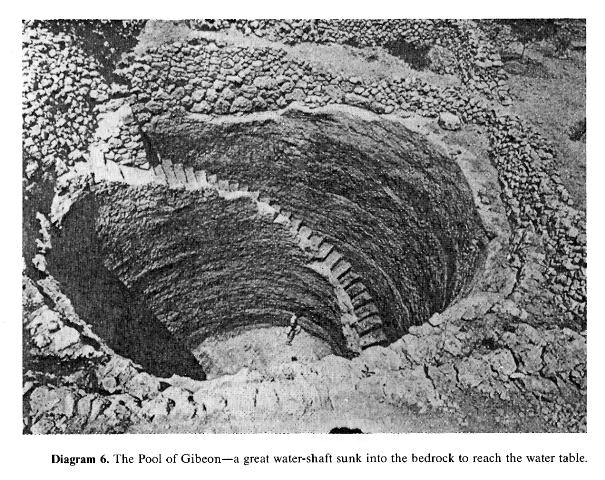
Ishmael made captives of all the rest of the people who were in Mizpah—the king’s daughters along with all the others who were left there, over whom Nebuzaradan commander of the imperial guard had appointed Gedaliah son of Ahikam. Ishmael son of Nethaniah took them captive and set out to cross over to the Ammonites. When Johanan son of Kareah and all the army officers who were with him heard about all the crimes Ishmael son of Nethaniah had committed, they took all their men and went to fight Ishmael son of Nethaniah. They caught up with him near the great pool in Gibeon. When all the people Ishmael had with him saw Johanan son of Kareah and the army officers who were with him, they were glad. All the people Ishmael had taken captive at Mizpah turned and went over to Johanan son of Kareah. But Ishmael son of Nethaniah and eight of his men escaped from Johanan and fled to the Ammonites. – Jeremiah 41:10-15

I took a couple days to eddy out and ponder this passage and this part of Jeremiah. It does seem like a bleak time in the life of Israel and Judah. The last couple of passages have recounted Ishmael doing some pretty horrendous things in the name of “purity”. He has used cisterns to both imprison Jeremiah, and store a raft of people he murdered. I guess it is not too surprising that he feels that he has overstayed his welcome in Jerusalem and Judah and is now fleeing, with the people he spared from death, to the east across the Jordan.

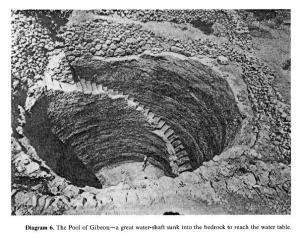
I had to review my geography for this passage. The ammonites live east of the Jordan and one had to cross mountains to reach them from Jerusalem. Apparently Ishmael is headed north out of Jerusalem and is being pursued by a posse of people bent on retribution for his brutal murders. They catch up to him “near the great pool in Gibeon”.

The location of Gibeon has been mentioned a few times up to this point in the bible. Back in Isaiah 28:16-21, God described a “strange work” that would be required in the valley of Gibeon, and the Pool of Gibeon was also the site of a senseless sacrifice of warriors described in 2 Samuel 2:8-26.

The prisoners that were being led by Ishmael across the countryside were understandably glad when Johanan and his army caught up to them. Apparently Ishmael and his men were out-manned and out-gunned and decided to cut their losses and leave the prisoners rather than fight it out at the “great pool” of Gibeon. They head east, cross the Jordan River, and hide out in the land of the Ammonites. This guy Ishmael sounds like a coward to me. He surprises and slaughters the people in Jerusalem, runs away with his “spoils”, then drops the spoils and runs east as soon as it looks like he is in for a real fight.

I guess the only spiritual meaning I can glean from this is to not be like Ishmael. Although as I consider this passage and what is going on in the life of the people of Judah and Israel it occurs to me that the people who were in Jerusalem are not a good role model either. They were also disobeying God’s command to go into exile in Babylon. Granted the consequences seems pretty harsh, but Jeremiah did warn them that if they remained they would die.

That is pretty much what happened, they just did not know that it would happen at the hands of a fellow Israelite. They chose to follow their own path, both Ishmael and the people he killed. They chose to be free of God and the result was not good. God’s plan came to pass and in the end God wins.

Prayer: God when we make plans that do not include You we are bound to fail. Help us to seek to understand You plan and figure out our role in it.

Posted in Conflict, Death and Dying, Discernment, Following God, Free Will, Jeremiah, Obedience, The Nature of God, Trusting God | Tagged , , , , , | Leave a comment

A Cistern Filled With Bodies

wm-destruction-of-temple_Francesco_HayezIn the seventh month Ishmael son of Nethaniah, the son of Elishama, who was of royal blood and had been one of the king’s officers, came with ten men to Gedaliah son of Ahikam at Mizpah. While they were eating together there, Ishmael son of Nethaniah and the ten men who were with him got up and struck down Gedaliah son of Ahikam, the son of Shaphan, with the sword, killing the one whom the king of Babylon had appointed as governor over the land. Ishmael also killed all the men of Judah who were with Gedaliah at Mizpah, as well as the Babylonian soldiers who were there.   The day after Gedaliah’s assassination, before anyone knew about it, eighty men who had shaved off their beards, torn their clothes and cut themselves came from Shechem, Shiloh and Samaria, bringing grain offerings and incense with them to the house of the Lord . Ishmael son of Nethaniah went out from Mizpah to meet them, weeping as he went. When he met them, he said, “Come to Gedaliah son of Ahikam.” When they went into the city, Ishmael son of Nethaniah and the men who were with him slaughtered them and threw them into a cistern. But ten of them said to Ishmael, “Don’t kill us! We have wheat and barley, olive oil and honey, hidden in a field.” So he let them alone and did not kill them with the others. Now the cistern where he threw all the bodies of the men he had killed along with Gedaliah was the one King Asa had made as part of his defense against Baasha king of Israel. Ishmael son of Nethaniah filled it with the dead. – Jeremiah 41:1-9

Well this is certainly a bloody interlude here in the book of Jeremiah.  The invasion of Jerusalem is complete and the king of Babylon has installed a governor, Gedaliah, to rule over Jerusalem and Judah.  There are Jews in the region who apparently are not happy with this state of affairs and are taking things into their own hands.  A gang of 10, led by Ishmael son of Nethaniah, assassinate Gedaliah, the governor appointed by King Nebuchadnezzar II of Babylon. Ishmael and his gang also kill all the Jews and Babylonians with the governor.  It sounds like something out of a Tom Clancy novel or a Hollywood action movie in search of an audience.

The passage then gets a little confusing.  A group of men come to Jerusalem, “eighty men who had shaved off their beards, torn their clothes and cut themselves came from Shechem, Shiloh and Samaria, bringing grain offerings and incense with them to the house of the Lord”.  On the face of it this would seem to be a good thing. These men have taken off their facial hair, torn their clothes, and come with offerings to God. They are trying to reconnect with God. Unfortunately for them God asked them to leave and go into exile.  So they will reap the consequences of the inability to trust God and His plan.

Ishamael goes out to meet this group of pilgrims weeping.  They were unaware that the governor and a bunch of other people had been murdered by Ishmael and his gang.  It is unclear why Ishmael is weeping.  Is he conflicted about the murderous rampage he has already committed or the one that is in his heart to commit in the future?  It seems like he feels like he has committed himself to a path that he knows to be wrong and apart from the path God has asked the people to walk.  Perhaps he feels powerless to turn aside from this path now that he has started down it.  As Paul from the new testament demonstrated, it is never too late to turn back and retrace our steps to follow the path God has for us.

Ishmael and his men slaughter the people who are on their way to make offerings in the house of the Lord and throw them into the cistern.  My sense is that Ishmael is upset that the people of Jerusalem and Judah have given up without a fight.  Even though that is exactly what God has instructed them to do through the prophet Jeremiah.  Ultimately, neither these pilgrims in search of grace or Ishmael trust God’s plan because it involves “giving up” to the Babylonians.  They do not believe that God has their back.

Sometimes God requires us to “give up” for the sake of a larger purpose. God needed His people to walk humbly into exile, and those that obey his command will return and prosper.  Those that chose to follow their own way have a much more bleak future.

Prayer: God help us to humbly follow the path you have set before us, even when that path seems to be leading us toward something we do not understand.

Posted in Conflict, Covenant, Death and Dying, Discernment, Following God, God's Love for Us, Jeremiah, Obedience, Trusting God | Tagged , , , , , , , | 3 Comments

Muddy Cistern

jeremiah_pitShephatiah son of Mattan, Gedaliah son of Pashhur, Jehukal son of Shelemiah, and Pashhur son of Malkijah heard what Jeremiah was telling all the people when he said, “This is what the Lord says: ‘Whoever stays in this city will die by the sword, famine or plague, but whoever goes over to the Babylonians will live. They will escape with their lives; they will live.’ And this is what the Lord says: ‘This city will certainly be given into the hands of the army of the king of Babylon, who will capture it.’ ”   Then the officials said to the king, “This man should be put to death. He is discouraging the soldiers who are left in this city, as well as all the people, by the things he is saying to them. This man is not seeking the good of these people but their ruin.”   “He is in your hands,” King Zedekiah answered. “The king can do nothing to oppose you.”   So they took Jeremiah and put him into the cistern of Malkijah, the king’s son, which was in the courtyard of the guard. They lowered Jeremiah by ropes into the cistern; it had no water in it, only mud, and Jeremiah sank down into the mud.   But Ebed-Melek, a Cushite, an official in the royal palace, heard that they had put Jeremiah into the cistern. While the king was sitting in the Benjamin Gate, Ebed-Melek went out of the palace and said to him, “My lord the king, these men have acted wickedly in all they have done to Jeremiah the prophet. They have thrown him into a cistern, where he will starve to death when there is no longer any bread in the city.”   Then the king commanded Ebed-Melek the Cushite, “Take thirty men from here with you and lift Jeremiah the prophet out of the cistern before he dies.”   So Ebed-Melek took the men with him and went to a room under the treasury in the palace. He took some old rags and worn-out clothes from there and let them down with ropes to Jeremiah in the cistern. Ebed-Melek the Cushite said to Jeremiah, “Put these old rags and worn-out clothes under your arms to pad the ropes.” Jeremiah did so, and they pulled him up with the ropes and lifted him out of the cistern. And Jeremiah remained in the courtyard of the guard. – Jeremiah 38:1-13

I got seriously side-tracked by multiple overlapping events the last couple of weeks and have been off the water.  I am back on the water today exploring this passage about a muddy cistern used to imprison Jeremiah.  Actually, as I reflect on the last couple weeks off the water I have been feeling a little like a dried up cistern myself.  Time for a refill from the Great Cistern.

This passage begins with a group of apparently influential leaders, “Shephatiah son of Mattan, Gedaliah son of Pashhur, Jehukal son of Shelemiah, and Pashhur son of Malkijah” worried about the prophecies that Jeremiah is sharing.  In a nutshell, Jeremiah is saying that those who stay in “the city” will die and those who go into exile in Babylon will live.  These leaders are pleading with the King to do something because they think that Jeremiah is discouraging the soldiers who are tasked with defending the city.  They do not like what Jeremiah is saying and they intend to do put a stop to it.

They seem to be missing the point that God is the true defender of the City of David.  They do not seem so concerned with discerning whether this prophecy is from God and if so what that might say about their behavior and actions.  This reminds me of the Pharisees and scribes in the time of Jesus.  They also did not like the message Jesus was bringing and rather than reflect on why God would be sending such a message they got angry and imprisoned and killed the messenger.  Of course, in the end, God won, and I suspect these leaders will find out that, in this case, God will have His way as well.

King Zedekiah chooses the same path as Pontius Pilate did in the time of Jesus.  He says “He is in your hands,”…“The king can do nothing to oppose you.”  So these leaders take the already imprisoned Jeremiah and they “put him into the cistern of Malkijah, the king’s son, which was in the courtyard of the guard. They lowered Jeremiah by ropes into the cistern; it had no water in it, only mud, and Jeremiah sank down into the mud.”  This had to be a time of very mixed feelings for both the leaders and Jeremiah.

Jeremiah was probably feeling somewhat discouraged that his faithful sharing of God’s message has landed him waist deep in mud in a smelly dark cistern.  The leaders might be thinking to themselves, “well that did not work out as planned, now what”.  There are interesting similarities here between the path that Jesus walked to his crucifixion and Jeremiah’s descent into the muddy cistern.

In Ephesians 9:4 Paul discusses Jesus’ ascent which implies some sort of prior descent. There are two ways of looking at Jesus’ descent and  subsequent ascent.  The first is to envision God, through his son Jesus, descending into Hades to battle the forces of darkness on our behalf after his death and prior to His resurrection.  The other is that in coming to Earth Jesus did the equivalent of descending into a muddy cistern on our behalf. Perhaps it is a distinction without a difference.  Either way, God entered enemy territory on our behalf and rescued those who choose to be rescued.  We are all, like Jeremiah, stuck in a muddy cistern.

Jeremiah is eventually rescued by another leader willing to consider that He is, in fact, God’s messenger and putting him in a cistern to die is probably not a good move.  He is rescued by “Ebed-Melek, a Cushite, an official in the royal palace”.  Ebed-Melek reminds me of Nicodemus in the new testament (John 3).  Both men were part of an oppressive establishment that was oppressing a messenger of God.  Nicodemus, and apparently Ebed-Melek, are teachable, willing to ask hard questions, and consider the possibility that the establishment is wrong.

The take home message for me in this passage is that those in positions of leadership should continually ask themselves whether they are teachable and truly listening to the messages, and messengers, from God.  If we become deaf to hearing hard truths, and God’s quiet whisper, then we may end up assisting in something as ludicrous and evil as lowering someone into a muddy cistern or crucifying the Son of God.

Prayer: God help us to listen intently to your messages and messengers, even when they are telling us hard truths.


Posted in Christian Community, Christian Leadership, Christianity, Conflict, Death and Dying, Faith, Following God, Free Will, Hell, Jeremiah, Jesus, Obedience, reconciliation, The Earthly Realm, The Nature of God, Trusting God | Tagged , , , , , , | 3 Comments

Burning Words

123.Baruch_Writes_Jeremiah's_PropheciesAfter the king burned the scroll containing the words that Baruch had written at Jeremiah’s dictation, the word of the Lord came to Jeremiah: “Take another scroll and write on it all the words that were on the first scroll, which Jehoiakim king of Judah burned up. Also tell Jehoiakim king of Judah, ‘This is what the Lord says: You burned that scroll and said, “Why did you write on it that the king of Babylon would certainly come and destroy this land and wipe from it both man and beast?” Therefore this is what the Lord says about Jehoiakim king of Judah: He will have no one to sit on the throne of David; his body will be thrown out and exposed to the heat by day and the frost by night. I will punish him and his children and his attendants for their wickedness; I will bring on them and those living in Jerusalem and the people of Judah every disaster I pronounced against them, because they have not listened.’ ”   So Jeremiah took another scroll and gave it to the scribe Baruch son of Neriah, and as Jeremiah dictated, Baruch wrote on it all the words of the scroll that Jehoiakim king of Judah had burned in the fire. And many similar words were added to them. – Jeremiah 36:27-32

So the water reference here is somewhat tangential, frost, but it is an interesting passage so I figured it was worth a look.  Jeremiah is beginning to get serious resistance from the leaders in Judah and Jerusalem.  In this passage the king of Judah, Jehoiakim orders that a scroll of prophetic words uttered by Jeremiah be burned.  This “book burning” is a physical metaphor for the way the people have been treating all of the prophecies uttered by Jeremiah.  They are ignoring, working against, and trying to destroy them.

The king was upset because the scroll predicts the invasion and destruction of Judah by the king of Babylon.  Instead of reflecting on why God might want to allow this and perhaps change his behavior the king would rather blame the message and the messenger.  The consequences of the king of Judah’s actions are that “He will have no one to sit on the throne of David; his body will be thrown out and exposed to the heat by day and the frost by night.”  It will be the end of the line for Jehoiakim and his descendants.

I am not sure the reference to heat by day and frost by night holds any special meaning except that it is common in the desert to experience very large swings in temperature from day to night.  The king is subject to the ravages of this world, including heat and frost, because he has removed himself from God’s protection.  The core problem is that the people have failed to listen.  They have ears but they do not hear and eyes but they do not see.  This is the very same thing Jesus said to the religious leaders when they were choosing to persecute rather than praise Him (Mark 8:18).

Jeremiah did not give up when the king burned the words God had given him.  He simply had his scribe Baruch prepare another scroll and the second version included all that was previously written and more.  The take-home message for me is that we should always be prepared to listen to what God has to say to us and if we are called to share a message from God to others we should not become discouraged if it is not received well.  God may ask us to share an unpopular message as he did the early followers of Christ.  They were willing to remain steadfast  and courageous despite persecution and hardship.  We should be willing to do the same.

Prayer: God help us to be both good listeners and faithful to share Your message with others when we are called to do so.

Posted in Conflict, Covenant, Following God, Jeremiah, Obedience, Prophecy | Tagged , , , , | 2 Comments

Sand on the Seashore

DSCN5026The days are coming,’ declares the Lord , ‘when I will fulfill the good promise I made to the people of Israel and Judah.   “ ‘In those days and at that time I will make a righteous Branch sprout from David’s line; he will do what is just and right in the land.   In those days Judah will be saved and Jerusalem will live in safety. This is the name by which it will be called: The Lord Our Righteous Savior.’   For this is what the Lord says: ‘David will never fail to have a man to sit on the throne of Israel, nor will the Levitical priests ever fail to have a man to stand before me continually to offer burnt offerings, to burn grain offerings and to present sacrifices.’ ”   The word of the Lord came to Jeremiah: “This is what the Lord says: ‘If you can break my covenant with the day and my covenant with the night, so that day and night no longer come at their appointed time, then my covenant with David my servant—and my covenant with the Levites who are priests ministering before me—can be broken and David will no longer have a descendant to reign on his throne. I will make the descendants of David my servant and the Levites who minister before me as countless as the stars in the sky and as measureless as the sand on the seashore.’  – Jeremiah 33:14-22
Well this Superbowl Sunday once again and the cultural carnival will begin at 6:30 p.m ET, Superbowl 50 (I guess the roman numeral “L” was just too confusing).  Last year at this time I was floating through the book of Nehemiah and Ezra was giving a Superbowl of sermons (Nehemiah 8:1-6).

Here in the book of Jeremiah a year later we find a prophetic description of an earth changing event to come — the arrival of the righteous one, Jesus.  Superbowl hype not withstanding, an event far bigger than any Superbowl.  This is the most clear reference to a coming Messiah that I have come to in the book of Jeremiah so far.

Jeremiah is sharing this hopeful message to a largely unruly and hopeless people.  They need a righteous savior to heal their wounded souls.  The coming Jesus is the “good promise” that God is making amidst the wasteland of despair that the people find themselves living within, both in Jerusalem and soon in exile in Babylon.

God makes it clear that the coming Messiah will come from “a righteous Branch sprout from David’s line; he will do what is just and right in the land.”  The coming Messiah will be the fulfillment of a promise made to David and through David to all those who will choose to follow God through His son.

God speaking through Jeremiah does not leave any room for doubt about whether this much anticipated Messiah will come.  God engages in somewhat playful hyperbole when He says “If you can break my covenant with the day and my covenant with the night, so that day and night no longer come at their appointed time, then my covenant with David my servant—and my covenant with the Levites who are priests ministering before me—can be broken and David will no longer have a descendant to reign on his throne.”

God is saying we can no more prevent the sun from rising and falling (i.e stop the planets from moving around the sun as we now understand it) than prevent Him from sending a savior from the line of David to free us from our bondage to sin and disobedience.  His going to settle the matter once and for all.  God will “make the descendants of David my servant and the Levites who minister before me as countless as the stars in the sky and as measureless as the sand on the seashore.”

All God-followers, both Jew and gentile, that God could foresee joining His family are part of this “sand on the seashore” He is describing.  Modern-day followers of Jesus are all sand grains on this vast beach that lies between the secular and the spiritual.  My pursuit of God through His Son links back to this very prophecy given by Jeremiah to a frustrated and angry people.  It is up to us to act on it and make our sure our hearts are channeled by God and our daily actions glorify God.

Prayer: God thank You for sending Your son to show us what it is like to live a life devoted to You.  Help us to emulate Him by making devoting each act to You and Your glory.

Posted in Christianity, Covenant, Discernment, Forgiveness, Free Will, God's Love for Us, Jeremiah, Jesus, Obedience, Prophecy, reconciliation, Redemption, The Earthly Realm, The Nature of God, The Spiritual Realm | Tagged , , , , , , , , | Leave a comment

They Will All Know Me

51dc821be4b097e4d38392b0“This is the covenant I will make with the people of Israel after that time,” declares the Lord . “I will put my law in their minds and write it on their hearts. I will be their God, and they will be my people.   No longer will they teach their neighbor, or say to one another, ‘Know the Lord ,’ because they will all know me, from the least of them to the greatest,” declares the Lord . “For I will forgive their wickedness and will remember their sins no more.”   This is what the Lord says, he who appoints the sun to shine by day, who decrees the moon and stars to shine by night, who stirs up the sea so that its waves roar— the Lord Almighty is his name:   “Only if these decrees vanish from my sight,” declares the Lord , “will Israel ever cease being a nation before me.”   This is what the Lord says: “Only if the heavens above can be measured and the foundations of the earth below be searched out will I reject all the descendants of Israel because of all they have done,” declares the Lord . – Jeremiah 31:33-37

Ahhh what a refreshing passage.  This is the God I am familiar with from my pursuit through the bible so far.  A God who will “put my law in their minds and write it on their hearts. I will be their God, and they will be my people.”  God has certainly made an impression on my heart.  He has in fact channeled my heart toward Him, and continues to do so day by day as I explore new reaches of the bible with this blog.

The word picture here is amazing and wonderful.  He will be such a part of His people “No longer will they teach their neighbor, or say to one another, ‘Know the Lord ,’ because they will all know me, from the least of them to the greatest.”  God is describing a time when His people will know Him so well that the people will exude Him from their pores like sweat.  This path to forgiveness and intimacy will come about because of God’s forgiveness rather than some new found passion or skill within the people.  God says: “For I will forgive their wickedness and will remember their sins no more.

God is the one to settle the matter.  God does require that the people repent and return to Him, but the hard work will fall on Him.  The one who “appoints the sun to shine by day, who decrees the moon and stars to shine by night, who stirs up the sea so that its waves roar” will accomplish this reconciliation.

The passage ends with a part that I confess I am still a little confused about.  God says “Only if these decrees vanish from my sight,” declares the Lord , “will Israel ever cease being a nation before me…Only if the heavens above can be measured and the foundations of the earth below be searched out will I reject all the descendants of Israel because of all they have done”.  I have read this part several times and the only way it makes sense to me is if God is engaging in hyperbole.  I am reminded of the Psalm 103:8-12.

The Lord is compassionate and gracious, slow to anger, abounding in love. He will not always accuse, nor will he harbor his anger forever; he does not treat us as our sins deserve or repay us according to our iniquities. For as high as the heavens are above the earth, so great is his love for those who fear him; as far as the east is from the west, so far has he removed our transgressions from us. – Psalm 103: 8-12

God is saying that as “descendants of Israel”, we are all His treasured possessions and in the end nothing can separate us from Him.  No ocean is too wide or mountain too tall.  He will find us if we are willing to be found.  That is a reassuring truth to be sure.

Prayer: God it is amazing to know that You will find us no matter what obstacles we think separate us from You.

Posted in Covenant, Discernment, Following God, Forgiveness, God's Love for Us, grace, Jeremiah, Love for the Lost, Obedience, reconciliation, Redemption, The Earthly Realm, The Nature of God, The Spiritual Realm, Trusting God | Tagged , , , , , , , | 1 Comment

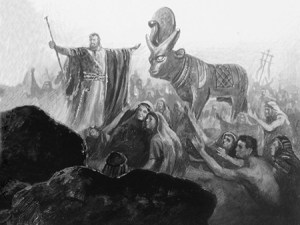
An Unruly Calf

golden-calf-israelites-worship-olsen_1299360_inlThis is what the Lord says: “A voice is heard in Ramah, mourning and great weeping, Rachel weeping for her children and refusing to be comforted, because they are no more.”   This is what the Lord says: “Restrain your voice from weeping and your eyes from tears, for your work will be rewarded,” declares the Lord . “They will return from the land of the enemy.   So there is hope for your descendants,” declares the Lord . “Your children will return to their own land.   “I have surely heard Ephraim’s moaning: ‘You disciplined me like an unruly calf, and I have been disciplined. Restore me, and I will return, because you are the Lord my God.   After I strayed, I repented; after I came to understand, I beat my breast. I was ashamed and humiliated because I bore the disgrace of my youth.’   Is not Ephraim my dear son, the child in whom I delight? Though I often speak against him, I still remember him. Therefore my heart yearns for him; I have great compassion for him,” declares the Lord . – Jeremiah 31:15-20
There is a whole lot of weeping going on here.  If we can agree that tears are samples of our souls then the people of Israel are baring their souls to God.  God responds to this weeping by saying “restrain your voice from weeping and your eyes from tears, for your work will be rewarded”.  I assume God means the work of returning to Him, but it is not very clear.

It is clear that it is in the returning “there is hope for your descendants”.  So in turning back to God they have found the hope they have been missing.  The people acknowledge that they have been disciplined.  Instead of being angry about it they are willing to admit that they were behaving “like an unruly calf”. I am no rancher and I really have no experience tending cows, but my impression of an unruly calf would be a large animal lacking coordination or purpose bent on hurting itself or others….hmmm not a bad description of the way the people have been behaving.  They have used their power and purpose to hurt themselves and others by following useless idols.

The people seem to get it in this passage when they say “Restore me, and I will return, because you are the Lord my God”.  The order still seems a bit muddled but they get that they need restoration and that restoration can ultimately only come from God.  Then they get the order right when they say “After I strayed, I repented; after I came to understand, I beat my breast”.

The order here is still a bit different than the New Testament.  The order of restoration described here seems to be 1) stray; 2) understand; 3) repent; 4) beat my breast; and 5) return.  A New Testament order of events, at least as I understand them, would be 1) stray ; 2) beat my breast; 3) return; 4) repent; and 5) understand.  The last item, understanding, is something that waxes and wanes throughout our journey in pursuit of God.

Despite their imperfect understanding God remembers and yearns for his people.  It is then up to us to remember and yearn for God with equal passion and pursuit.  In the end God does see us and believe in us and has compassion even for those who do not fully understand Him.

Prayer: Thank You God for loving us and remembering us even when we have a hard time remembering You.

Posted in Covenant, Discernment, Following God, Forgiveness, Free Will, Jeremiah, Obedience, reconciliation, Redemption, The Nature of God, Trusting God | Tagged , , , , , , | 6 Comments

New Wine After a Difficult Road

486443_10101096791328405_1102373657_n

This is what tghe Lord says: “Sing with joy for Jacob; shout for the foremost of the nations. Make your praises heard, and say, ‘ Lord , save your people, the remnant of Israel.’ See, I will bring them from the land of the north and gather them from the ends of the earth. Among them will be the blind and the lame, expectant mothers and women in labor; a great throng will return. They will come with weeping; they will pray as I bring them back. I will lead them beside streams of water on a level path where they will not stumble, because I am Israel’s father, and Ephraim is my firstborn son. “Hear the word of the Lord , you nations; proclaim it in distant coastlands: ‘He who scattered Israel will gather them and will watch over his flock like a shepherd.’ For the Lord will deliver Jacob and redeem them from the hand of those stronger than they. They will come and shout for joy on the heights of Zion; they will rejoice in the bounty of the Lord — the grain, the new wine and the olive oil, the young of the flocks and herds. They will be like a well-watered garden, and they will sorrow no more. Then young women will dance and be glad, young men and old as well. I will turn their mourning into gladness; I will give them comfort and joy instead of sorrow. I will satisfy the priests with abundance, and my people will be filled with my bounty,” declares the Lord . – Jeremiah 31:7-14

This is a very welcome return to the God of Grace with whom I am more familiar. I was getting a little depressed by the anger and consequences of the actions of the people of Judah and Jerusalem. God is caring for the remnant here, those who chose to return to Him. His care extends to those who return from exile in the north and those “from the ends of the earth”, which would include all of us “scraps of cloth” who currently follow God.

These people returning will be “damaged goods” — blind and lame, but God will accept them as they are when they return to Him. The people will be weeping and praying as they return to God. Their souls will be laid bare. In response, God will care for them as His people again. God will “lead them beside streams of water on a level path where they will not stumble.” This sounds very much like the quiet waters described back in the psalms (Psalm 23:1-6). The One who scattered the Shepherds will become the shepherd to his flock.

God will “deliver Jacob and redeem them from the hand of those stronger than they.” God will redeem His people, at least those who choose to return to Him. The remnant who returns will “rejoice in the bounty of the Lord — the grain, the new wine and the olive oil, the young of the flocks and herds.” God will make all things new and redeem His people. This sounds like a prophetic reference to the coming redeemer, Jesus. God is a God of new beginnings. He is willing to transform these stubborn, stiff-necked, flawed followers into “a well-watered garden, and they will sorrow no more.”

This passage is describing a “happy ending” for God’s people after the extreme sorrow and destruction up to this point. Apparently sometimes the road we must walk to arrive at our destination is really hard and confusing. I am sure the people of Israel were feeling very confused and lost at times. The key is keeping God at the center through difficult and good times. God wants to carry us like a son or daughter, but it seems He is unwilling to carry us when our arms are full of idols and we insist on being carried in our own way.

Prayer: God thank You for carrying us when time are hard. Help us to make Your load lighter by releasing the idols we hold on to so dearly.

Posted in Covenant, Discernment, Following God, Free Will, God's Love for Us, Jeremiah, Love for the Lost, Obedience, reconciliation, Redemption, The Nature of God, Trusting God | Tagged , , , , , , , | 6 Comments