Eddying Out – Choosing a Line

Patrick_salmon 175It has been a busy week of food, family, and friends.  In honor of this being my 160th post, and the fact that my Monday is looking kind of busy I decided this would be a good time to “eddy out”.

I am taking my daughter back to college today.  On the way she has an interview for an internship this summer that she is really excited about.  I also have an interview of sorts in the afternoon with a committee that reviews proposals for new study abroad programs for our university.  I have put forward a study abroad proposal for taking students to Haiti in 2016 that we will be discussing.  I am praying that both interviews will go well.

Times like this remind me of rafting a river.  When one is rafting you are always moving down the river, unless your have eddied out for a break.  As you move down river you are looking ahead trying to decide on the best “line” to take with your raft.  In serious white water (class 4+) this might mean trying to stay alive and in your boat, and in more gentle white water (class <3) it might mean finding the “line” that will be the most fun.  All these decisions must be made while in motion and there is no going back upstream to choose another line once you are committed.  Sometimes our life decisions feel like this, we have to pick a line and go with it.

Sometimes we pick a good line and all is well, and other times we pick a line that ends up flipping the boat.  I am hoping the line that I end up on after tomorrow is the one God needs me to follow.

Prayer: God help us to pick the “line” you need us to follow as we journey through the river that is our life.

Posted in Discernment, Eddying Out, Faith, Following God, Obedience | Tagged , , , , | Leave a comment

Forcing the Dew

Ahithophel said to Absalom, “I would choose twelve thousand men and set out tonight in pursuit of David. I would attack him while he is weary and weak. I would strike him with terror, and then all the people with him will flee. I would strike down only the king and bring all the people back to you. The death of the man you seek will mean the return of all; all the people will be unharmed.” This plan seemed good to Absalom and to all the elders of Israel.   But Absalom said, “Summon also Hushai the Arkite, so we can hear what he has to say as well.” When Hushai came to him, Absalom said, “Ahithophel has given this advice. Should we do what he says? If not, give us your opinion.”   Hushai replied to Absalom, “The advice Ahithophel has given is not good this time. You know your father and his men; they are fighters, and as fierce as a wild bear robbed of her cubs. Besides, your father is an experienced fighter; he will not spend the night with the troops. Even now, he is hidden in a cave or some other place. If he should attack your troops first, whoever hears about it will say, ‘There has been a slaughter among the troops who follow Absalom.’ Then even the bravest soldier, whose heart is like the heart of a lion, will melt with fear, for all Israel knows that your father is a fighter and that those with him are brave.   “So I advise you: Let all Israel, from Dan to Beersheba—as numerous as the sand on the seashore—be gathered to you, with you yourself leading them into battle. Then we will attack him wherever he may be found, and we will fall on him as dew settles on the ground. Neither he nor any of his men will be left alive. If he withdraws into a city, then all Israel will bring ropes to that city, and we will drag it down to the valley until not so much as a pebble is left.” – 2 Samuel 17:1-13

The intrigue runs deep and turbulent in this passage…plans within plans.  Ahithophel is the spy that David sent from the top of the Mount of Olives to be his eyes and ears in the house of his son Absalom.  Absalom, perhaps suspicious of Ahithophel, calls in two of his military leaders for advice.  They give an alternative plan that involves attacking David with help from other tribes so that they can “fall on him like dew settles on the ground”.

Dew is an interesting substance.  It is a physical manifestation of something in the air that we often cannot see (water vapor).  This sort of “godly condensate” has been used to describe God’s presence and the provision many times in my walk with water in the bible.  I do not ever remember it being used to describe a destructive force like the one in this passage.

Gideon used the presence or absence of dew to confirm that God would show up for him in his battle with the Midianites and others.  The Israelites were given Manna, bread from Heaven, that arrived on the dew.  God tells Joseph that He will bless the land with “precious dew from heaven“.  In all these cases the dew arrives and moves a bit like the spirit of God.  It is subtle, and seems to appear out of nowhere, to affect the lives of the people in the bible who are looking and listening carefully enough to see the “dew”.

In this instance the term dew has been commandeered by Absalom and his military leaders.  They are “forcing the dew” rather than letting God determine where His “dew from heaven” will fall.  In some ways David too is trying to “force the dew” by sending Ahithophel to spy on Absalom.  Lest we become smug, I believe that as Christians we sometimes try to “force the dew”.  This can take the form of pretend piety, legalistic liturgy, or alternate altars.  Sometimes it is really difficult to sense the spirit of God moving in our midst.  We are often looking for a more tangible God.  We miss what God’s spirit is trying to tell us and we get out ahead of God and his plans in the process.

Prayer: God give me the patience to wait on your spirit rather than “force the dew”.


Posted in 2 Samuel, Christianity, Conflict, Following God, religion, The Nature of God, The Spiritual Realm, Trusting God | Tagged , , , , , , | Leave a comment

Tears – Samples of our Souls?

But David continued up the Mount of Olives, weeping as he went; his head was covered and he was barefoot. All the people with him covered their heads too and were weeping as they went up. Now David had been told, “Ahithophel is among the conspirators with Absalom.” So David prayed, “ Lord , turn Ahithophel’s counsel into foolishness.”   When David arrived at the summit, where people used to worship God, Hushai the Arkite was there to meet him, his robe torn and dust on his head. David said to him, “If you go with me, you will be a burden to me. But if you return to the city and say to Absalom, ‘Your Majesty, I will be your servant; I was your father’s servant in the past, but now I will be your servant,’ then you can help me by frustrating Ahithophel’s advice. – 2 Samuel 15:30-34

David’s fairy tale life has transmogrified into a tragic tale of family conflict and dysfunction, and David’s lies and deceit have borne a bitter and prickly fruit.  Absalom, his son, has become the favored leader of the Israelites over David. David and his supporters have fled Jerusalem to the nearby Mount of Olives. They arrive at the summit, which is described as a place “where people used to worship God”. This is a telling detail. The Israelites have failed to remember God and all the ways He has cared for them. David has been leading them away from God rather than toward Him — he has failed the Meribah Test and is failing to lead while following God. David and his faithful followers are discouraged and weeping as they toil up the mountain.

I think their toil up the mountain is a metaphor for the way they perceive their lives at the moment. David’s rule seems at an end, people are chasing them, and they have little food or water. What David and the people fail to see is the God who sees them and wants to carry them up this mountain, and all the “mountains” in their lives.  A God who desires to carry them like a son or daughter. God wants them to trust Him rather than their own plans and schemes; but rather than falling on his knees David chooses to send a spy, Ahithopel, into Absalom’s house to keep track of what he is doing.

Weeping and tears have come up before in the bible, but I do not remember ever focusing on them for a post.  Since tears are mostly water I thought it would be worth some reflection. Tears as a moisturizer for our eyes make sense to me, but tears as a response to strong emotions are little more puzzling. Why tears? Why not sneezing or sweating?  Apparently humans are one of the only animals that sheds tears in response to emotions.

When I think of people crying I think of injuries, funerals, weddings, and unhappy young children. Young children cry because they do not have the words to express their needs, both physical and emotional. It occurs to me that adults sometimes cry for basically the same reason. At a funeral our souls are struggling to make sense of the loss of someone we love and the crossing over that has occurred. Our souls come face to face with the “spilling out” that was the focus of yesterday’s post.

It has been said that eyes are the window to the soul.  If that is true what meaning does that give to tears?  Are they samples of the state of our soul? Tears often seem like an outward manifestation of a soul in turmoil. They let us know when people are “soul sick”. This idea that our souls can be sick is intriguing and worthy of some further reflection. When our physical bodies are sick it can be traced to the invasion of our bodies by a foreign entity like bacteria or viruses, a malfunction of some critical system like our heart or liver, or a lack of food and/or water. I think our souls get “sick” for similar reasons, but within the spiritual realm rather than the physical realm.

David and his followers are clearly “soul sick”, but they seem to be avoiding the one who can heal their soul sickness, God.  I think that this can happen with us as Christians as well.  We can become “soul sick” through: 1) the influences of foreign entities like television, movies, or other people; 2) malfunction or dysfunction of parts of the body of Christ; and 3) cutting ourselves off from spiritual nourishment and the living water that God provides.

Prayer: God when our souls are sick help us to identify the cause, and remember that you are the true cure for our soul sickness.

Posted in 2 Samuel, Christian Community, Christian Leadership, Christianity, Death and Dying, Faith, Following God, Life Together, religion, The Earthly Realm, The Spiritual Realm | Tagged , , , , , , , , | Leave a comment

Spilled Water

OLYMPUS DIGITAL CAMERAThe king asked her, “What is troubling you?” She said, “I am a widow; my husband is dead. I your servant had two sons. They got into a fight with each other in the field, and no one was there to separate them. One struck the other and killed him. Now the whole clan has risen up against your servant; they say, ‘Hand over the one who struck his brother down, so that we may put him to death for the life of his brother whom he killed; then we will get rid of the heir as well.’ They would put out the only burning coal I have left, leaving my husband neither name nor descendant on the face of the earth.”   The king said to the woman, “Go home, and I will issue an order in your behalf.”   But the woman from Tekoa said to him, “Let my lord the king pardon me and my family, and let the king and his throne be without guilt.”   The king replied, “If anyone says anything to you, bring them to me, and they will not bother you again.”   She said, “Then let the king invoke the Lord his God to prevent the avenger of blood from adding to the destruction, so that my son will not be destroyed.” “As surely as the Lord lives,” he said, “not one hair of your son’s head will fall to the ground.”   Then the woman said, “Let your servant speak a word to my lord the king.” “Speak,” he replied.   The woman said, “Why then have you devised a thing like this against the people of God? When the king says this, does he not convict himself, for the king has not brought back his banished son? Like water spilled on the ground, which cannot be recovered, so we must die. But that is not what God desires; rather, he devises ways so that a banished person does not remain banished from him.   “And now I have come to say this to my lord the king because the people have made me afraid. Your servant thought, ‘I will speak to the king; perhaps he will grant his servant’s request. Perhaps the king will agree to deliver his servant from the hand of the man who is trying to cut off both me and my son from God’s inheritance.’   “And now your servant says, ‘May the word of my lord the king secure my inheritance, for my lord the king is like an angel of God in discerning good and evil. May the Lord your God be with you.’ ”   Then the king said to the woman, “Don’t keep from me the answer to what I am going to ask you.” “Let my lord the king speak,” the woman said.   The king asked, “Isn’t the hand of Joab with you in all this?” The woman answered, “As surely as you live, my lord the king, no one can turn to the right or to the left from anything my lord the king says. Yes, it was your servant Joab who instructed me to do this and who put all these words into the mouth of your servant. Your servant Joab did this to change the present situation. My lord has wisdom like that of an angel of God—he knows everything that happens in the land.”   The king said to Joab, “Very well, I will do it. Go, bring back the young man Absalom.” – 2 Samuel 14:5-21

This passage requires a little more context.  Absalom is David’s son who killed David’s other son Amnon because he had raped his sister Tamar.  Although this sounds like a Hollywood movie gone overboard to get an audience this is David’s family.  It is really messed up.  I have to conclude that his family dysfunction is part of the collateral damage from his very poor choices with Bathsheba and Uriah.  Joab is trying to deceive David into reconciling with Absalom by using the woman in this passage.  David ultimately sees through the thinly veiled story and realizes that she is talking about Absalom and that Joab put her up to it.  The messiness and dysfunction between David and Absalom will get worse in the future and I am sure I will have opportunity to reflect on this in later passages so let’s get back to the water reference in this passage.

I find the water imagery in this passage very intriguing…”Like water spilled on the ground, which cannot be recovered, so we must die”.  This concept and language was used back in 1 Samuel 7:2-6 when the Israelites were asked by God to turn back and pour out.  I think in that reference, and in this passage, God may be using water to refer to more than just H2O.

Humans seem somewhat obsessed with death and dying.  I explored some of this territory in a previous post about crossing over.  I suppose this is because there are so many mysteries surrounding it and it evokes such strong emotions in us.  I have been present at the deaths of my father, my mother, and my oldest brother.  Each of their deaths was different.  One thing all deaths have in common is that it is a one way trip.  Very few people come back from death, with a few rare exceptions like Jesus.  In this way the description here is very apt.  Once you pour water onto the ground it is very difficult to “un-pour” it and get it back into whatever container it came from.  In a sense this is like our souls, which are “poured out” of our bodies when we die.

As we grow older, and nearer the end of our earthly lives, it is natural to think more about what is to come.  It is easy to become preoccupied with death to the point where we fail to live.  I think this is where the water imagery in this passage is helpful.  God is likening death (and I think the lives leading up to our death) to water being spilled on the ground…..dust to dust…ashes to ashes.

It seems to me there are at least two ways one could look at this “spilling out” at the end of our lives.  One could see the statement as confirmation that everything in life is meaningless…a chasing after the wind.  What is the point of anything in life if in the end we are to be lost in a pile of dirt?  This would be close to my understanding of the view of existentialists.  I reject this perspective and interpretation of life and death.

The second option, which I favor, is the view that the transition from life to death described as “water spilled out” is when our souls are spilled out of our earthly containers, our physical bodies.  Our spirit then joins the ocean of the spiritual realm with God.  This final “pouring out” can be the culmination of a life of “pouring out” in which case there may not be much left to pour out.  Each time we love one another and faithfully follow God we are choosing to share part of our living water.  Considered in this way the final “spilling out” onto the ground at the end of our life could be very anticlimactic.  If we are pouring ourselves out our entire life…there might be little left to pour out onto the ground. This would be sort of like climbing up a mountain and at some point realizing you have already arrived at the top.

Prayer: God help us to be so preoccupied with pouring out our souls for You here on earth that we hardly notice when we reach the end of our earthly life.


Posted in 2 Samuel, Christianity, Covenant, Death and Dying, Faith, Following God, Love for the Lost, Redemption, The Earthly Realm, The Nature of God, The Spiritual Realm, Trusting God | Tagged , , , , , , | Leave a comment

Water Supply

P1000304Meanwhile Joab fought against Rabbah of the Ammonites and captured the royal citadel. Joab then sent messengers to David, saying, “I have fought against Rabbah and taken its water supply. Now muster the rest of the troops and besiege the city and capture it. Otherwise I will take the city, and it will be named after me.”   So David mustered the entire army and went to Rabbah, and attacked and captured it. David took the crown from their king’s head, and it was placed on his own head. It weighed a talent of gold, and it was set with precious stones. David took a great quantity of plunder from the city and brought out the people who were there, consigning them to labor with saws and with iron picks and axes, and he made them work at brickmaking. David did this to all the Ammonite towns. Then he and his entire army returned to Jerusalem. – 2 Samuel 12:26-31

Happy Thanksgiving! I considered taking a break from my walk with water for today, but I decided that I would push on and prepare this on “Thanksgiving Eve”.  The “waters” I have encountered on my walk through 2 Samuel have been been turbulent and challenging.  Thankfully this passage provides a respite from the family dysfunction of the house of David.  I was able to float right by several disturbing parts of 2 Samuel because they lacked references to water.

Since yesterday’s post about David and his son dying his family dysfunction has only grown.  Without going into details, there is incest, rape, and murder…all within David’s immediate family!  I will leave my reflections and rumination on this for a rabbit trail at some point in the future.

Today’s passage recounts Joab’s continuing “Clash of Clans” with the Ammonites.  Joab sends word of his success in battle by informing David that he had better come in a hurry otherwise the city may be named after Joab rather than David.  Joab indicates they have captured the “water supply”.  In the desert this is tantamount to saying “the city is ours” — without water desert people can only survive for a short time.  It is not clear from this passage what the water supply was for the city of Rabbah.  Apparently Rabbah is close to the modern city of Amman, Jordan.

David shows up with his men and takes the crown, and credit, for the victory.  No mention of God or His part in the victory.  David claims several towns and proceeds to enslave the inhabitants in a manner reminiscent of pharaoh when the Israelites were in Egypt — hardly someone to emulate.  His actions perpetuate the cycle of retribution and conflict which characterize this time and place.  This region is rife with conflict even today. Why does this part of the world seem to breed conflicts.  They seem to occur in this area like thunderstorms on a hot and muggy afternoon.

David and Joab are busy conquering, killing, and securing “water supplies” — they seem to have forgotten the greatest water supply of all, God, the great cistern.  Only God can provide a constant and consistent supply of living water to quench our thirsty souls.

Prayer: God thank You for the supply of living water you provide for us to quench our thirsty souls.


Posted in 2 Samuel, Conflict, Obedience | Tagged , , , , , , | Leave a comment

Washed for Worship?

After Nathan had gone home, the Lord struck the child that Uriah’s wife had borne to David, and he became ill. David pleaded with God for the child. He fasted and spent the nights lying in sackcloth on the ground. The elders of his household stood beside him to get him up from the ground, but he refused, and he would not eat any food with them.   On the seventh day the child died. David’s attendants were afraid to tell him that the child was dead, for they thought, “While the child was still living, he wouldn’t listen to us when we spoke to him. How can we now tell him the child is dead? He may do something desperate.”   David noticed that his attendants were whispering among themselves, and he realized the child was dead. “Is the child dead?” he asked. “Yes,” they replied, “he is dead.”   Then David got up from the ground. After he had washed, put on lotions and changed his clothes, he went into the house of the Lord and worshiped. Then he went to his own house, and at his request they served him food, and he ate.   His attendants asked him, “Why are you acting this way? While the child was alive, you fasted and wept, but now that the child is dead, you get up and eat!”   He answered, “While the child was still alive, I fasted and wept. I thought, ‘Who knows? The Lord may be gracious to me and let the child live.’ But now that he is dead, why should I go on fasting? Can I bring him back again? I will go to him, but he will not return to me.”   Then David comforted his wife Bathsheba, and he went to her and made love to her. She gave birth to a son, and they named him Solomon. The Lord loved him; and because the Lord loved him, he sent word through Nathan the prophet to name him Jedidiah. – 2 Samuel 12:15-25

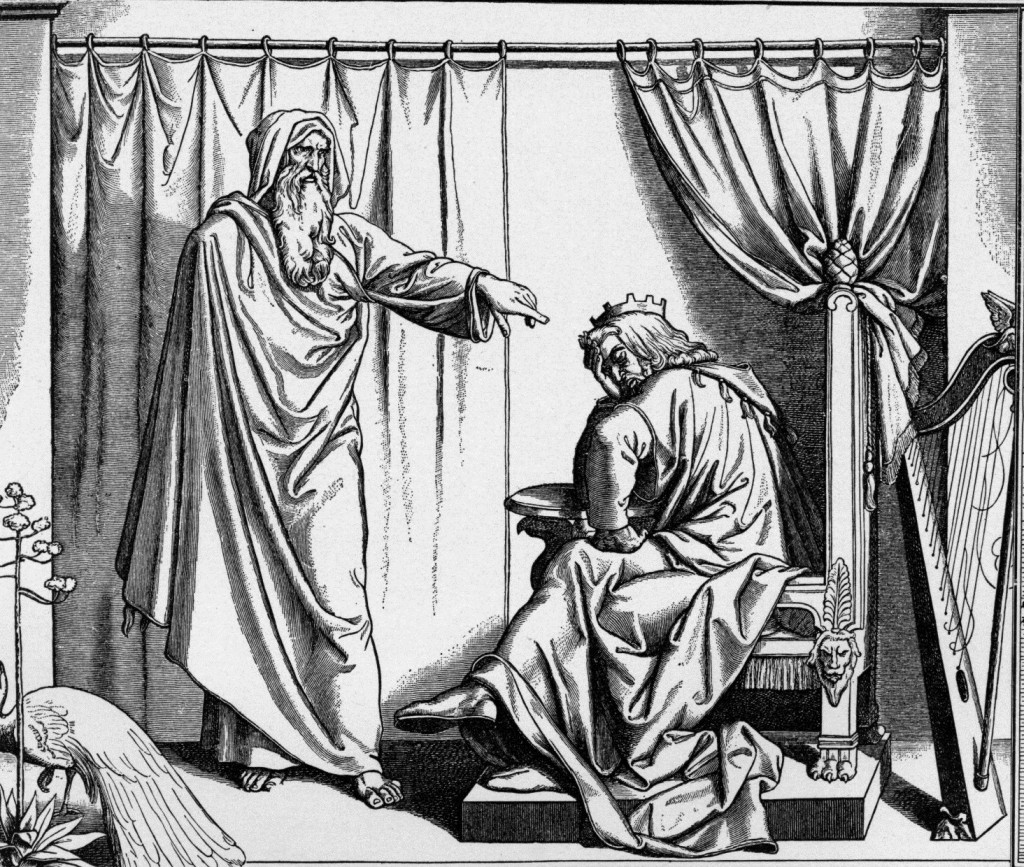
In this verse we see David experiencing the consequences of his sin and the cover up he created with his power as King.  Nathan was sent by God to call David to account for his actions.  God does this through Nathan when he shares a very moving story about a rich man who takes something that does not belong to him — a cherished sheep owned by a poor man.  David is outraged at the wickedness of the rich man in the story then Nathan drops the hammer…. he tells David “you are that man !” David took Uriah’s cherished possession and Uriah’s life to take something that did not belong to him and was not meant for him.  This choice will continue to ripple through David’s life and family for generations.

Nathan informs David that because he showed “utter contempt” for the Lord, God was going to give his wives to others and take the son he fathered with Bathsheba. After his son dies David seems to be repentant and realizes he needs to be washed clean before entering God’s presence to worship.  Over the last several chapters of 2 Samuel David had gotten rather deaf and blind to the leading of God.  It took the death of his son to get his attention.  Unfortunately I am not sure that David is truly getting it.  God wants all of who David is, but He also wants David to allow himself to be “fixed”.  I am not sure that David is doing that at the moment.

The idea of being forgiven for sins and being washed clean is a little more explicit here than in previous discussions of being clean or ceremonially clean.  This is a foreshadowing of the cleansing water of baptism and the forgiveness of sins through Jesus, the living water.  David seems somewhat repentant, but it is not until he and Bathsheba have another another son that he seems to “snap out of it”.  Interestingly, they name the son Solomon, which means peace.  God communicates through Nathan that He wants his name to be Jedidiah, which means “beloved of God”.  God wants to rebuild a relationship with David based on God loving David and David loving God.  I think David is still thinking in terms of a successor for his Kingdom and peace.

God sent a major flood, or rain storm, into David’s life to get his attention and to wake him from his power-induced trance. God’s rain was only partially effective. There was significant “collateral damage” from David’s sin and his efforts to cover it up. Part of me bristles at the idea that God would punish David, and more importantly his wife and son, in this way.  Part of me also feels God’s punishment did not go far enough for such horrendous acts that David did to Uriah and his wife. I guess this is part of God’s spiritual cycle that is sometimes difficult to understand from our earthly perspective.

David is intermittently willing to admit he is broken (has sinned), but he is not always willing to let God do the fixing on His terms. It is hard to trust God enough to let Him do the fixing. Why is it so hard to trust God when we know he loves us? I think it comes down to our desire to control our lives trumping our love for God.  We want to be watered on our own terms, rather than accept the rain on tender plants that God provides.

There is a song called “Hold me Jesus” by Rich Mullins that seems appropriate here.  It is one of my favorite songs.  Here is the chorus:

Surrender don’t come natural to me 
I’d rather fight You for something 
I don’t really want 
Than to take what You give that I need 
And I’ve beat my head against so many walls 
Now I’m falling down, I’m falling on my knees
 

David is beating his head against walls in his efforts to fix himself.  I know I am guilty of doing the same thing at times.  It is difficult to let go, and let God.

Prayer: God I confess that surrender does not come natural to me.  Help me to hunger and thirst for a restored relationship with You.

 SDG
Posted in 2 Samuel, Christianity, Conflict, Covenant, Discernment, Discipleship, Faith, Following God, Forgiveness, Sin, The Spiritual Realm, Trusting God | Tagged , , , , , , , , | Leave a comment

View from the Top

In the spring, at the time when kings go off to war, David sent Joab out with the king’s men and the whole Israelite army. They destroyed the Ammonites and besieged Rabbah. But David remained in Jerusalem.   One evening David got up from his bed and walked around on the roof of the palace. From the roof he saw a woman bathing. The woman was very beautiful, and David sent someone to find out about her. The man said, “She is Bathsheba, the daughter of Eliam and the wife of Uriah the Hittite.” Then David sent messengers to get her. She came to him, and he slept with her. (Now she was purifying herself from her monthly uncleanness.) Then she went back home. The woman conceived and sent word to David, saying, “I am pregnant.”   So David sent this word to Joab: “Send me Uriah the Hittite.” And Joab sent him to David. When Uriah came to him, David asked him how Joab was, how the soldiers were and how the war was going. Then David said to Uriah, “Go down to your house and wash your feet.” So Uriah left the palace, and a gift from the king was sent after him. But Uriah slept at the entrance to the palace with all his master’s servants and did not go down to his house.   David was told, “Uriah did not go home.” So he asked Uriah, “Haven’t you just come from a military campaign? Why didn’t you go home?”   Uriah said to David, “The ark and Israel and Judah are staying in tents, and my commander Joab and my lord’s men are camped in the open country. How could I go to my house to eat and drink and make love to my wife? As surely as you live, I will not do such a thing!”   Then David said to him, “Stay here one more day, and tomorrow I will send you back.” So Uriah remained in Jerusalem that day and the next. At David’s invitation, he ate and drank with him, and David made him drunk. But in the evening Uriah went out to sleep on his mat among his master’s servants; he did not go home.   In the morning David wrote a letter to Joab and sent it with Uriah. In it he wrote, “Put Uriah out in front where the fighting is fiercest. Then withdraw from him so he will be struck down and die.”   So while Joab had the city under siege, he put Uriah at a place where he knew the strongest defenders were. When the men of the city came out and fought against Joab, some of the men in David’s army fell; moreover, Uriah the Hittite died. – 2 Samuel 11:1-17

This passage begins like a fairy tale and ends like a nightmare.  “In the spring, at the time when kings go off to war…”  It makes it sound like a very regular occurrence like – spring training for a baseball team or something.  Clearly the view of war was different back then, more like a past time than an all consuming conflagration like our world wars.  I knew this story was coming and to be honest I have been dreading it.  My opinion of David falls so far so fast.

David sees a beautiful woman, Bathsheba, bathing from his rooftop.  He becomes inflamed with lust for her and begins a series of very bad choices. David abuses his high position in two ways. First David takes advantage of his position on the rooftop of the palace to see into the courtyards and lives of those “below” him. If this happened in another context we might call David a “peeping tom”.  He also took advantage of his high position as king, given to him by God, to sleep with Bathsheba and she ends up pregnant. Not a good day for the house of David.

In trying to cover up the fact that he had gotten Bathsheba pregnant David compounded his sin.  He brings Uriah back from the wars and tries to convince Uriah, an honest and loyal man, to do something that he felt honor-bound not to do. Uriah did not want to partake of a privilege that the soldiers under him could not partake of, namely to sleep with his wife at home. The irony here is quite striking…Uriah the honorable honest man unwilling to dishonor himself by sleeping with his wife; and David a deceitful and dishonorable man who sleeps with Uriah’s wife because he can.  God will still use David even though he has clearly demonstrated that he is a flawed follower.

There are several cultural things going on here that I do not pretend to understand, and David is unquestionably one of the bible’s perplexing people. The first is the polygamous palace life. David, and apparently other wealthy and powerful men of his day, had multiple wives and concubines. Women seem to be treated like trophies or commodities – a status symbol like the number of garages your house has. I am somewhat appalled by this treatment of women, but there are men who treat women in a similar manner today.  Our culture does not do a good job of honoring women.

The Clippers owner Donald Sterling comes to mind. He used his wealth and power to be with beautiful young women openly while he was still married.  Very few people even mentioned this when the scandal surrounding his racist remarks arose. I am sure his illicit relationships ended up costing him, but I suspect he has enough money that it will not make him a pauper.

The current rape scandal swirling around Bill Cosby makes me feel sick to my stomach. If even a smidgen of what he is accused of doing is true he has done things that were very wrong and hurt others by trying to cover it up. David was clearly abusing his power as king to satisfy his selfish needs. Based on the accounts coming out about Bill Cosby it sounds like he also abused his power to satisfy his selfish needs when young women came to him for advice and guidance.

God made us sexual beings, so how come this aspect of our lives is so often messed up. The sexual revolution promised freedom and the end of “repression” and yet sexual sin seems even more rampant than in the past.  Sexual sin seems to have a unique ability to ensnare otherwise faithful followers. I guess it is not so different from other flaws that God is able to hammer and shape out of us, if we let Him, but this particular flaw has the ability to wreak generations of havoc on our relationships. Clearly David changed the trajectory of Uriah’s family through his poor choices.  How many people you know who have been impacted by someone’s poor choices in the area of sexual sin?

Prayer: God help us to keep sex in a proper perspective and within the context you have provided.

Posted in 2 Samuel, Christianity, Conflict, Following God, religion, Sin | Tagged , , , , , , , , , | Leave a comment

Crossing Over to Kill

Play-Clash-of-ClansJoab saw that there were battle lines in front of him and behind him; so he selected some of the best troops in Israel and deployed them against the Arameans. He put the rest of the men under the command of Abishai his brother and deployed them against the Ammonites. Joab said, “If the Arameans are too strong for me, then you are to come to my rescue; but if the Ammonites are too strong for you, then I will come to rescue you. Be strong, and let us fight bravely for our people and the cities of our God. The Lord will do what is good in his sight.”   Then Joab and the troops with him advanced to fight the Arameans, and they fled before him. When the Ammonites realized that the Arameans were fleeing, they fled before Abishai and went inside the city. So Joab returned from fighting the Ammonites and came to Jerusalem.   After the Arameans saw that they had been routed by Israel, they regrouped. Hadadezer had Arameans brought from beyond the Euphrates River; they went to Helam, with Shobak the commander of Hadadezer’s army leading them.   When David was told of this, he gathered all Israel, crossed the Jordan and went to Helam. The Arameans formed their battle lines to meet David and fought against him. But they fled before Israel, and David killed seven hundred of their charioteers and forty thousand of their foot soldiers. He also struck down Shobak the commander of their army, and he died there. When all the kings who were vassals of Hadadezer saw that they had been routed by Israel, they made peace with the Israelites and became subject to them. So the Arameans were afraid to help the Ammonites anymore. – 2 Samuel 10:9-19

This passage contains a continuation of the clan wars and killing that has been so prevalent in 2 Samuel.  There seems to be a perpetual tit for tat with one people chasing another and seeking retribution for past wrongs.  The original crossing over of the Jordan River was to take possession of the Promised Land that God provided the Israelites. This crossing over is for a very different reason.  In this case it is to chase down an enemy and kill them.

Joab acknowledges God’s role in whether they win or lose. I think this is good, although I am still not convinced that God takes sides in every conflict. David’s men crossed over the Jordan River without the direct intervention of God like the Israelites experienced when the waters of the Jordan were “held up“.  It is not clear whether God is really going ahead of them or not — maybe they are getting out ahead of God again.

I have a confession to make.  My nephew got me hooked on a computer game called Clash of Clans last summer.  It is a simulation game where you build and fortify your “village” against on-line marauders who come and attack your village while you are away.  If you are feeling vengeful you can even attack them back to get revenge.  You can even form virtual clans and go to war with other clans.  I am currently a member of my nephew’s “clan” which for a time definitely contributed to my “cool uncle” coefficient.

I don’t mean to be flippant about this story, but the clans chasing each other about and killing one another feels like a bunch of boys playing a game…albeit a game with deadly consequences.  Perhaps I am not tuned into the cultural context of the time and place, but it feels like a lot of time, effort, and lives are being spent on fighting each other that could be spent in better ways.  I find it interesting that when Jesus came he did so as a God who serves rather than a military leader.  Perhaps David and his men have gotten so accustomed to resolving conflict with clan warfare that they have forgotten how to love each other as God loves  them.

Prayer: God help us to learn how to resolve conflict with love rather than violence.


Posted in 2 Samuel, Conflict, Following God, Life Together, Obedience, reconciliation, Trusting God | Tagged , , , , , , , , , | Leave a comment

Eddying Out – Sea Legs

IMG095Yesterday marked the five month anniversary of the beginning of my journey walking on water with God and the bible.  It has been an amazing journey with good days, bad days, hard days, and frustrating days.  I thought this would be a good time to Eddy Out and muse a little.

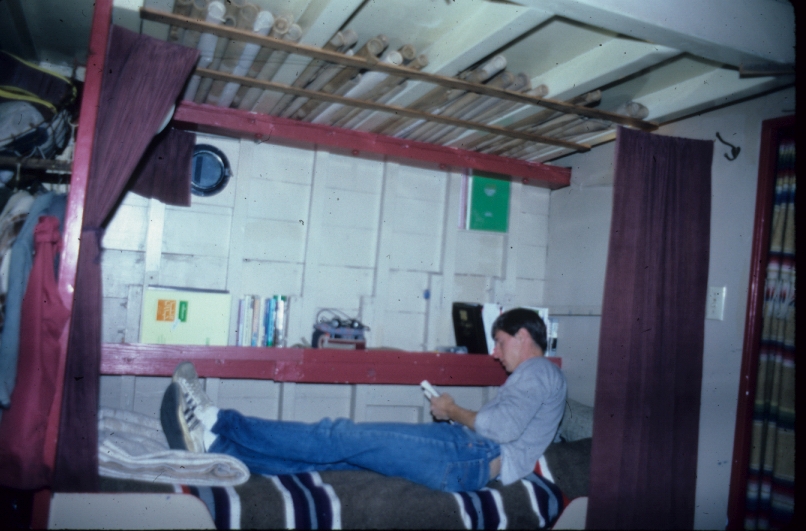
When I was a junior in college I had the good fortune to work in southeast Alaska.  I was hired as a deckhand/geologist on a mineral collecting charter boat called the M/V Hyak.  It was a stately old wooden boat called a Liberty Launch.  The wood and steel required a lot of maintenance which was my job when we were not hunting for minerals.  I scraped a lot of paint that summer, but I also got to see some of the most beautiful and untouched wild areas I have ever seen.

I only spent a couple of months living and sleeping on the boat, but something interesting IMG053happened after the first couple weeks or so.  The land began to feel like the strange place and being on the water felt normal.  I guess this is where the expression “sea legs” came from.  I always thought this mainly referred to getting sea sick and one’s body getting used to the rolling and pitching of the boat, but after my experience in Alaska I think it has deeper meanings.

I feel somewhat similar about my walk with water in the bible.  I can honestly say that after the first couple of weeks of spending time daily reflecting about God and what He was trying to tell me through water and the bible this felt normal — and not doing so felt strange.  I had become accustomed to the “water” that was the daily wondering and wandering with God.  Don’t get me wrong I still feel frustrated and challenged sometimes — when I see the waves instead of the face of Jesus leading me on.  God is also teaching me about humility and how to maintain a proper posture toward Him and other people.

I had an experience in southeast Alaska that I remember like it was yesterday.  I had been on the boat for about a month and I was getting pretty familiar with reading nautical charts, tying knots, and the general skills of living on and running a boat.  My boss decided I was ready to pilot the boat on my own one day.  He was below deck and I was alone in the wheelhouse navigating through the islands of southeast Alaska.  I admit I had gotten a little cocky about my boat skills and I thought I was the master of my destiny.

IMG015I was motoring happily along thinking I knew where we were on the chart when I looked off the bow of the boat and saw a small island that was not where it should have been — or the boat was not where I thought it was on the chart.  Since large rocky islands rarely move I had to conclude that the boat was in fact not where I thought it was on the chart and it was in fact in a very different place full of shallow rocks and shoals.  After I slowed the boat down and pulled my heart out of my throat I carefully navigated back into a safer channel.  I was truly humbled by this experience and it taught me to allow room for being wrong.

I am pretty sure that as I reflect and write about the bible there are things I am getting wrong, but I think that is OK.  God did not call us to be perfect….He calls us to be persistent, and faithfully follow Him.

Prayer: God thank you for meeting me each day and helping me gain my “sea legs” while I learn how to walk on water.

Posted in Eddying Out, Faith, Following God, Obedience, religion, The Nature of God, Trusting God | Tagged , , , , , , , | Leave a comment

Waters Break Out

IMGP1427

When the Philistines heard that David had been anointed king over Israel, they went up in full force to search for him, but David heard about it and went down to the stronghold. Now the Philistines had come and spread out in the Valley of Rephaim; so David inquired of the Lord , “Shall I go and attack the Philistines? Will you deliver them into my hands?” The Lord answered him, “Go, for I will surely deliver the Philistines into your hands.” So David went to Baal Perazim, and there he defeated them. He said, “As waters break out, the Lord has broken out against my enemies before me.” So that place was called Baal Perazim. The Philistines abandoned their idols there, and David and his men carried them off. – 2 Samuel 5:17-21

When I was in elementary school we had a forested area to roam in during our recess times. Recess for me was a wondrous break from the confines of the classroom. I was a little ADHD when I was a kid…OK I still am a bit ADHD but I have learned to cope. My mother used to tell a story about my first grade teacher’s frustration at this little bundle of activity in her classroom that would stand on his head during story time….I have no idea who she was talking about….but I was always more comfortable listening upside down.

Anyway the playground was a bastion for busy little beavers and we did our best, with the 30 minutes we had during recess, to dominate and transform our world. This included creating epic dams across a drainage ditch that traversed the playground made of rocks, sticks, clumps of grass, and leaves. Some of these dams were taller than we were, which was not that tall, but probably over three feet. The highlight was when the bell rang and we got to “free the river” and watch the havoc we could cause by letting the “waters break out”.

I am pretty sure this is not what David had in mind when he used this phrase to describe God. So what did he mean and what does it tell us about God’s nature? I do not recall this particular language being used to describe God up to this point in the bible. Water breaking out could have many levels of meaning, but anyone who has ever tried to dam up water knows that it has a way of finding the weaknesses in any structure. Water with enough force can even cause concrete to corrode and break apart.

David was clearly paying God a complement when he described Him “breaking out like water” — uncontrollable – in a good way. At this point in time David really seems to get it. God is God and we are not. We can attempt to build all the dams and diversions we want but they will not contain God if He chooses to break out like water. This is both humbling and horrifying.

One approach to staying out of God’s way is to try to ignore Him altogether. This is the path that atheists have chosen. This can work for a time, but one day even atheists can find themselves careening down a river impossible to ignore. Another approach is to acknowledge God’s existence but run like heck at the first sight of high water. This is the path that agnostics have chosen, and the path I chose for a time in college. The tricky thing about running from God, or water, is that we do not always know which way to run. God always seems to find a way to break through our stubborn skin of sophistry.

Another path is that chosen by David and Christ followers, which is to acknowledge God’s power and do our best to work with the “Mighty River” rather than against Him. Allow His Holy Spirit to shape our souls like islands sculpted by a glacier.

Prayer: God may we celebrate when your waters break forth in our lives rather than run from, or ignore, them.

Posted in 2 Samuel, Christianity, Faith, Following God, The Nature of God, Trusting God | Tagged , , , , , , , , | Leave a comment