Running the Same River

On hearing this, David sent Joab out with the entire army of fighting men. The Ammonites came out and drew up in battle formation at the entrance to their city, while the kings who had come were by themselves in the open country.   Joab saw that there were battle lines in front of him and behind him; so he selected some of the best troops in Israel and deployed them against the Arameans. He put the rest of the men under the command of Abishai his brother, and they were deployed against the Ammonites. Joab said, “If the Arameans are too strong for me, then you are to rescue me; but if the Ammonites are too strong for you, then I will rescue you. Be strong, and let us fight bravely for our people and the cities of our God. The Lord will do what is good in his sight.”   Then Joab and the troops with him advanced to fight the Arameans, and they fled before him. When the Ammonites realized that the Arameans were fleeing, they too fled before his brother Abishai and went inside the city. So Joab went back to Jerusalem.   After the Arameans saw that they had been routed by Israel, they sent messengers and had Arameans brought from beyond the Euphrates River, with Shophak the commander of Hadadezer’s army leading them.   When David was told of this, he gathered all Israel and crossed the Jordan; he advanced against them and formed his battle lines opposite them. David formed his lines to meet the Arameans in battle, and they fought against him. But they fled before Israel, and David killed seven thousand of their charioteers and forty thousand of their foot soldiers. He also killed Shophak the commander of their army.   When the vassals of Hadadezer saw that they had been routed by Israel, they made peace with David and became subject to him. So the Arameans were not willing to help the Ammonites anymore. – 1 Chronicles 19:8-19

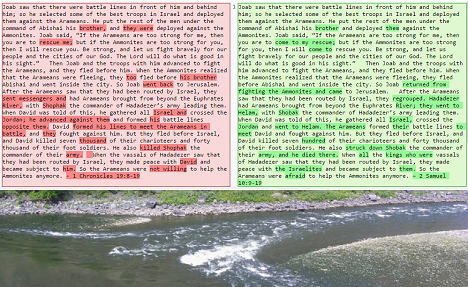
This passage is another retelling of an account that first occurs in the book of 2 Samuel 10:9-19 where it was the subject of a post called “crossing over to kill“.  The accounts in this case are so similar that I had to use an on-line program to compare the texts.  that is shown in the graphic at the top of the post.

The only real difference is a numerical difference in the number of charioteers that David killed.  In Samuel the number is 700 and in 1 Chronicles the number is 7,000.  I suppose this could have been a transcription error, but the similarity between the passages definitely points to either 1) a common source for both accounts; or 2) the author of 1 Chronicles was using 2 Samuel as a source for this account.

I thought there might be more differences, given the author of 1 Chronicles is thought to have been a priest, but there seems to be synoptic parallelism that I thought was confined to the synoptic gospels.

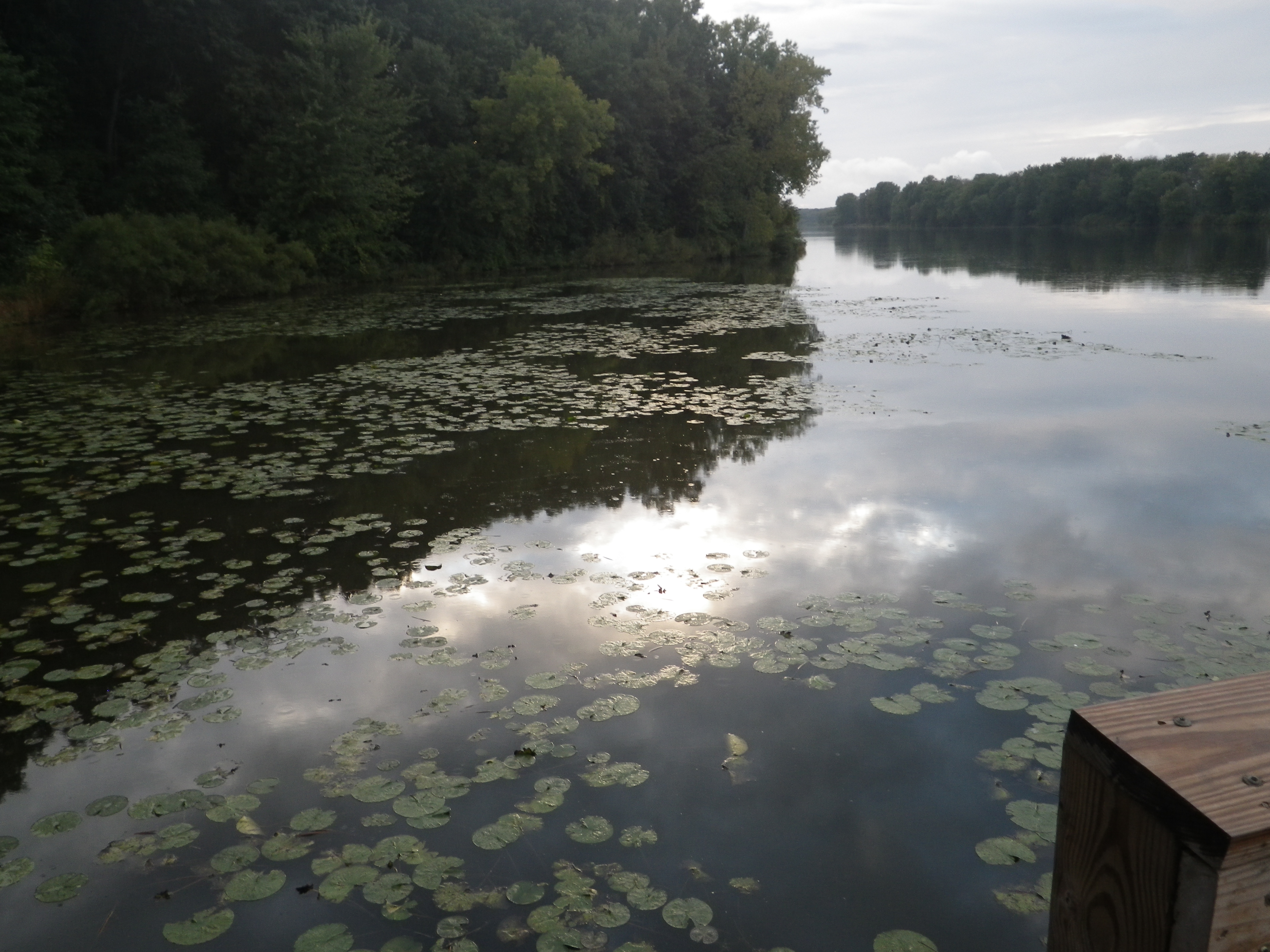
I guess this is a bit like running the same stretch of river, it may look the same but the water is never the same.  Our Christian journey can be like that…we go to the same church, see the same people, and have the same traditions…but the living water is not the same no matter how much we feel like we are “running the same stretch of river”.

Prayer: God help us to make each day a new stretch of river even when it feels like the same river. 

Posted in 1 Chronicles, Conflict, Covenant, Death and Dying, Faith, religion | Tagged , , , , , | Leave a comment

Let the Sea Resound

This gallery contains 4 photos.

Declare his glory among the nations, his marvelous deeds among all peoples.   For great is the Lord and most worthy of praise; he is to be feared above all gods.   For all the gods of the nations are idols, but … Continue reading

More Galleries | Tagged , , , , , , | Leave a comment

Things Left Out

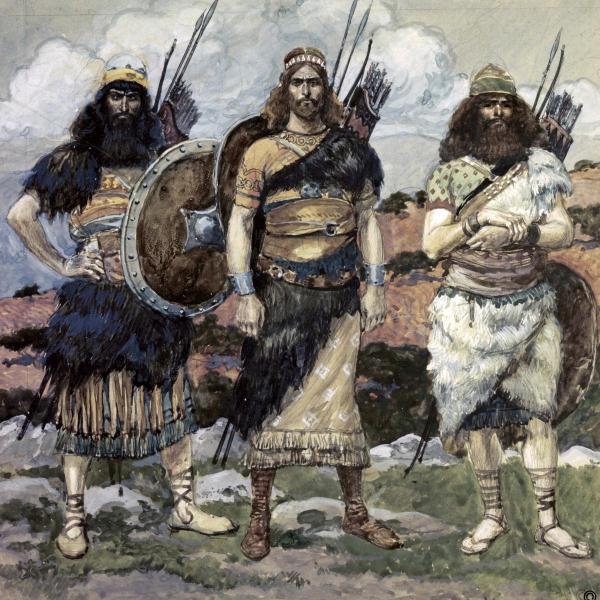
Men of David by James Tissot http://render.globalgallery.com/

Men of David by James Tissot http://render.globalgallery.com/

Three of the thirty chiefs came down to David to the rock at the cave of Adullam, while a band of Philistines was encamped in the Valley of Rephaim. At that time David was in the stronghold, and the Philistine garrison was at Bethlehem. David longed for water and said, “Oh, that someone would get me a drink of water from the well near the gate of Bethlehem!” So the Three broke through the Philistine lines, drew water from the well near the gate of Bethlehem and carried it back to David. But he refused to drink it; instead, he poured it out to the Lord . “God forbid that I should do this!” he said. “Should I drink the blood of these men who went at the risk of their lives?” Because they risked their lives to bring it back, David would not drink it. Such were the exploits of the three mighty warriors. – 1 Chronicles 11:15-19

Well my walk with water in the bible has brought me to the book of 1 Chronicles. I admit I have never really spent much time reading Chronicles and I am going into this feeling like it will be a slog….sort of like I felt entering the book of Leviticus.  I do not know much about the book so I did a little research and there are many things that are still not known about the book and it’s author.  It seems there is general agreement that this is an attempt to circle back and recount stories already told in the previous books of the bible, and it is likely written by a priest — maybe Ezra.

The Greek version of the Hebrew Bible (the Septuagint) calls this book “Things Left Out”.  This could be taken two ways…it could mean that things were left out of this book which were included in other biblical accounts, or it could mean that this book contains things not included (left out) in other accounts.

Based on what I have read so far both meanings seem to apply.  The first 10 chapters or so were a detailed account of lineages and lists of groups of people which were not provided in other accounts which describe the same time period (they were left out).  I have to confess that I skimmed these chapters as they did not seem relevant to my journey seeking water references in the bible.

This verse is the first one I came upon which contained a water reference.  It is a retelling of a story from the book of 2 Samuel 23:13-17 which I reflected on in a previous post on December 10, 2014 called “well” intentioned.  Since these are essentially the same story I thought it would be interesting to reflect on any differences in the accounts or my understanding of it since I reflected on it before.

The stories are almost identical in all details with the exception of a few minor word differences when the three mighty warriors return with the water and David pours it out.  In the 2 Samuel account David says “Far be it from me, Lord , to do this!”and in this account he says “God forbid that I should do this!”.  I am not sure there is a real difference except perhaps in the posture and perspective of the author.  In the first response the focus is David, and in the second it is on God and what he does or does not forbid.

One of the things “left out” of the 1 Chronicles account of David so far, and the accounts of the earlier leaders, is the details that help us understand that these leaders had flaws (i.e. King David with Bathsheba and Uriah) — they were all flawed followers just like me.  I think the earlier accounts which have not been “scrubbed” are more meaningful and “real” to me.  None of us is perfect and pretending to be does not bring us closer to God — we are not fooling Him.

Prayer: God help us to boldly share our life stories with others, including the ways that you are still working to make us more like You. 

Posted in 1 Chronicles, Christianity, Faith, Following God, Forgiveness, God's Love for Us, Love for the Lost, Obedience, Sin, The Nature of God, Trusting God | Tagged , , , , , , , | Leave a comment

Eddying Out – Beaches

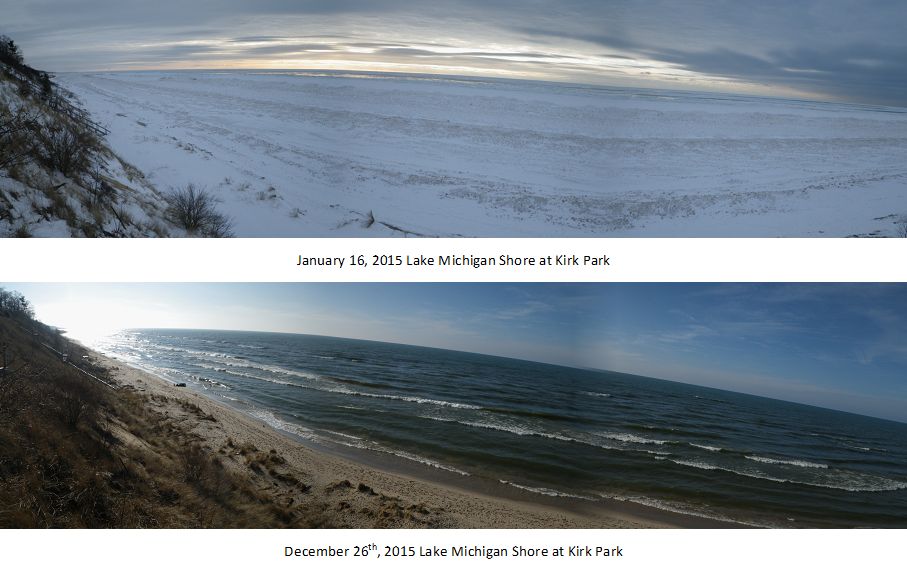
Lake Michigan Freeze Up 2014-2015Yesterday’s post marked the end of the book of 2 Kings so I thought this would be a good time to “eddy out” and reflect on 2 Kings and the tumultuous times it describes.  As I have prayed and reflected on the book of 2 Kings I have been trying to think of a water analogy that captures the series of Kings and the dysfunctional relationship between God and the Israelites during this time.

The best analogy I have been able to come up with is a beach.  Beaches are places where water meets the land either at the ocean or at a lake, like Lake Michigan where I live.  I think in some ways the “meeting” place between us and God is like this.  In a spiritual sense we look out upon the vast ocean of God’s kingdom and the spiritual realm from the “spiritual land” where our soul dwells — our bodies.  When we seek and pursue God we are “getting in the water” so to speak.  Sometimes we are only confident enough to dip our toes in the water,and other times, when our faith has grown strong enough, we have the confidence to rush into the waves.

I have seen days when Lake Michigan has hardly a ripple or a wave.  The meeting place between the land and the water is a peaceful and tranquil place.  On a warm late summer day one could easily wade out into the warm water and enjoy it’s refreshing coolness.  Then there are other days where the beach is a wild and scary place where it would seem that the rip currents would drown us if we entered the water.  In my journey as a Christian I have experienced God as both  tranquil waters and raucous waves.  The challenge is maintaining the same posture toward God in all kinds of “seas”.

During the time of 2 Kings the “meeting place” between God and the people was a stormy and tumultuous place.  The people erected all sorts of “artificial structures” similar to jetties and sea walls, in the form of idols and altars, to try to control the raw fury of a jealous God.  God sent many “lifeguards”, his prophets, to help the people navigate what they perceived as dangerous waters that threatened to drown them.  Many of the lifeguards were “drowned” trying to rescue the very people they were trying to save.

The Israelites were ill-served by the leadership of most of their kings.  These kings were not leading by following and most failed the “Meribah Test” miserably.  What they really needed was a savior who could walk on water and teach them how to do it too, but alas His time was many years down the road for them.  The Israelites will have to continue their “swimming lessons” for some time before they are given the choice of being a sailor or finding a savior.

Prayer: God thank You for sending Jesus to teach us how to swim and navigate the turbulent spiritual waters so that we can leave the beach — with His help — and walk on water.

Posted in Christian Leadership, Christianity, Covenant, Discernment, Discipleship, Eddying Out, Faith, Following God, God's Love for Us, Obedience, religion, The Earthly Realm, The Nature of God, The Spiritual Realm, Trusting God | Tagged , , , , , , , , , | Leave a comment

Hezekiah’s Crossing Over

Then Isaiah said to Hezekiah, “Hear the word of the Lord: The time will surely come when everything in your palace, and all that your predecessors have stored up until this day, will be carried off to Babylon. Nothing will be left, says the Lord. And some of your descendants, your own flesh and blood who will be born to you, will be taken away, and they will become eunuchs in the palace of the king of Babylon.”The word of the Lord you have spoken is good,” Hezekiah replied. For he thought, “Will there not be peace and security in my lifetime?” As for the other events of Hezekiah’s reign, all his achievements and how he made the pool and the tunnel by which he brought water into the city, are they not written in the book of the annals of the kings of Judah? Hezekiah rested with his ancestors. And Manasseh his son succeeded him as king. 2 Kings 20:16-21

Here at the end of Hezekiah’s life the end gets a little strange.  Just prior to this passage Hezekiah took representatives from Babylon on a tour of his palace and treasures.  I am not sure why Hezekiah felt the need to do this, but one of the results seems to be that the Babylonians will return and pillage Jerusalem.

What is really weird is Hezekiah’s response when Isaiah shares the word of the Lord….that everything will be carried away to Babylon and even his own descendants will become “eunuchs in the palace of the king of Babylon”.  Hezekiah, seemingly oblivious to what Isaiah just told him responds that the word is good.  It certainly does not sound so good to me, but perhaps I am unable to put myself in Hezekiah’s place.

It seems that Hezekiah values “peace and security within his lifetime” more than he values everything in the palace and even his own descendants.  I admit I am confused.  Why would this man of God, who has boldly held steadfast in the face of armies and kings, now essentially “throw in the towel”.  This is certainly one strange “crossing over“.

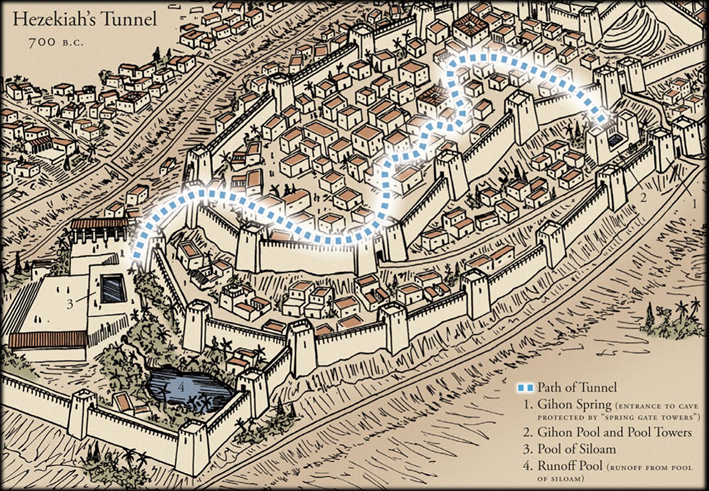
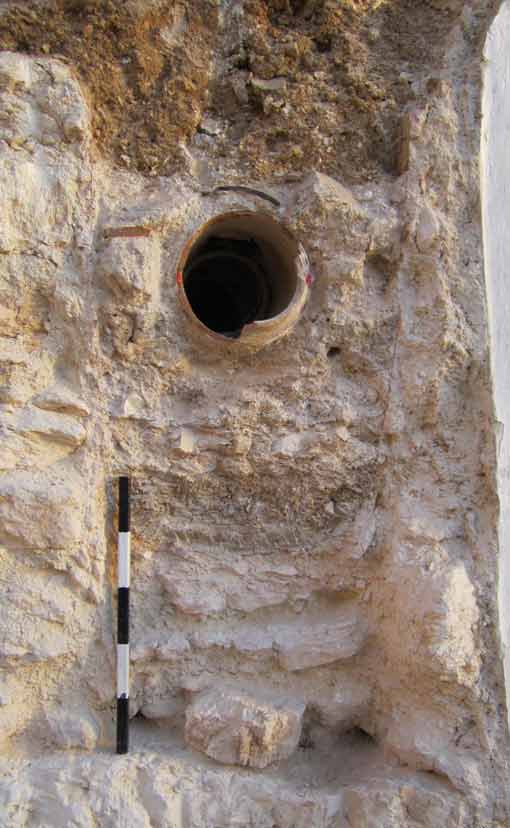
The final part of the passage contains the water reference.  Hezekiah is the one who “brought water into the city” by building a tunnel and pools for storage.  I think despite Hezekiah’s odd exit he did restore faith in God and turned people back from their path of following idols and other gods.  He connected them to living water — the great cistern and the one river, in addition to building a tunnel to provide water when the city was under siege. Hezekiah provided a conduit from the spring (God) to the people.  I think that is one of the most important things we can do as Christians too…provide living water for others when they feel they are “under siege” by connecting them to the spring.

Sometimes connecting people to “the spring” can be really hard, just like it was probably hard for Hezekiah to dig a tunnel through solid rock under the city to access the spring.  In my experience people often have elaborate defenses they have built up to prevent them from accessing the “spring”.  I know in college I had erected sizable walls which God eventually was able to break down.  In my case God worked through friends and Christians He placed in my life.  I am very thankful that these people were willing to do the hard work of “digging a tunnel” for me.

Prayer: God thank You that You provide us with living water during times in our life when we feel “under siege”. Help us to share this water with others who need it.


Posted in 2 Kings, Death and Dying, Discernment, Following God | Tagged , , , , , , | Leave a comment

Indictments

Panel of Sennacherib http://www.britishmuseum.org

Panel of Sennacherib http://www.britishmuseum.org

Then Isaiah son of Amoz sent a message to Hezekiah: “This is what the Lord , the God of Israel, says: I have heard your prayer concerning Sennacherib king of Assyria. This is the word that the Lord has spoken against him: “ ‘Virgin Daughter Zion despises you and mocks you. Daughter Jerusalem tosses her head as you flee.   Who is it you have ridiculed and blasphemed? Against whom have you raised your voice and lifted your eyes in pride? Against the Holy One of Israel!   By your messengers you have ridiculed the Lord. And you have said, “With my many chariots I have ascended the heights of the mountains, the utmost heights of Lebanon. I have cut down its tallest cedars, the choicest of its junipers. I have reached its remotest parts, the finest of its forests.   I have dug wells in foreign lands and drunk the water there. With the soles of my feet I have dried up all the streams of Egypt. – 2 Kings 19:20-24

This passage is a response from God to the prayer of Hezekiah, as shared through the prophet Isaiah the son of Amoz.  Isaiah is sharing God’s response to Sennacherib, king of Assyria, who has been abusing and deporting the Israelites.  He has also been tempting them to turn away from God and Hezekiah.

God is describing the destructive work of the king of Assyria.  It is quite an indictment, he has: 1) ridiculed the Lord; 2) cut down the choicest cedars and junipers; 3) reached the remotest parts of the kingdom with destruction; 4)  dug wells and drunk the waters; 5) dried up all the streams of Egypt with his feet.

This is such a strange and specific list that it seems God is trying to communicate deeper meaning through this discourse.  So what could it mean?  Let’s take these items one at a time and see if we can wring some spiritual meaning from them.

The first is not really metaphorical, but functional.  The Assyrian king, and his messengers, openly mocked both God and those who followed him.  They in essence said that following God was choosing death and following the king of Assyria was full of good things.

The second item on the list is somewhat odd.  Why would cutting down the trees be such a big deal unless these tree were meant to represent something else.  I wonder if the trees represent the well-rooted traditions and beliefs of the Israelites that the king of Assyria wanted to fell and turn into “buildings”  in his own land.

The third item may be just a statement about the extent to which the false truths and lies have infiltrated the “furthest reaches” and deepest depths of the Israelite’s souls.  The king and his messengers are trying to foment doubt about God’s existence and ability to protect the people of Israel.  This deception is apparently widespread in terms of geography, number of people affected, and depth of spiritual deception.

The fourth item is where we actually get to the water reference in this passage.  This one is more subtle.  If we agree that water in the desert is life,and the Israelites are essentially desert people, then the Assyrian King digging wells and drinking the water may mean he was stealing the inheritance that God had promised the Israelites.  He was also trying to replace the reliance on God with a reliance on himself…digging his own wells rather than relying on the great cistern.

The last indictment is in some ways the strangest and most confusing to me.  It also involves water.  God is saying that the Assyrian king is boasting of drying up streams with the soles (perhaps it should read souls) of his feet.  I guess in an odd way this is like a destructive version of walking on water.  Everywhere the Assyrian king steps he is “drying up” the spiritual living water that God is trying to provide the Israelites — rain on a dry and dusty land.

Prayer: God help us to rely upon You for our water and food and resist those who would try to replace You in our lives.

Posted in 2 Kings, Christian Community, Christian Leadership, Christianity, Discernment, Faith, Following God, God's Love for Us, Obedience, Satan, Sin, The Spiritual Realm | Tagged , , , , , , , , , | Leave a comment

Undiscovered Country

IMGP4755Then Eliakim son of Hilkiah, and Shebna and Joah said to the field commander, “Please speak to your servants in Aramaic, since we understand it. Don’t speak to us in Hebrew in the hearing of the people on the wall.”   But the commander replied, “Was it only to your master and you that my master sent me to say these things, and not to the people sitting on the wall—who, like you, will have to eat their own excrement and drink their own urine?”   Then the commander stood and called out in Hebrew, “Hear the word of the great king, the king of Assyria! This is what the king says: Do not let Hezekiah deceive you. He cannot deliver you from my hand. Do not let Hezekiah persuade you to trust in the Lord when he says, ‘The Lord will surely deliver us; this city will not be given into the hand of the king of Assyria.’   “Do not listen to Hezekiah. This is what the king of Assyria says: Make peace with me and come out to me. Then each of you will eat fruit from your own vine and fig tree and drink water from your own cistern, until I come and take you to a land like your own—a land of grain and new wine, a land of bread and vineyards, a land of olive trees and honey. Choose life and not death! “Do not listen to Hezekiah, for he is misleading you when he says, ‘The Lord will deliver us.’ – 2 Kings 18:26-32

This is a continuation of the passage from yesterday when the Assyrians met with the leaders of Judah at the Aqueduct outside Jerusalem.  The leaders that Hezekiah sent are afraid that the people will hear the taunts of the Assyrian army commanders and lose heart and faith in Hezekiah and God.

They ask the Assyrians to speak in Aramaic so the people on the wall, who speak Hebrew, will not understand it.  They ultimately do not trust God and the message he sent to hold up to the competing messages being discussed by the Assyrians.  This reminds me of the practice of the early Catholic church of holding mass in Latin and only allowing priests to read the bible.  The early priests, just like these Israelite leaders, did not trust the message God had provided enough to let the people hear it and read it themselves.

The message of the Assyrians is really the same one that Satan shared in the Garden of Eden and in the Wilderness when he tempted Jesus.  Paraphrased that message is “your God is not great enough to protect you”.  Toward the end of the passage the tempting of the Israelites get’s even more eerily similar to Satan’s tempting.  The Assyrians promise that their king will allow the Israelites to “eat fruit from your own vine and fig tree and drink water from your own cistern“….Wow this verse is truly a hidden well of deep waters.

Throughout the desert wanderings, crossing over into the Promised Land, and a cacophony of crazy kings God has been asking the Israelites to choose Him for their water supplythe great cistern, the one river.  He has offered to water them like rain on tender plants and asked them to drink deeply of the water He provides to those who are connected to the spring and planted by the river.

There is clearly a spiritual battle going on here in the desert at the aqueduct outside the walls of Jerusalem.  The Israelites are given a choice — “choose life not death”.  The part that the Assyrians did not share, and Satan also withheld in the Garden of Eden, is that the “life” offered would come at the cost of their souls.  In choosing not to trust Hezekiah and God the Israelites would have to give up their souls to the Assyrian king.

We are all given this same choice by God — do we choose life or death?  Do we trust God to protect us from the “mortal coil” of this world?  William Shakespeare confronted this internal conflict we must all face when he wrote:

“The undiscovere’d country, from whose bourn
No traveller returns, puzzles the will,
And makes us rather bear those ills we have
Than fly to others that we know not of?” –  William Shakespeare

God revealed Shakespeare’s “undiscovere’d country” when he showed up in Bethlehem, took us by the hand, and led us there.  We have but to choose to faithfully follow Him unconditionally.

Prayer: God we are given a clear choice each day whether to trust You or this world.  Help us to choose wisely and follow You to the “undiscovered country”.

Posted in 2 Kings, Christian Community, Christian Leadership, Christianity, Conflict, Discernment, Discipleship, Faith, Following God, God's Love for Us, Heaven, Obedience, religion, Satan, The Earthly Realm, Trusting God | Tagged , , , , , , , , , , | Leave a comment

Assyrians at the Aqueduct

The king of Assyria sent his supreme commander, his chief officer and his field commander with a large army, from Lachish to King Hezekiah at Jerusalem. They came up to Jerusalem and stopped at the aqueduct of the Upper Pool, on the road to the Washerman’s Field. They called for the king; and Eliakim son of Hilkiah the palace administrator, Shebna the secretary, and Joah son of Asaph the recorder went out to them.   The field commander said to them, “Tell Hezekiah: “ ‘This is what the great king, the king of Assyria, says: On what are you basing this confidence of yours? You say you have the counsel and the might for war—but you speak only empty words. On whom are you depending, that you rebel against me? Look, I know you are depending on Egypt, that splintered reed of a staff, which pierces the hand of anyone who leans on it! Such is Pharaoh king of Egypt to all who depend on him. But if you say to me, “We are depending on the Lord our God”—isn’t he the one whose high places and altars Hezekiah removed, saying to Judah and Jerusalem, “You must worship before this altar in Jerusalem”? – 2 Kings 18:17-22

This passage is a welcome departure from the pattern of crummy kings that have been leading Israel astray for the last several generations.  The water references in this passage are interesting too…a two-fer.

First a little context…Hezekiah is leading the Isrealites in Jerusalem and the Israelites are being harassed and relocated by the king of Assyria.  Hezekiah has agreed to pay the king of Assyria, and the Assyrian king has sent his army with several military leaders to ask Hezekiah to pay up.

Hezekiah sends his representatives and they meet the Assyrians at the location of a water aqueduct to the “upper pool” on the road to the washerman’s field.  This is an interesting detail because the Assyrians had besieged the city and availability of water would have been very important for the Israelite’s survival.  Perhaps meeting at the connecting aqueduct between the water source and the city was to reinforce the position of power the Assyrians felt they had over the Israelites…kind of like bullies on the playground.

The representatives of the Assyrian king are trying to find out why king Hezekiah is so confident he will not lose….is he allied with those “splintered reed of a staff” Egyptians?  Are they trusting their Lord to save them?  They try to rebuke Hezekiah as the one who had removed high places and altars so that people would worship in Jerusalem.  This seems a bit like an atheist walking into a church and telling the worshippers what songs they should sing.  We will see how this all plays out, but at the moment king Hezekiah is leading by following and the people he is leading are faithfully following God.

Prayer: God give us the confidence to follow you even when we are confronted by those who seek to rule over us and doubt Your existence.

Posted in 2 Kings, Following God | Tagged , , , , , | Leave a comment

Resettlement on the River

IMGP4789In King Hezekiah’s fourth year, which was the seventh year of Hoshea son of Elah king of Israel, Shalmaneser king of Assyria marched against Samaria and laid siege to it. At the end of three years the Assyrians took it. So Samaria was captured in Hezekiah’s sixth year, which was the ninth year of Hoshea king of Israel. The king of Assyria deported Israel to Assyria and settled them in Halah, in Gozan on the Habor River and in towns of the Medes. This happened because they had not obeyed the Lord their God, but had violated his covenant—all that Moses the servant of the Lord commanded. They neither listened to the commands nor carried them out.   In the fourteenth year of King Hezekiah’s reign, Sennacherib king of Assyria attacked all the fortified cities of Judah and captured them. So Hezekiah king of Judah sent this message to the king of Assyria at Lachish: “I have done wrong. Withdraw from me, and I will pay whatever you demand of me.” The king of Assyria exacted from Hezekiah king of Judah three hundred talents of silver and thirty talents of gold. So Hezekiah gave him all the silver that was found in the temple of the Lord and in the treasuries of the royal palace.   At this time Hezekiah king of Judah stripped off the gold with which he had covered the doors and doorposts of the temple of the Lord , and gave it to the king of Assyria. – 2 Kings 18:9-16

Wow the last several chapters of 2 Kings have been a litany of kings who have been doing wrong in the eyes of the Lord.  Finally we arrive here at King Hezekiah of Samaria and a king who seems to be at least trying to follow God by removing some of the idols and altars to gods other than God.

The king of Assyria attacks and deports the people of Israel to the Habor River in Assyrian territory. Then the king of Assyria attacks Judah and captured all their cities so the king of Judah basically surrendered and looted the temple to pay tribute to the king of Assyria.

This seems like a very uncertain and “lost” time for the israelites.  They do not really know who they are because they remain perpetually disconnected from the spring.  I hope this trend turns around soon as I am growing weary of all the kings and the havoc they are inflicting on their people.

I really yearn for the arrival of the true king, but alas that is many books, chapters, and miles of water “down the river”…so I will continue to pray and press on with the confidence that there are more interesting rapids and adventures ahead.

Prayer: When the journey gets long help us to keep on keeping on until we come to the spacious place you have prepared for us.

Posted in 2 Kings, Faith, Following God, Obedience, The Nature of God | Tagged , , , , , | Leave a comment

Slaughter by the Well

The next morning Jehu went out. He stood before all the people and said, “You are innocent. It was I who conspired against my master and killed him, but who killed all these? Know, then, that not a word the Lord has spoken against the house of Ahab will fail. The Lord has done what he announced through his servant Elijah.” So Jehu killed everyone in Jezreel who remained of the house of Ahab, as well as all his chief men, his close friends and his priests, leaving him no survivor.   Jehu then set out and went toward Samaria. At Beth Eked of the Shepherds, he met some relatives of Ahaziah king of Judah and asked, “Who are you?” They said, “We are relatives of Ahaziah, and we have come down to greet the families of the king and of the queen mother.”   “Take them alive!” he ordered. So they took them alive and slaughtered them by the well of Beth Eked—forty-two of them. He left no survivor. – 2 Kings 10:9-14

This a return to “dark water” for the Israelites and their current king, Jehu. God has directed Jehu to wipe out the line of Ahab because of the way he and his wife Jezebel led Israel to worship idols and other gods.  Jezebel and Ahab were certainly evil, they killed hundreds of prophets in the time of Elijah. Perhaps the cancer of idolatry is sufficiently lethal to warrant the eradication Jehu has been tasked to perform.

I admit this passage has me somewhat puzzled and perplexed.  It is a return to the messy bloodshed that was so common in the time of David and Solomon.  Why would God want to wipe out Ahab’s entire line?  Was Jehu getting an accurate message from God to kill everyone in this brutal fashion?  Even to the point of slaughtering forty-two of the relatives of Ahaziah next to a well in Beth Eked.

Clearly this was a very different time and culture than we live in today.  I have a hard time imagining what this would have been like.  I have been raised in a democratic culture where voting rather than slicing decides the rulers or the people.  The democratic system is not perfect but I prefer it to familial genocide with each change of kings.

I am not sure there is any deeper meaning to the last verse about Jehu killing the relatives of Ahaziah near the well at Beth Eked.  Except that wells in this time, and even today, are places where communities gather and discuss what is happening in the community.   Jehu committing this very public “cleansing” would have certainly sent a message that he was in charge.

This passage and the communication between Jehu and God that it describes remains troubling for me.  I need to continue to pray about it and perhaps at some point in the future it will become more clear.

Prayer: God help me to understand this difficult passage how it fits into the love you have for Your people.

Posted in 2 Kings, Conflict, Covenant, Death and Dying, Obedience, The Nature of God | Tagged , , , , , , , | Leave a comment