Rabbit Trail #7 – Cave Dwellers

IMGP2148Happy New Year!

“The soul has eyes with which to see and ears with which to hear. Feeble they may be from long disuse, but by the life-giving touch of Christ alive now and capable of sharpest sight and most sensitive hearing.” – AW Tozer 

I have been ruminating on the above passage from “The Pursuit of God” by A.W. Tozer for several days now.  In honor of this being my 190th post, the first post of 2015, and the last passage from 1 Kings I thought it was time for a Rabbit Trail.  Tozer’s short book contains amazing insights.  As I have been reading this book, and writing this blog, it has occurred to me that the spiritual environment in which we live is a bit like a cave.

We are isolated from the Kingdom of God (the spiritual realm) in a physical body which exists in the material world.  Occasionally we have glimpses of the rich spiritual world which is taking place parallel to the physical world.  Our five senses inform us about the physical world, but the sensing and experiencing of the spiritual world requires different eyes and ears, with the gift of site and hearing given by Jesus.

Tozer’s main point is that we have spiritual senses that our souls use to sense and interact with the spiritual realm, but many of these faculties have atrophied due to disuse.  This is similar to the way many cave dwelling creatures have adapted to live their entire lives underground in caves.  For example, the organs that were formerly used to sense light are not needed and become non-functional.

These cave-dwelling creatures, referred to as troglofauna, have adapted to living in darkness.  They often look similar to creatures that live outside of caves, but their sensory apparatus is either non-functional or hyper sensitized to deal with survival in a low light environment. Although these creatures are well adapted to living in a cave they are practicality helpless outside the cave.  Caves can be beautiful and magical places, but most of us would not choose to live in one.

I think our existence on earth, in our bodily vessels, is a bit like living in a “spiritual cave” of sorts. We are isolated from the pure light of God’s kingdom. Jesus entered our “spiritual cave” to help us learn to see outside the “cave”, in the light.  But our souls have become accustomed to the cave that is our existence here on earth — in our earthy bodies.  The spiritual senses which our souls use to sense this spiritual world have “grown feeble due to disuse”.

We see glimpses of the “outside” world (i.e. God’s spiritual kingdom) and it sometimes seems foreign and scary to us.  When God shows up in our “cave”, and shines his light into our lives, it sometimes hurts or is scary because we are not used to it — our spiritual “eyes” are not used to such light.  We must seek out opportunities to experience God’s presence so that we can become accustomed to the light.

Prayer: God help us to become accustomed to the spiritual realm so that we can see and hear your kingdom on earth.

Posted in Christian Community, Christian Leadership, Christianity, Following God, Rabbit Trails, The Earthly Realm, The Nature of God, The Spiritual Realm, Trusting God | Tagged , , , , , , , , , , | Leave a comment

A Double Portion of Spirit

http://upload.wikimedia.org/wikipedia/commons/thumb/a/a8/SaintIliaFromRilaMonastery.jpg/1024px-SaintIliaFromRilaMonastery.jpg
By Edal Anton Lefterov (Own work) [Public domain], via Wikimedia Commons

Then Elijah said to him, “Stay here; the Lord has sent me to the Jordan.” And he replied, “As surely as the Lord lives and as you live, I will not leave you.” So the two of them walked on.   Fifty men from the company of the prophets went and stood at a distance, facing the place where Elijah and Elisha had stopped at the Jordan. Elijah took his cloak, rolled it up and struck the water with it. The water divided to the right and to the left, and the two of them crossed over on dry ground.   When they had crossed, Elijah said to Elisha, “Tell me, what can I do for you before I am taken from you?” “Let me inherit a double portion of your spirit,” Elisha replied.   “You have asked a difficult thing,” Elijah said, “yet if you see me when I am taken from you, it will be yours—otherwise, it will not.”   As they were walking along and talking together, suddenly a chariot of fire and horses of fire appeared and separated the two of them, and Elijah went up to heaven in a whirlwind. Elisha saw this and cried out, “My father! My father! The chariots and horsemen of Israel!” And Elisha saw him no more. Then he took hold of his garment and tore it in two.   Elisha then picked up Elijah’s cloak that had fallen from him and went back and stood on the bank of the Jordan. He took the cloak that had fallen from Elijah and struck the water with it. “Where now is the Lord , the God of Elijah?” he asked. When he struck the water, it divided to the right and to the left, and he crossed over.   The company of the prophets from Jericho, who were watching, said, “The spirit of Elijah is resting on Elisha.” And they went to meet him and bowed to the ground before him. “Look,” they said, “we your servants have fifty able men. Let them go and look for your master. Perhaps the Spirit of the Lord has picked him up and set him down on some mountain or in some valley.” “No,” Elisha replied, “do not send them.” – 2 Kings 2:6-16

Elijah is in the process of passing the baton to Elisha, the one God selected to take on Elijah’s role after he crosses over.  Elijah has given Elisha several opportunities to turn back from the journey God has set before him.  Each time Elisha has decided not to leave Elijah’s side.  What a great example of faithful following.  I think this is the way God wants Elisha, and us, to follow Him.

Elijah and Elisha arrive at the Jordan River once again.  The Jordan River seems to be the focal point for much of the Israelite’s history.  Perhaps it can be viewed as a metaphor for the spiritual divide that separates them from God.  The Israelites have crossed over the Jordan numerous times and for a variety of reasons.  This time the crossing is aided by a miraculous parting of the Jordan similar to the time it was parted by God for Joshua and the leaders of Israel before they entered the Promised Land.

Elisha’s request of Elijah is a bit strange…a “double portion of your spirit”.  This was certainly a very flattering thing to say to Elijah, but also a bit bold for Elisha. It reminds me of Peter asking Jesus to wash his whole body when Jesus was prepared to wash his feet (John 13:9).  Humility would suggest that Elisha should not expect to exceed his predecessor.  I would expect him to say something like “God give me even half the spirit that Elisha has and I will be a great man”.  It is also interesting that Elisha talks of Elijah’s spirit as if it were some sort of elixir, rather than the soul of a man of God.

Elijah is taken up into heaven and Elisha is witness to it, ensuring that he will in fact obtain a “double portion” of Elijah’s spirit.  This is confirmed by Elisha and the company of prophets from Jericho when Elisha takes Elijah’s cloak and parts the Jordan River just like Elijah did prior to his being taken up into heaven.  This relational miracle sealed the new covenant between God and Elisha — making it clear that Elisha would follow God unconditionally and God would have Elisha’s back.

This is the first time I can remember in the bible where someone “crossing over” has taken place in a way other than the normal death experienced by most humans.  It is very interesting that in the future some will think that John the Baptist is Elijah returning near this very spot on the Jordan River (John 1:28).  I hope to visit the Jordan River some day and experience this place of many crossings.

Prayer: God thank You for providing a “double portion” of the Holy Spirit to guide those who faithfully follow You.

Posted in 2 Kings, Christian Community, Christian Leadership, Christianity, Covenant, Death and Dying, Discernment, Discipleship, Following God, God's Love for Us, Miracles, Obedience, religion, The Nature of God, The Spiritual Realm, Trusting God | Tagged , , , , , , , , | 1 Comment

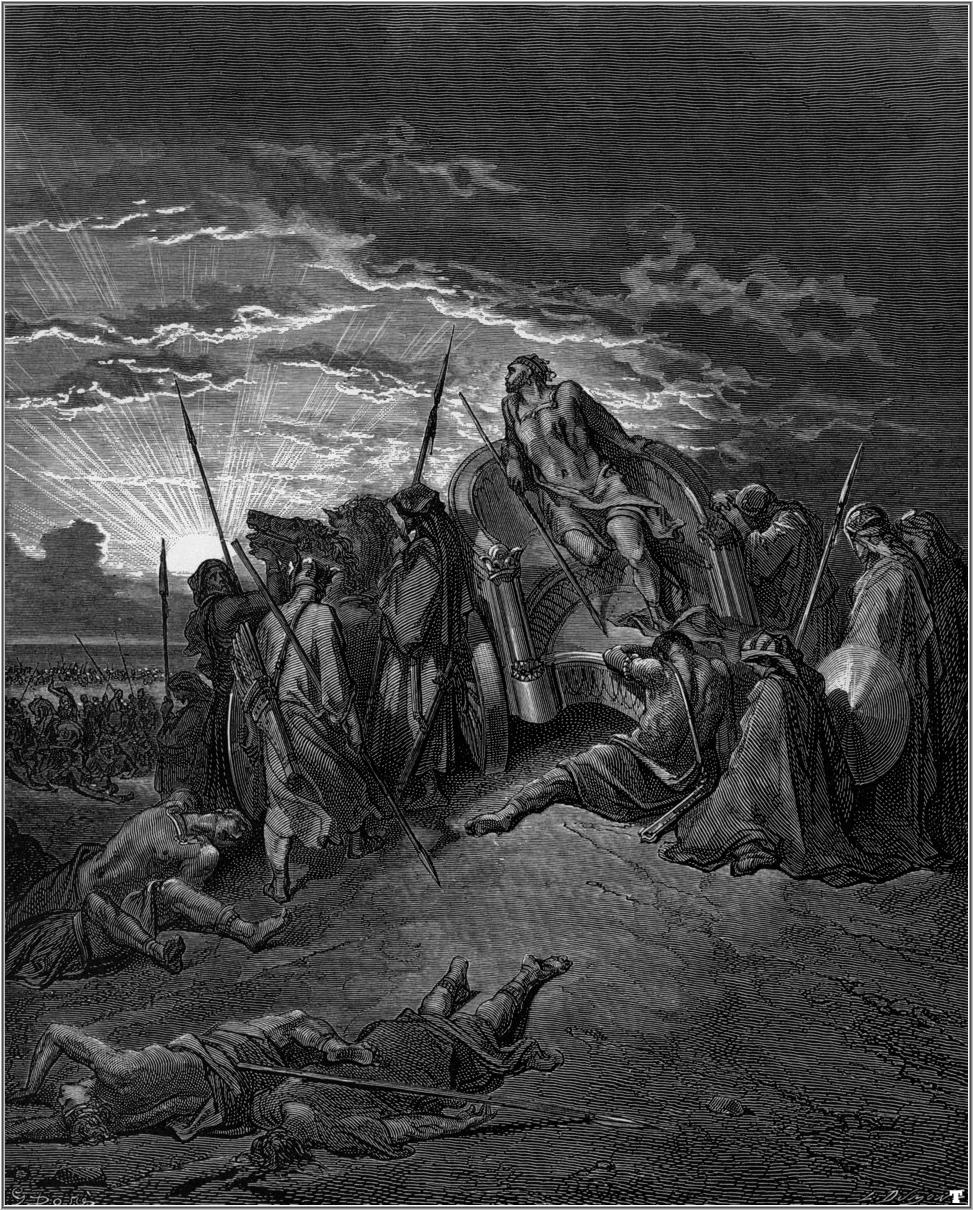
Ahab Crosses Over – Incognito

http://www.helsinki.fi/~pjojala/Bible_Gustave-Dore-Death_of_Ahab.jpg

Ahab’s Death by Gustave Doré (http://www.helsinki.fi/)

The king of Israel then ordered, “Take Micaiah and send him back to Amon the ruler of the city and to Joash the king’s son and say, ‘This is what the king says: Put this fellow in prison and give him nothing but bread and water until I return safely.’ ” Micaiah declared, “If you ever return safely, the Lord has not spoken through me.” Then he added, “Mark my words, all you people!” So the king of Israel and Jehoshaphat king of Judah went up to Ramoth Gilead. The king of Israel said to Jehoshaphat, “I will enter the battle in disguise, but you wear your royal robes.” So the king of Israel disguised himself and went into battle. Now the king of Aram had ordered his thirty-two chariot commanders, “Do not fight with anyone, small or great, except the king of Israel.” When the chariot commanders saw Jehoshaphat, they thought, “Surely this is the king of Israel.” So they turned to attack him, but when Jehoshaphat cried out, the chariot commanders saw that he was not the king of Israel and stopped pursuing him. But someone drew his bow at random and hit the king of Israel between the sections of his armor. The king told his chariot driver, “Wheel around and get me out of the fighting. I’ve been wounded.” All day long the battle raged, and the king was propped up in his chariot facing the Arameans. The blood from his wound ran onto the floor of the chariot, and that evening he died. As the sun was setting, a cry spread through the army: “Every man to his town. Every man to his land!” So the king died and was brought to Samaria, and they buried him there. They washed the chariot at a pool in Samaria (where the prostitutes bathed), and the dogs licked up his blood, as the word of the Lord had declared. – 1 Kings 22:26-38

There are many aspects of this passage that are strange…” funny water” if you will. The current king of Israel (the northern kingdom) Ahab wants to retake some territory called Ramoth Gilead. He is trying to enlist the king of Judea, ( the southern kingdom) Jehoshaphat…apparently he is the origin of the expression “jumping Jehoshaphat”. According to some accounts Jehoshaphat was influenced by powerful advisors who made him jump through “hoops” according to their own schemes. Ahab is doing much the same here, convincing Jehoshaphat to “jump” into a battle with the king of Aram.

In general, Jehoshaphat has been a good king trying to reverse some of the idol worship started under king Solomon. Ahab and the southern kingdom are still running from God despite God’s efforts through Elijah. Ahab has invited Micaiah, a prophet of God, to tell him whether his efforts to take Ramoth Gilead will be successful. Ahab does not like the answer he gets… Micaiah predicts failure and death for Ahab. King Ahab has Micaiah sent home and imprisoned with nothing but bread and water for his honest prophecy.

Here is where it gets weird. Ahab and Jehoshaphat go into battle at Ramoth Gilead, but King Ahab goes into battle in disguise…incognito. It seems Ahab is either trying to get Jehoshaphat killed, or at a minimum he realizes that the King of Israel would be a target for the Arameans they were attacking and wanted to avoid being killed himself. The king of Aram had directed his charioteers to do just that…take out the king of Israel, but they were having trouble because of his disguise. This hardly seems like an honorable way for the king of Israel to behave.

A random arrow pierces Ahab’s armor and he bleeds to death while watching his army and Jehoshaphat’s army fight his battle for him. His blood fills his chariot and his lifeless body is taken to Samaria, the very same place where he stole the land of a man named Naboth and his wife Jezebel had Naboth stoned to death.  In Samaria they washed his chariot with water where his blood mingled with water to be licked up by dogs….fulfilling the prophesy about the manner of his death made by Elijah (1 Kings 21:19).

On one level Ahab’s death was a consequence of his unjust stoning and robbery of Naboth (carried out by his wife Jezebel), but it was also a consequence of his failure to receive the rain God offered to end the physical and spiritual drought that Israel was experiencing. God gave Ahab a chance to return to Him and faithful following… he chose poorly.

We also are given a choice each time we choose whether to continue in our faithful following or to turn to other gods in our lives. Our consequences may not be as immediate or graphic as bleeding to death in a chariot, but we may loose out on things God has for us, just like Ahab missed out on what God had for him if he had chosen differently.

Prayer: God help us to choose wisely when given a choice whether we faithfully follow you or turn to other gods in our lives.

Posted in 1 Kings, Christianity, Covenant, Death and Dying, Faith, Following God, Obedience, reconciliation, religion, Sin | Tagged , , , , , , , , | Leave a comment

Great Winds and Whispers

Cave Mouth in Puerto Rico

Cave Mouth in Puerto Rico

There he went into a cave and spent the night. And the word of the Lord came to him: “What are you doing here, Elijah?”   He replied, “I have been very zealous for the Lord God Almighty. The Israelites have rejected your covenant, torn down your altars, and put your prophets to death with the sword. I am the only one left, and now they are trying to kill me too.”   The Lord said, “Go out and stand on the mountain in the presence of the Lord , for the Lord is about to pass by.” Then a great and powerful wind tore the mountains apart and shattered the rocks before the Lord , but the Lord was not in the wind. After the wind there was an earthquake, but the Lord was not in the earthquake. After the earthquake came a fire, but the Lord was not in the fire. And after the fire came a gentle whisper. When Elijah heard it, he pulled his cloak over his face and went out and stood at the mouth of the cave. Then a voice said to him, “What are you doing here, Elijah?”   He replied, “I have been very zealous for the Lord God Almighty. The Israelites have rejected your covenant, torn down your altars, and put your prophets to death with the sword. I am the only one left, and now they are trying to kill me too.”   The Lord said to him, “Go back the way you came, and go to the Desert of Damascus. When you get there, anoint Hazael king over Aram. Also, anoint Jehu son of Nimshi king over Israel, and anoint Elisha son of Shaphat from Abel Meholah to succeed you as prophet. – 1 Kings 19:9-18

OK so the connection to water here is very weak, but this is such an interesting passage, and there are several geological connections, so I felt I should reflect on it. Elijah has fled to a cave, probably a limestone cave created by flowing groundwater, and he is hiding out there so that Ahab and Jezebel can’t kill him.

God asks him why he is hiding in a cave and Elijah responds that the leaders in Israel are hopeless. They have broken the altar, their covenant with God, and killed all of God’s prophets. Elijah tells God he is the only one left who is “zealous for the Lord”. God tells Elijah to go outside the cave for “the Lord is about to pass by”.

This is where it gets really interesting… a great and powerful wind tears at the mountain and shatters the rocks. That is one powerful wind! Even category 5 hurricane winds don’t often break apart rocks.  God was not in this powerful feat of nature.

Then an earthquake happened that shook the mountain to its core, followed by fire.  All of this must have been rather frightening for Elijah who was witnessing this from inside the cave.  He did not emerge until he heard what followed…a gentle whisper.  Then he covered his face and went out to meet with God.  God tells Elijah to return to where he came from and to anoint several kings and a successor for himself, Elisha.

This passage has always intrigued me but I have never approached it from the historical context that my current “walk on water” has provided.  Why did God show up for Elijah at this time and in this way?  Prior to Elijah’s escape to this cave he had experienced God showing up in some pretty miraculous and dramatic ways.

I think perhaps Elijah had put God in a “box”.  He had grown accustomed to communicating and following a God who showed up in dramatic or miraculous ways.  God wants Elijah, and us, to understand that He shows up when and how we need Him.  Sometimes that is in dramatic ways and other times it is in a whisper.  We need to be ready to see and hear from God in both sensational and subtle ways.

Prayer: God help us to see You when you show up in both subtle and dramatic ways in our lives.

Posted in 1 Kings, Covenant, Discernment, Discipleship, Faith, Following God, Miracles, religion, The Nature of God, Trusting God | Tagged , , , , , , , , , | Leave a comment

When the Journey is too Much

Now Ahab told Jezebel everything Elijah had done and how he had killed all the prophets with the sword. So Jezebel sent a messenger to Elijah to say, “May the gods deal with me, be it ever so severely, if by this time tomorrow I do not make your life like that of one of them.”   Elijah was afraid and ran for his life. When he came to Beersheba in Judah, he left his servant there, while he himself went a day’s journey into the wilderness. He came to a broom bush, sat down under it and prayed that he might die. “I have had enough, Lord ,” he said. “Take my life; I am no better than my ancestors.” Then he lay down under the bush and fell asleep. All at once an angel touched him and said, “Get up and eat.” He looked around, and there by his head was some bread baked over hot coals, and a jar of water. He ate and drank and then lay down again.   The angel of the Lord came back a second time and touched him and said, “Get up and eat, for the journey is too much for you.” So he got up and ate and drank. Strengthened by that food, he traveled forty days and forty nights until he reached Horeb, the mountain of God. There he went into a cave and spent the night. And the word of the Lord came to him: “What are you doing here, Elijah?” – 1 Kings 19:1-9

It sounds like Ahab is having difficulties breaking out of his old pattern of behavior. Jezebel has heard about everything Elijah had done, presumably both the miracle and the retribution on the prophets of Baal — she wants revenge and retribution. She can’t see the miracle through the massacre, or perhaps she does not want to see the miracle.

Elijah loses his confidence and flees. It is not clear to me what changed between Elijah boldly walking into Ahab’s palace to declare the coming rain in yesterday’s post, and Elijah heading for the hills in this passage.  It is possible that the massacre of the prophets of Baal was an “improvisation” on Elijah’s part.  Something beyond what God had directed him to do and he feels conflicted and guilty about it.

This seems to be supported by Elijah’s self recrimination  — “I have had enough, Lord …Take my life; I am no better than my ancestors.”  His ancestors, since the time they crossed over in to the Promised Land, were engaged in almost constant conflict and bloodshed.  In killing the prophets of Baal Elijah was continuing in this old pattern rather than the new pattern God was trying to establish with His people.  Both Ahab and Elijah seem to feel like they are stuck in old patterns of behavior.  Ahab returns to Jezebel and her council and Elijah flees from Jezebel and God.

Elijah ends up cowering in a Broom Bush (Retama raetam) wanting to die….guilt can be a powerful thing.  This account reminds me of when, back in Genesis 21:14-21, Hagar was cast out by Abraham and God provided her a hidden well in the desert. Here the “hidden well” takes the form of stone baked bread and a jar of water delivered by an angel of the Lord.

The angel says something really interesting to Elijah,“Get up and eat, for the journey is too much for you.”  I wonder if the angel is referring to Elijah’s hike into the wilderness or his spiritual journey?  Elijah has taken a detour spiritually and physically into discouragement and discontentment.  The provision of the bread and water was a tangible demonstration of God’s love and forgiveness…just like the bread and wine Jesus will later share with his disciples to remind them of God’s love and forgiveness.

Guilt is an interesting word.  We often think of it as an emotion or feeling. It can feel like sandbags weighing down our souls — keeping us from experiencing the freedom that God has promised if we faithfully follow him.   Guilt can be like the weights some people wear while exercising. It can make us spiritually tired and prone to want to find a bush to crawl under.  God desires our obedience and is sad and disappointed when we fail but he realizes we are flawed followers.  

The amazing thing is He loves us anyway…enough to sacrifice His blood and body for us. He provides us with endless flour, oil, and living water so that we don’t need to go hide in a bush. He wants us to pursue Him unfettered by sandbags of guilt — not because we are not guilty but because He has already forgiven us for all past, present, and future offenses.

Prayer: God free us from the grip of guilt so that we can pursue You with unfettered faithfulness.

Posted in 1 Kings, Christianity, Death and Dying, Discernment, Discipleship, Faith, Following God, God's Love for Us, Miracles, Obedience, Redemption, religion, The Spiritual Realm, Trusting God | Tagged , , , , , | Leave a comment

Small Cloud – Big Rain

IMGP4928And Elijah said to Ahab, “Go, eat and drink, for there is the sound of a heavy rain.” So Ahab went off to eat and drink, but Elijah climbed to the top of Carmel, bent down to the ground and put his face between his knees.   “Go and look toward the sea,” he told his servant. And he went up and looked. “There is nothing there,” he said. Seven times Elijah said, “Go back.”   The seventh time the servant reported, “A cloud as small as a man’s hand is rising from the sea.” So Elijah said, “Go and tell Ahab, ‘Hitch up your chariot and go down before the rain stops you.’ ”   Meanwhile, the sky grew black with clouds, the wind rose, a heavy rain started falling and Ahab rode off to Jezreel. The power of the Lord came on Elijah and, tucking his cloak into his belt, he ran ahead of Ahab all the way to Jezreel. – 1 Kings 18:41-46

This is the sequel to the passage where Elijah informs Ahab that the drought is about to end…both in terms of water on the land and spiritual “living water” from God.  Ahab and the prophets of Baal learn in a dramatic way that “He is God”  The beginning of the passage is a bit strange.  After the prophets of Baal are dealt with rather harshly Elijah tells Ahab to “go eat and drink” because he hears the sound of heavy rain.  It turns out that the rain has not started yet and it is still off in the distance.

Why would he tell Ahab to go, eat, and drink?  It seems like he would direct him to go be in prayer or do something that would put him in the proper posture to the receive the coming rain from heaven.  As I have prayed and reflected on this it occurs to me that perhaps Ahab was not in a place, spiritually, where he would know how to offer prayers or offerings to God.  Ahab is the equivalent of an atheist or perhaps an agnostic in modern times — perhaps worse as he has been actively persecuting those who believe in God.  This brings up a philosophical question.  How do we share our knowledge and experiences of God with others — Bible tracts, street evangelism, outreach service projects, or something else entirely?

My sister and I were talking about this the other day.  We are both reading a book by A.W. Tozer called the “The Pursuit of God”.  We were discussing how some parts of this book might be difficult to understand or relate to for some Christians because we are all at different places spiritually.  I wonder if Elijah is recognizing that Ahab is not in a place to receive God in the same way that he himself might.  They are in very different places spiritually.  Despite Ahab, and many of us, being in different places spiritually God will show up when and how we need Him — the rain will fall on the whole land.

Elijah provides a good example for us in this passage.  He goes to a high place and keeps a sharp lookout for God to show up.  Elijah has faith that even when his servant returns for the seventh time sighting only a small black cloud that God’s promised rain would show up.  There is a lesson here. If we are faithful and persistent what appears to be nothing more than a small black cloud can build into a sky full of dark clouds and rain.  Interestingly, when the rain begins in earnest Elijah does not gloat.  He tells Ahab that he better head off to Jezreel before the rain stops him.  Elijah runs out into the rain ahead of Ahab.  He does not abandon him or remain under a dry roof.  He experiences God’s rain with Ahab.  I think this is the key to effective sharing of the Good News about Christ, to share our experiences with those who have not experienced Him yet.

Prayer: God you send your life-giving rains on all of us, regardless of where we are at to receive them.  Help us to experience your life giving rains with others.


Posted in 1 Kings, Christian Community, Christian Leadership, Christianity, Discernment, Faith, Following God, Obedience, religion, Trusting God | Tagged , , , , , , | Leave a comment

He is God!

http://art.famsf.org/ Painting by Luca Giordano

http://art.famsf.org/ Painting by Luca Giordano

Elijah said to the prophets of Baal, “Choose one of the bulls and prepare it first, since there are so many of you. Call on the name of your god, but do not light the fire.” So they took the bull given them and prepared it.  Then they called on the name of Baal from morning till noon. “Baal, answer us!” they shouted. But there was no response; no one answered. And they danced around the altar they had made.  At noon Elijah began to taunt them. “Shout louder!” he said. “Surely he is a god! Perhaps he is deep in thought, or busy, or traveling. Maybe he is sleeping and must be awakened.”  So they shouted louder and slashed themselves with swords and spears, as was their custom, until their blood flowed.  Midday passed, and they continued their frantic prophesying until the time for the evening sacrifice. But there was no response, no one answered, no one paid attention.  Then Elijah said to all the people, “Come here to me.” They came to him, and he repaired the altar of the Lord, which had been torn down.  Elijah took twelve stones, one for each of the tribes descended from Jacob, to whom the word of the Lord had come, saying, “Your name shall be Israel.”   With the stones he built an altar in the name of the Lord, and he dug a trench around it large enough to hold two seahs of seed. He arranged the wood, cut the bull into pieces and laid it on the wood. Then he said to them, “Fill four large jars with water and pour it on the offering and on the wood.” “Do it again,” he said, and they did it again.  “Do it a third time,” he ordered, and they did it the third time.  The water ran down around the altar and even filled the trench.  At the time of sacrifice, the prophet Elijah stepped forward and prayed: “Lord, the God of Abraham, Isaac and Israel, let it be known today that you are God in Israel and that I am your servant and have done all these things at your command.  Answer me, Lord, answer me, so these people will know that you,Lord, are God, and that you are turning their hearts back again.”  Then the fire of the Lord fell and burned up the sacrifice, the wood, the stones and the soil, and also licked up the water in the trench.  When all the people saw this, they fell prostrate and cried, “The Lord—he is God! The Lord—he is God!” –  1 Kings 18:25-39

Elijah is having a “duel” of sorts with the followers and prophets of Baal….sort of a spiritual one on one match…God against Baal. The order of events here is interesting.  First Elijah calls to the people “come here to me”.  Once they are there he rebuilds the altar in a manner similar to the way the Israelites were instructed by God to build the first altar in the promised land. He builds the altar out of 12 smooth river rocks which represent the 12 tribes of Israel.  He brought them along while he was faithfully following what God called him to do….i.e. rebuild the altar.

Elijah confidently states that God’s fire will come to take the bull sacrificed on the newly reconstructed altar.  Elijah is so confident that God will show up that he has the people douse the altar and sacrificial bull with 4 large jars of water….three times. Elijah wants to male it clear that if the fire shows up it is from God and not some “conjurer’s trick”.

Before Elijah calls on God He prays and let’s everyone know that God is the God of Israel, not an idol made by men. The purpose of this miracle is clearly relational…”so these people will know that you, Lord, are God, and are turning their hearts back again”.  I think Elijah and God want to rebuild more than just an altar, they want to rebuild a relationship between God and His people.  This is the first step in that process.

God shows up in a big way and the fire he sends burns up everything — it even “licks up the water” leftover in the trench they dug around the altar.  This miracle had to be on par with the parting of the Red Sea and Moses bringing forth water from the rock.  The response of the people gathered is to acknowledge that “He is God”.  This is the fundamental truth that God has been trying to get the Israelites to remember since they left the Garden of Eden.

So what does this mean for us as followers of Christ today?  What if we are not able to call down fire from heaven like Elijah?  Can we still lead people to discover the same thing the Israelites did…that “He is God”.  We can start by following Elijah’s example in terms of his approach.  We can: 1) invite people along as we pursue God and our relationship with Him; 2) rebuild broken relationships between God and His followers; and 3)  Boldly expect God to show up, not in a cocky way that tests God, but in a way that makes it clear we have seen God do great things before.

Prayer: God you desire to be in relationship with us.  Help us to bring others along as we seek to know and love You.


Posted in 1 Kings, Christian Community, Christian Leadership, Christianity, Covenant, Discernment, Discipleship, Following God, Life Together, Miracles, Obedience, reconciliation, religion, The Nature of God, Trusting God | Tagged , , , , , , , , | Leave a comment

Rain on a Dry and Dusty Land

OLYMPUS DIGITAL CAMERAAfter a long time, in the third year, the word of the Lord came to Elijah: “Go and present yourself to Ahab, and I will send rain on the land.” So Elijah went to present himself to Ahab. Now the famine was severe in Samaria, and Ahab had summoned Obadiah, his palace administrator. (Obadiah was a devout believer in the Lord . While Jezebel was killing off the Lord ’s prophets, Obadiah had taken a hundred prophets and hidden them in two caves, fifty in each, and had supplied them with food and water.) Ahab had said to Obadiah, “Go through the land to all the springs and valleys. Maybe we can find some grass to keep the horses and mules alive so we will not have to kill any of our animals.” So they divided the land they were to cover, Ahab going in one direction and Obadiah in another. – 1 Kings 18:1-6

Merry Christ Mass!  This is the day we celebrate the arrival of God on earth.  I am preparing this post early so that I can spend this day with my family.  I considered “eddying out” for today’s post, but God served up a passage that holds great meaning in the context of what we celebrate at Christmas…the coming of the Messiah…the living water…rain on a dry and dusty land.

The land at the time of Jesus’ arrival in Jerusalem was truly a dry and dusty place spiritually, just like Israel in this passage.  The Jewish leaders were failing to lead their people toward God and they were persecuting the prophets God was sending to get their attention, just like the persecution of Elijah and the other prophets in this passage.  Obadiah is the one faithfully waiting for God to show up by protecting God’s prophets.  He reminds me of Nicodemus in the Gospel of John 3:1.  Nicodemus was part of the “establishment” yet he was searching and seeking for God. He was thirsty for living water and was able and willing to recognize Him when He arrived.

In the beginning was the Word, and the Word was with God, and the Word was God. He was with God in the beginning. Through him all things were made; without him nothing was made that has been made. In him was life, and that life was the light of all mankind. The light shines in the darkness, and the darkness has not overcome it. There was a man sent from God whose name was John. He came as a witness to testify concerning that light, so that through him all might believe. He himself was not the light; he came only as a witness to the light. The true light that gives light to everyone was coming into the world. He was in the world, and though the world was made through him, the world did not recognize him. He came to that which was his own, but his own did not receive him. Yet to all who did receive him, to those who believed in his name, he gave the right to become children of God— children born not of natural descent, nor of human decision or a husband’s will, but born of God. The Word became flesh and made his dwelling among us. We have seen his glory, the glory of the one and only Son, who came from the Father, full of grace and truth. – John 1:1-14

Prayer: God thank you for sending your Son to provide a thirsty people with rain from heaven.

SDG
Posted in 1 Kings, Christianity, Covenant, Discipleship, Faith, Following God, Forgiveness, God's Love for Us, Love for the Lost, Obedience, reconciliation, Redemption, religion, The Earthly Realm, The Nature of God, The Spiritual Realm, Trusting God | Tagged , , , , , , , | Leave a comment

Endless Oil and Flour

IMGP5762Some time later the brook dried up because there had been no rain in the land. Then the word of the Lord came to him: “Go at once to Zarephath in the region of Sidon and stay there. I have directed a widow there to supply you with food.” So he went to Zarephath. When he came to the town gate, a widow was there gathering sticks. He called to her and asked, “Would you bring me a little water in a jar so I may have a drink?” As she was going to get it, he called, “And bring me, please, a piece of bread.”   “As surely as the Lord your God lives,” she replied, “I don’t have any bread—only a handful of flour in a jar and a little olive oil in a jug. I am gathering a few sticks to take home and make a meal for myself and my son, that we may eat it—and die.”   Elijah said to her, “Don’t be afraid. Go home and do as you have said. But first make a small loaf of bread for me from what you have and bring it to me, and then make something for yourself and your son. For this is what the Lord , the God of Israel, says: ‘The jar of flour will not be used up and the jug of oil will not run dry until the day the Lord sends rain on the land. – 1 Kings 17:7-14

One of our favorite restaurants to go to on special occasions is Red Robin.  They make a pretty fine burger and the bottomless steak fries are amazing.  They used to bring you a large container of fries at the beginning of your meal.  Now they only give you a small portion of fries and wait for you to ask for a refill.  That is in a sense what God is doing in this passage with Elijah and the widow.

I really like this passage.  What a refreshing “hidden well” among this otherwise difficult book.   The water in this passage, as well as the language surrounding the oil and bread, have many layers of meaning.   This is by far my favorite passage in 1 Kings so far.  It features Elijah, following God where he leads; and a widow and her son…a single mom.

First the brooks of water….Back in Deuteronomy 10:6-11 the Israelites traded hidden wells for brooks of water.  They preferred the regular flow of water to the day to day reliance on God to provide for them.  God has provided for Elijah in a miraculous way as drought has stricken the Israelites because of their wayward ways.  As we see in this passage the consequences of the Israelites poor choices are beginning to effect Elijah.  The brook that God provided has dried up and God sends Elijah to Zarephath so that God can provide food and water through a widow and son.

Elijah shows up in town and finds the widow.  He asks for water and she goes to fetch him some in a jar.  Then Elijah asks her for bread too.  This must have created a conflict in her mind as she had only enough flour and oil for one more batch of bread for herself and her son.  They must have been on the edge of starvation as she says this is the last batch of bread they will make then they will die.  Elijah essentially tells the widow to trust God and make him bread first, then God will provide for her through endless oil and flour.  God shows up in a big way for the widow, her son, and Elijah.

The widow did not think she could provide for Elijah in her poverty and desperation, but God used her anyway to provide food and water to Elijah at a time when drought was affecting all of Israel.  There are several nuggets of spiritual truth embedded in this passage: 1) Elijah was faithfully following God even when it seemed the brook had run dry; 2) the widow was able to provide for Elijah even when she did not think she was able, and the provision of oil and flour required a reliance on God daily; 3) the daily reliance on God would not end until God sent rain upon the land.

Elijah is doing a great job of showing us what it looks like to follow God unconditionally. He did not get upset when the brook ran dry…he simply trusted God to provide in another way.  God showed up in a miraculous way and provided for Elijah and God used a seemingly unlikely person to do it.  The widow was not rich or powerful.  She was merely obedient and willing to listen.

The widow (I wish we knew her name) sounds like an amazing woman.  She is trying to provide for her son amid a drought that has made it very difficult to survive.  Her faithfulness and trust in God is rewarded by the equivalent of daily manna for her, her son, and Elijah.  God was meeting her physical needs, but she had to rely on him daily.  God also meets our physical and spiritual needs but I think he wants us to rely on Him daily too.  It may look different for each one of us, but I believe God still provides for His faithful followers in miraculous ways.

The end of this passage makes an interesting allusion to the coming Kingdom of God.  It is saying in essence that the daily reliance being practiced by Elijah and the widow will continue until God sends rain on the land.  I think this applies to followers of Christ as well.  We need to rely daily on God for his spiritual and physical provision until the coming of His Kingdom, or perhaps more accurately until we find ourselves there.  This blog has been a reminder for me that I need to rely daily on God for my “oil and flour”, an Omer of blog post.

Prayer: God you provide for us in miraculous ways both spiritually and physically.  Help us to daily rely on You for our spiritual “bread”.


Posted in 1 Kings, Christian Community, Christian Leadership, Christianity, Discernment, Discipleship, Faith, Following God, Love for the Lost, Obedience, The Nature of God, The Spiritual Realm, Trusting God | Tagged , , , , , , , , , , | Leave a comment

Drought

IMGP5566Now Elijah the Tishbite, from Tishbe in Gilead, said to Ahab, “As the Lord , the God of Israel, lives, whom I serve, there will be neither dew nor rain in the next few years except at my word.”   Then the word of the Lord came to Elijah: “Leave here, turn eastward and hide in the Kerith Ravine, east of the Jordan. You will drink from the brook, and I have directed the ravens to supply you with food there.”   So he did what the Lord had told him. He went to the Kerith Ravine, east of the Jordan, and stayed there. The ravens brought him bread and meat in the morning and bread and meat in the evening, and he drank from the brook. – 1 Kings 17:1-6

Wow the last  several chapters of 1 Kings has been a dry and dusty place spiritually.  Each king is worse than the last…dragging the Israelites further and further from God.  They have replaced God with idols and the worship of other gods.  This is somewhat a legacy of the choice by Solomon to take wives…700 hundred of them….from the non-Israelite neighbors.  In this passage we have a refreshing return to following God.

It is interesting that the water imagery used in the early books of the bible describing “Brooks of Water” and “dew from heaven” is used again here as the Israelites are trying to get a clue and return to following God unconditionally.

Ahab is the current king of Israel and is described in the previous chapter, “Ahab son of Omri did more evil in the eyes of the Lord than any of those before him”.  This lack of following God has become a landslide of disrespect and disobedience.  It is out of control and careening toward disaster.  Elijah the prophet is sent to get the Israelites attention by informing them that God intends to bring a drought on the land.  Spiritually this drought has been ongoing since the times of David and has become a dust bowl of desperation for the Israelites.  Perhaps they are ready to listen now…

God provided for Elijah in a miraculous way with ravens delivering his meals and water from a brook.  What God wants from the Israelites is not so different.  He wants them to wholeheartedly trust Him with their lives and livelihood just like Elijah.  I think God desires the same thing of us as followers of Christ.  What does this look like today?  How can we rely on ravens and brooks?

The ravens in this passage represent a miraculous provision that Elijah probably would not have predicted.  We too should expect God to show up in miraculous ways that we do not expect.  I suspect it will look different than ravens arriving with dinner from Applebee’s, but it may be just as unexpected and surprising.  I believe God delights in surprising us, just like we like to give gifts to surprise our kids or friends.

Obtaining the water from “brooks” looks a little different.  I think this is expecting that God will show up in a consistent and regular way just like the water flowing in a brook.  Brooks or streams are classified as either perennial or ephemeral based on whether they have water flowing in them throughout the year.  In the desert streams are often ephemeral and only flow in response to heavy rains.  Perennial streams have a source of water that allows them to flow year-round.  This water source can be from groundwater or from a watershed that is large enough to capture and slowly release water over a long period of time.

God provides living water in our lives in both modes, as a flash flood and perennially, however we do need to go where God needs us to be to find it.

Prayer: God thank You for providing brooks of water when and where we need it.

Posted in 1 Kings, Christianity, Discernment, Following God, Haiti, Obedience, reconciliation | Tagged , , , , , , , | Leave a comment