Messing with a Man of God

By the word of the Lord a man of God came from Judah to Bethel, as Jeroboam was standing by the altar to make an offering.  By the word of the Lord he cried out against the altar: “Altar, altar! This is what the Lord says: ‘A son named Josiah will be born to the house of David. On you he will sacrifice the priests of the high places who make offerings here, and human bones will be burned on you.’”  That same day the man of God gave a sign: “This is the sign the Lord has declared: The altar will be split apart and the ashes on it will be poured out.”  When King Jeroboam heard what the man of God cried out against the altar at Bethel, he stretched out his hand from the altar and said, “Seize him!” But the hand he stretched out toward the man shriveled up, so that he could not pull it back.  Also, the altar was split apart and its ashes poured out according to the sign given by the man of God by the word of the Lord.  Then the king said to the man of God, “Intercede with the Lord your God and pray for me that my hand may be restored.” So the man of God interceded with the Lord, and the king’s hand was restored and became as it was before.  The king said to the man of God, “Come home with me for a meal, and I will give you a gift.”  But the man of God answered the king, “Even if you were to give me half your possessions, I would not go with you, nor would I eat bread or drink water here. For I was commanded by the word of the Lord: ‘You must not eat bread or drink water or return by the way you came.’”  So he took another road and did not return by the way he had come to Bethel. – 1 Kings 13:1-10

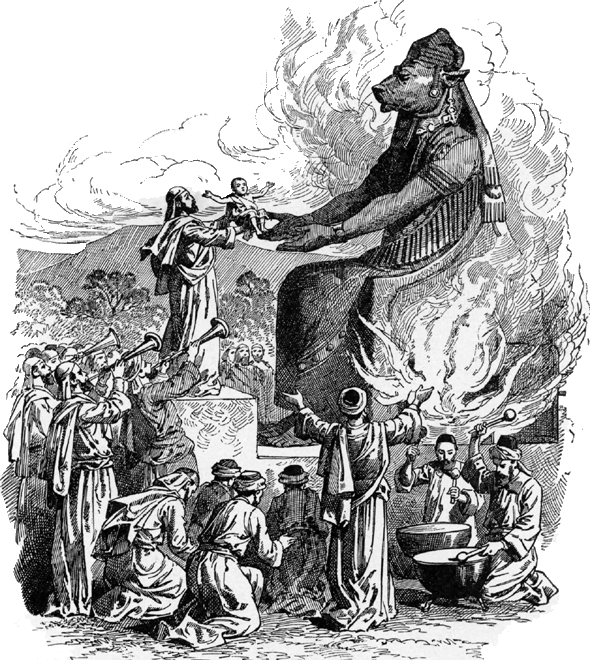
These are dark days for Israel and their kings. Solomon has crossed over, and like his father David, has conspicuously gone to join “his ancestors” rather than God. Solomon began an open rebellion against God during his rule by marrying hundreds of wives from other lands. These wives practiced other religions and worshiped other gods. Solomon built temples, idols, and monuments to honor gods described as “detestable”.

This turning away feels very different than the slow fade the Israelites began soon after entering the promised land. Jeroboam was an official under Solomon and was given the rule of most of Israel (10 tribes) after Solomon’s death and the tearing apart of Israel under the harsh rule of Rehoboam, Solomon’s son. The line of David remains unbroken in Judah, but the rest of the tribes have placed themselves under the rule of Jeroboam.

God sends this unnamed “man of God” to rebuke Jeroboam and inform him that the line of David will retake Bethel and the altar will be broken.  For some odd reason this reminds me of the scene in Lord of the Rings when Gandalf returns to rebuke Saruman for joining with Sauron.  Sauromon’s magic staff is broken because he has used it for evil.  The altar here at Bethel will also be broken because it is being used for evil in God’s eyes.  The man of God refuses to even drink water with Jeroboam.  He does not want to be part of his dysfunctional and broken relationship with God.

How did the Israelites get to this dark and dry place?  How will they get out?  Perhaps most importantly, how can we avoid doing the same thing ourselves?  As I have been reflecting and praying about this I think the theme that has bubbled to the top is one of generational sin and an active turning away from the source of living water, God.

Back in Exodus God said “You shall not bow down to them or worship them; for I, the LORD your God, am a jealous God, punishing the children for the sin of the parents to the third and fourth generation of those who hate me”  David began the slide into generational sin when he stole Bathsheba and killed Uriah.  Solomon took this to a whole new level when he married hundreds of wives and adopted their religions.  Solomon’s son, Rehoboam became like Pharaoh, abusing his own workers and listening to advisers rather than God and His prophets.  How does one break this cycle of generational sin?

It seems to me that the first step is to acknowledge that you have sinned and confess that you cannot survive without “being connected to the spring” that is God.  My wife and I are both teachers, my wife as a fourth grade teacher and I am a professor at a university.  We both see the wreckage and brokenness of “no fault” divorce on kids and families.  I think that divorce and broken families are one of this generation’s, “generational sins”.  It is difficult to break the cycle of dysfunction once it has started in a family.  The only hope of reconciliation is through trusting God enough to heal our brokenness, and that starts with an admission that we are broken.

Prayer: God help us to heal our broken relationships by trusting in You and allowing your healing water to wash over us and our relationships.

Posted in 1 Kings, Christian Community, Christianity, Conflict, Discernment, Divorce, Faith, Following God, Forgiveness, Life Together, Obedience, reconciliation, Redemption, religion, Sin, Trusting God | Tagged , , , , , , | Leave a comment

Apes and Baboons

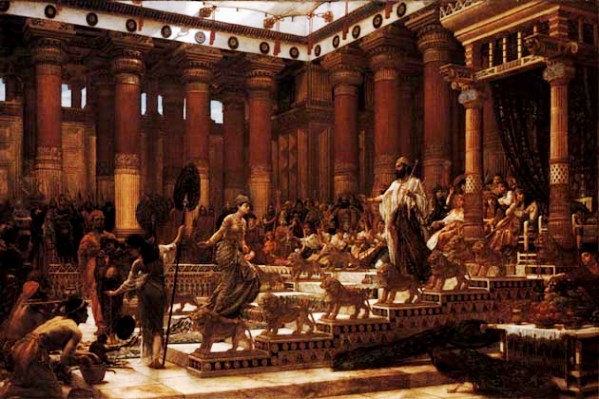
Then the king made a great throne covered with ivory and overlaid with fine gold.  The throne had six steps, and its back had a rounded top. On both sides of the seat were armrests, with a lion standing beside each of them. Twelve lions stood on the six steps, one at either end of each step. Nothing like it had ever been made for any other kingdom.  All King Solomon’s goblets were gold, and all the household articles in the Palace of the Forest of Lebanon were pure gold. Nothing was made of silver, because silver was considered of little value in Solomon’s days.  The king had a fleet of trading ships at sea along with the ships of Hiram. Once every three years it returned, carrying gold, silver and ivory, and apes and baboons.  King Solomon was greater in riches and wisdom than all the other kings of the earth. The whole world sought audience with Solomon to hear the wisdom God had put in his heart. Year after year, everyone who came brought a gift—articles of silver and gold, robes, weapons and spices, and horses and mules. – 1 Kings 10:18-25

Okay, I have to admit I don’t get the apes and baboons thing. I suppose Solomon may have wanted apes and baboons to be exotic or perhaps to highlight his wealth and trading abilities.  It sounds like Solomon has set up a complex trading network which was quite advanced and well-established for the time.

Solomon does not do anything halfway, he goes big with his throne, the temple, and the palace.  It seems like Solomon is very comfortable in his wisdom and wealth.   Sometimes when we get comfortable we stop thinking and pursuing God.  There is little evidence, other than the public dedications, that Solomon’s life is dedicated to God.

Solomon also seems to be taking his affluence  and influence to extremes.  His palace is ornate and uses only gold goblets.   Material wealth can be a blessing and a curse.  It all depends on one’s posture and perspective toward the earthly things that God has entrusted us with, and the ability of those things to prevent us from faithfully following God.

Solomon’s father David took Uriah’s wife, the wreckage and collateral damage of this choice transformed David’s life.  We will find out soon, in a subsequent passage, that Solomon has taken 700 wives from royal households and has 300 concubines.  This choice will also lead to many problems with idols and falling away from God.

Solomon excels at being an earthly leader, but he fails the “Meribah Test“.  His priorities and choices will lead the Israelites far away from God for generations of leaders.  It will take many prophets and attempts to get them to turn back to God.

Prayer: God help us to keep our material wealth in perspective.

Posted in 1 Kings, Covenant, Following God, The Nature of God, wealth, Wisdom | Tagged , , , , , , | Leave a comment

Resolution and Riches

King Solomon also built ships at Ezion Geber, which is near Elath in Edom, on the shore of the Red Sea.  And Hiram sent his men—sailors who knew the sea—to serve in the fleet with Solomon’s men. They sailed to Ophir and brought back 420 talents of gold, which they delivered to King Solomon. – 1 Kings 9:26-28

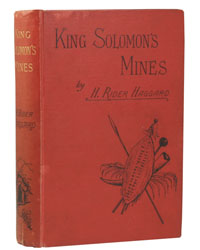
This passage is one of the passages that gave rise to the famous obsession with “King Solomon’s Mines”.  The fiction book, written in 1885 by Sir H. Rider Haggard, tells the story of the epic search for these rich deposits of gold used by Solomon.  It was the original “Indiana Jones” story.  It has been made into movies numerous times.  These lost mines clearly sparked the imagination of both readers and movie-viewers alike.

If the theme of David’s life and rule was conflict and war, it seems that King Solomon will be known for wealth and “industry”.  Solomon seems to be more interested in building alliances and trading partners than battling foes.  I am not sure why there is this fundamental difference in perspective but clearly David wanted a different life for his son — giving him the name Solomon which means peace.

The connection to water in this passage is brief and difficult to extract much deeper meaning from.  The water mentioned, the Red Sea, is not being parted by God, but rather is being used to house a fleet of ships — a navy if you will — that Solomon has put together with the help of Hiram and his “sea fairing” men.  In this passage the main purpose of the fleet seems to be to bring back riches (420 talents of gold).  There seems to be a focus on acquiring things for Solomon and in displaying those things in a flamboyant and dramatic way.

The tension or dissonance in David’s life was between the relationship he had with God and the distractions of clashing clans; poor moral choices; and broken alliances.  It seems Solomon’s relationship with God will have to compete with his love of knowledge, women, and his ability to form earthly alliances and business partnerships.  The working out of this tension between each man’s God given talent, and the God who gave it to them, defines their life-trajectories.

This type of tension that David and Solomon are experiencing is not unique to them.  I know there is a tension in my life that I think is similar and I suspect I am not alone in this.  The tension for me is between a scientific, rational, and naturalistic worldview which I encounter and utilize in my profession as a researcher and scientist; and my emotional, spiritual, and metaphysical desire to follow God where he leads.  This blog is an effort to explore, reflect, and hopefully reconcile these two streams of my life.  I think David was intermittently successful in resolving the tension in his life and we will see as we learn more about Solomon whether he is able to resolve his life-tension.  I know for me the resolution is a process rather than an event.

Prayer: God help us to identify those aspects of our lives which cause tension and make it more difficult to faithfully follow You.


Posted in 1 Kings, Conflict, Discernment, Faith, Following God, Obedience, religion, The Earthly Realm, The Spiritual Realm, Trusting God, Wisdom | Tagged , , , , , | Leave a comment

Will God Really Dwell on the Earth?

IMGP4561“But will God really dwell on earth? The heavens, even the highest heaven, cannot contain you. How much less this temple I have built! Yet give attention to your servant’s prayer and his plea for mercy, Lord my God. Hear the cry and the prayer that your servant is praying in your presence this day. May your eyes be open toward this temple night and day, this place of which you said, ‘My Name shall be there,’ so that you will hear the prayer your servant prays toward this place. Hear the supplication of your servant and of your people Israel when they pray toward this place. Hear from heaven, your dwelling place, and when you hear, forgive.   “When anyone wrongs their neighbor and is required to take an oath and they come and swear the oath before your altar in this temple, then hear from heaven and act. Judge between your servants, condemning the guilty by bringing down on their heads what they have done, and vindicating the innocent by treating them in accordance with their innocence.   “When your people Israel have been defeated by an enemy because they have sinned against you, and when they turn back to you and give praise to your name, praying and making supplication to you in this temple, then hear from heaven and forgive the sin of your people Israel and bring them back to the land you gave to their ancestors.   “When the heavens are shut up and there is no rain because your people have sinned against you, and when they pray toward this place and give praise to your name and turn from their sin because you have afflicted them, then hear from heaven and forgive the sin of your servants, your people Israel. Teach them the right way to live, and send rain on the land you gave your people for an inheritance. – 1 Kings 8:27-36

Solomon is giving a “dedication” of sorts to the temple and asking himself and the Israelites a question that I think many Christians ask themselves…Can God really dwell on earth?  Can the God of the universe love me?  Can God dwell within me?  I think the answer to these questions for those willing to faithfully follow God is yes!

When Jesus showed up in Bethlehem as a Human baby God demonstrated that He really could dwell on earth — not in a temple built by human hands. God answered the rhetorical question posed by Solomon and, in a broad sense, all of humanity.

Jesus also makes the incredible claim that God desires to dwell in us. I think sometimes Christians loose sight of this simple truth.  God does not dwell in church buildings no matter how beautiful, solemn, or endowed with espresso bars — He dwells in each of us. As A.W. Tozer said in his book, the Pursuit of God “if my fire is not large it is yet real, and there may be those who can light their candle at it’s flame.”  We must gather together to pass more than the offering plate and the attendance register — we are called to pass the very flame of God’s love.

Solomon in his prayer suggests that when the heavens are “shut up” we, the people, are to ask for forgiveness for our sins so that God will restore rain on the land and we will have our inheritance.  This rich water imagery is reminiscent of some of the language used when God suggested in Deuteronomy that He would send rain on tender plants (us).  There is more at stake than dead plants when the heavens are “shut up”.

The equivalent of the heavens being shut up in the spiritual realm is for our lives to feel spiritually dry or dead — disconnected from God’s life giving rain and living water.  I think many Christians experience dry spiritual times.  Sometimes these dry times are just part of the spiritual cycle that brings both heavy rain and drought, but dry times can also be because we have moved away from God and His life giving rain.  It is reassuring that God promises to send rain if we seek his forgiveness and confidently “pray for rain”.

Prayer: God thank you for the life giving rain you provide and the fire you have placed in us.  Help us to confidently pray for rain during dry spiritual times and “pass the flame” when we gather. 

Posted in 1 Kings, Christian Community, Christian Leadership, Christianity, Covenant, Discipleship, Faith, Following God, Forgiveness, Redemption, religion, Sin, The Spiritual Realm | Tagged , , , , , , , | Leave a comment

Eddying Out – Whitewater and Doldrums

Taptap_haiti

Tap Tap “taxi/bus” in Haiti

Some of you may have noticed I took a brief hiatus from my walk with water and the bible yesterday…I was detained and distracted by my journey from a rural hospital in Deschapelles, Haiti to the Embassy Suites Hotel in Miami, Florida.  The distance between these two places is great — geographically, economically, and culturally.  I thought I would take some time to recount and reflect on this physical and cultural journey.

I woke up the day of my departure in a guest house at Hôpital Albert Schweitzer (HAS) called “Kay alumni”, which means Alumni House in Creole.  This is the place doctors, nurses, and researchers like myself stay when they visit the hospital.  It is a modest cinder block house with no air conditioning or hot water, hardly roughing it, but not the Embassy Suites either.  I was awoken several times during the night by roosters who seem to have some issues trying to time their crowing to coincide with the actual sunrise.  When the sun finally rose so did I.  The roosters, by the way, were largely silent at this time…

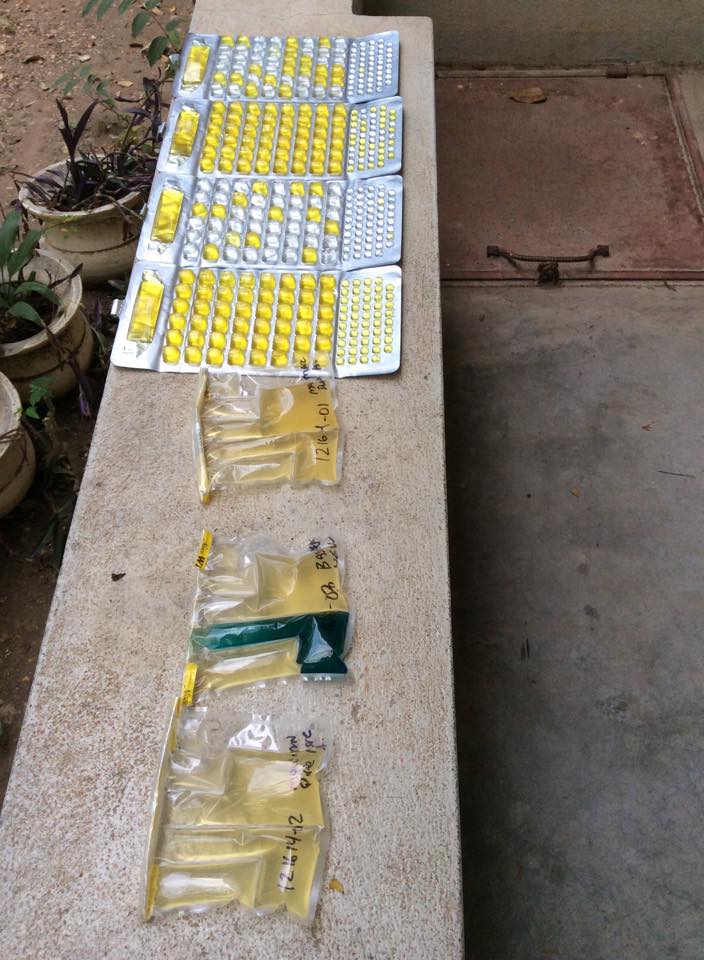
1509899_10102278332874675_8450506104563011314_nI shared breakfast of fresh Haitian bananas, coffee, tea, corn flakes, and bread with an engineer from Germany installing solar panels for the hospital; a videographer documenting what the hospital does; an undergrad from the U.S who had just arrived in Haiti for a month on his break, and a colleague from my university who I am travelling with to explore bringing students to Haiti on a study abroad trip in 2016.  After breakfast I went to “read” the bacterial results for well water samples we had taken from two experimental wells the previous day…good news…no e. Coli in the samples.

This was my colleague’s first trip to Haiti so I wanted to show him a local market.  We arranged for the driver who was taking us to the airport to take us to the Saturday market in Verrettes, about 10 minutes by car.   We invited the undergrad student along, who had arrived the night before, so he could see it as well.  The market was a hustling and bustling hive of activity with hundreds of people all occupy the space of a small grocery store in the U.S.  Many travel on foot for hours to bring items down from the mountains to sell at the market.  Each vendor has a stall about three feet by three feet.  There are loose “departments” or sections in the market such as the fruit, sugar cane, housewares, rice, and meat.  There is even a “food court” where many large pots of rice and beans and other take out food is prepared.  The “floor” of the market is a well worn and compacted mixture of dirt, debris, and assorted liquids (some of which it is best not to think about).

We made a quick transit of the market and purchased some mangos for the videographer back at Kay Alumni.  I made a quick stop to say hello to a family who lives in Verrettes near the market.  We returned to HAS after a brief detour to Kay Ayiti, the only hotel in Dechapelles, to say goodbye to the owner, Legrand Mellon, who had graciously hosted us for dinner and her famous rum punches the night before.  Ms. Mellon, known to the locals as madam “B”, described the Haitian markets as a ballet… I second her description.

We returned to Kay alumni, grabbed our bags, and said our goodbyes.  We piled in the Toyota Land cruiser with our luggage and three other passengers bound for Port au Prince.  The road from Deschapelles to Port au Prince is actually pretty good and we made good time until we approached the Port au Prince suburbs.  We dropped off our first passenger, a young Haitian girl about 12, at a bustling intersection west of the city where “tap taps” were lined up and making u-turns in the middle of the street to return to PAP with a load of passengers.  Tap taps are the Haitian equivalent of mass transit…sort of a cross between a taxi, a bus, and a broken down Toyota truck.  Imagine a small Toyota truck with 20 or more people in the back…I was thankful for our Landcruiser with just 6.

HaitiRoadAfter a few more miles of winding down bumpy dirt roads we arrived at the depot where we stretched, waited, and dropped off two more passengers.  The depot is a house near PAP that HAS uses to store supplies, and sometimes people.  I spent a long four hours there once on a previous trip.  We loaded up for the final leg of our journey to a hotel called Visa Lodge near the airport, where we could have lunch, drink Prestige beer and rum punch, and wait for our afternoon flight.

On the way to Visa Lodge the driver encountered heavy traffic approaching the airport.  He clearly had driven this route many times and he knew of many shortcuts and “alternate” routes.  One such alternate was a sketchy looking two-track through an interesting section of town, but we emerged onto an actual road that conveyed us to Visa Lodge with minimal traffic delay.  We had a lunch of pepperoni pizza and grilled chicken to go with our Prestige beer.

We called for an airport shuttle about three hours before our flight.  It took the airport shuttle about 40 minutes to go 2 miles to come pick us up and the driver was not optimistic about getting back to the airport any faster.  The drive to the airport was…..what is the right word….invigorating.  A true “whitewater” experience.  Each time we encountered seemingly impassable traffic obstructions the driver found new and interesting ways to proceed.  This included: driving behind a police car on the wrong side of the road; driving down the sidewalk for a short way, and a detour through a gas station.  Creative driving at it’s best!

We arrived at the PAP airport and got checked in for our flight.  We found the waiting area under construction, and entered the doldrums of delay….our flight was going to arrive at least 2 hours late from Guadalupe. The construction meant no air conditioning and more mosquitoes than we had encountered on the trip so far…I wish I had remembered that I had bug towelettes in my pack.

We waited, then went through a final security check, then waited, then proceeded to the gate, then waited, got to the plane door, then waited.  We finally got settled in, flew to Miami, caught a cab to the Embassy Suites Hotel, got to our room….and collapsed 🙂   The entire trip from rural Haiti to modern Miami had taken about 14 hours…

It is hard to put into perspective the economic gulf that separates the beginning from the end of our journey.  I suspect a fraction of the annual operating budget of our Miami hotel could support HAS for a year to heal hurting Haitians.  Haitians are amazing at making what little they have work for them.  It seems many in the U.S., myself included, often do little with a lot of resources.  If you or someone you know has funds they would like to donate to help Haiti please consider HAS….they are doing a lot with little resources.

Prayer: Thank You God for protecting me on my journey both today and always.

Posted in Christianity, Eddying Out, Faith, Haiti, Love for the Lost, Trusting God, Uncategorized | Tagged , , , , , , | Leave a comment

A Cloud in the Temple

Clouds over Haiti

Clouds over Haiti, December 2014

The priests then brought the ark of the Lord ’s covenant to its place in the inner sanctuary of the temple, the Most Holy Place, and put it beneath the wings of the cherubim. The cherubim spread their wings over the place of the ark and overshadowed the ark and its carrying poles. These poles were so long that their ends could be seen from the Holy Place in front of the inner sanctuary, but not from outside the Holy Place; and they are still there today. There was nothing in the ark except the two stone tablets that Moses had placed in it at Horeb, where the Lord made a covenant with the Israelites after they came out of Egypt.   When the priests withdrew from the Holy Place, the cloud filled the temple of the Lord . And the priests could not perform their service because of the cloud, for the glory of the Lord filled his temple.   Then Solomon said, “The Lord has said that he would dwell in a dark cloud; I have indeed built a magnificent temple for you, a place for you to dwell forever.”   While the whole assembly of Israel was standing there, the king turned around and blessed them. Then he said: “Praise be to the Lord , the God of Israel, who with his own hand has fulfilled what he promised with his own mouth to my father David. For he said, ‘Since the day I brought my people Israel out of Egypt, I have not chosen a city in any tribe of Israel to have a temple built so that my Name might be there, but I have chosen David to rule my people Israel.’ – 1 Kings 8:6-16

This is an interesting passage.  Solomon has just finished completing a very ornate and decorated temple for God….and God has shown up.  God shows up as a Godly condensate…an elemental God rather than one adorned like the temple.

This is the first earthly place God chose to “inhabit”.  Up to this point God has appeared to the Israelites as a Consuming fire or permeating cloud.  God dwelling in the temple built by Solomon fulfilled God’s promise to David, although David did not get to build the temple or welcome God into it.  David had to “train his replacement” when he gave the leadership and covenant over to Solomon knowing that he would not get to build the temple for God.

I find it intriguing that God did not show up until the priests left the temple.  Either they were not ready for God or God was not ready for them.  It is very awe-inspiring that God now dwells within those who faithfully follow Him.  We do not need to “leave the temple”, God actually enters the temple of our bodies with us still in it!  How amazing is that!

I return from Haiti tomorrow and will be able to focus more “bandwidth” on my walk with water.  I have had many interesting adventures here in Haiti and I remain convinced that water is life, especially for Haiti.

Prayer: It is amazing that You have chosen to dwell within us as believers in Christ.  Thank you that we no longer need to “leave the temple”.

Posted in 1 Kings, Covenant, Discipleship, Faith, Following God | Tagged , , , , , , | Leave a comment

Sprinkling Bowls

He then made ten bronze basins, each holding forty baths and measuring four cubits across, one basin to go on each of the ten stands. He placed five of the stands on the south side of the temple and five on the north. He placed the Sea on the south side, at the southeast corner of the temple. He also made the pots and shovels and sprinkling bowls. So Huram finished all the work he had undertaken for King Solomon in the temple of the Lord :   the two pillars; the two bowl-shaped capitals on top of the pillars; the two sets of network decorating the two bowl-shaped capitals on top of the pillars;   the four hundred pomegranates for the two sets of network (two rows of pomegranates for each network decorating the bowl-shaped capitals on top of the pillars);   the ten stands with their ten basins;   the Sea and the twelve bulls under it;   the pots, shovels and sprinkling bowls. All these objects that Huram made for King Solomon for the temple of the Lord were of burnished bronze. – 1 Kings 7:38-45

Water was clearly prominent in Solomon’s new temple for the Lord. Bronze seas and sprinkling bowls…Solomon was expressing his own unique style of worshiping God through the design of the temple. What does this tell us about Solomon and the relationship he will have with God? My cynical side would tell me Solomon is favoring style over substance, but a more generous reading would be that Solomon is trying to create a place of reflection (literally in the case of the pools of water) and reverence. I suspect time will tell where Solomon’s true heart lies.

It is not clear to me why the sprinkling bowls are called “sprinkling bowls”. Was the sprinkling part of being clean or unclean? Who was sprinkled – the priests or the people? Some churches have a permanent baptismal. We use a temporary baptismal at our church, which is setup once or twice a year. In the summer we gather at Lake Michigan and people are baptized amid the waves and sand…this is one of my favorite events in our Christian community.

The idea of having a bowl of water at our places of worship is intriguing… why not? I think they have basins of holy water in catholic churches, but I am not Catholic so I am not sure what is done with the holy water. Perhaps this is a tradition worth adopting in non-Catholic churches. The “holy water” would not be made holy by a blessing from clergy, but it could serve as a reminder that we are called to bless one another every time we gather. A symbol of the living water within each of us that we are called to share.

Prayer: God help us to sprinkle one another with Your Spirit that is within us.

SDG
Posted in 1 Kings, Christian Community, Christian Leadership, Christianity, Life Together, Love for the Lost, Redemption, religion, Sin | Tagged , , , , , | 1 Comment

A Big Bath!

image

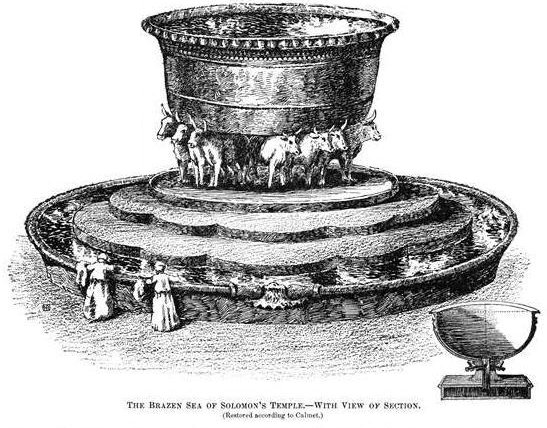
He cast two bronze pillars, each eighteen cubits high and twelve cubits in circumference.  He also made two capitals of cast bronze to set on the tops of the pillars; each capital was five cubits high. A network of interwoven chains adorned the capitals on top of the pillars, seven for each capital. He made pomegranates in two rows encircling each network to decorate the capitals on top of the pillars. He did the same for each capital. On the capitals of both pillars, above the bowl-shaped part next to the network, were the two hundred pomegranates in rows all around. He erected the pillars at the portico of the temple. The pillar to the south he named Jakin and the one to the north Boaz.  The capitals on top were in the shape of lilies. And so the work on the pillars was completed.   He made the Sea of cast metal, circular in shape, measuring ten cubits from rim to rim and five cubits high. It took a line of thirty cubits to measure around it. Below the rim, gourds encircled it—ten to a cubit. The gourds were cast in two rows in one piece with the Sea.   The Sea stood on twelve bulls, three facing north, three facing west, three facing south and three facing east. The Sea rested on top of them, and their hindquarters were toward the center. It was a handbreadth in thickness, and its rim was like the rim of a cup, like a lily blossom. It held two thousand baths. – 1 Kings 7:15-18, 20-26

I am in Haiti at the moment exploring possibilities for bringing students to study down here. Since bandwidth is limited here, both internet and my own personal “bandwidth”, the posts for the next couple of days may be a bit terse.

Solomon is finishing the temple in style. He has enlisted the help of an expert bronze caster. The decorations sound truly amazing. In addition to numerous bronze objects Solomon commissioned a “bronze sea”. This swimming pool sized object was filled with water and is thought to symbolize the Red Sea that was parted to save the Israelites from the Egyptians — sort of an uber baptismal.

It is not entirely clear what this large container of water would be used for — perhaps it was just for decoration? Apparently the 12 bulls represent the twelve tribes of Israel. There is also some speculation about the symbolic connection between this body of water, present in the temple, and God’s presence in the temple. There is a way that the kingdom of God is like a sea and we, or at least our spirits, can join this sea when we choose to be with God.

Our “drop of soul” joins the great sea of God’s presence. What is amazing about this joining is that from what I have read and understand we remain distinct even though we join the great sea. God still loves all of the drops of soul.

Prayer: Thank you God that you love every drop of soul in the sea of your presence.

.

Posted in 1 Kings, Faith, Following God, religion, The Spiritual Realm | Tagged | Leave a comment

Wood Rafted for Worship

wpid-img_20141212_212827.jpg

Western Red Cedar Star I made in college

When Hiram king of Tyre heard that Solomon had been anointed king to succeed his father David, he sent his envoys to Solomon, because he had always been on friendly terms with David. Solomon sent back this message to Hiram: “You know that because of the wars waged against my father David from all sides, he could not build a temple for the Name of the Lord his God until the Lord put his enemies under his feet. But now the Lord my God has given me rest on every side, and there is no adversary or disaster. I intend, therefore, to build a temple for the Name of the Lord my God, as the Lord told my father David, when he said, ‘Your son whom I will put on the throne in your place will build the temple for my Name.  So give orders that cedars of Lebanon be cut for me. My men will work with yours, and I will pay you for your men whatever wages you set. You know that we have no one so skilled in felling timber as the Sidonians.”   When Hiram heard Solomon’s message, he was greatly pleased and said, “Praise be to the Lord today, for he has given David a wise son to rule over this great nation.”   So Hiram sent word to Solomon: “I have received the message you sent me and will do all you want in providing the cedar and juniper logs. My men will haul them down from Lebanon to the Mediterranean Sea, and I will float them as rafts by sea to the place you specify. There I will separate them and you can take them away. And you are to grant my wish by providing food for my royal household.” – 1 Kings 5:1-9

Solomon has taken over the reigns of ruling the Israelites.  He is in the process of trying navigate alliances and relationships forged by his father King David.  Hiram, a king in a nearby kingdom, is attempting to build a new relationship with Solomon by collaborating on the building of a new temple in Jerusalem.

I find it interesting that Solomon’s first priority as king is to rebuild the temple and a place for the Ark of the Covenant.  He explained that David could not do this because he was too busy being chased and chasing those around him.  I suspect part of the reason was also the “stuck” position that David felt he was in due to past decisions.

Solomon shows wisdom in knowing what his men were skilled at and what tasks he should entrust to others. He enlists the help of Sidonian woodworkers to obtain the cedars for the temple.  It turns out that Solomon builds the entire temple mostly out of wood instead of stone.  the foundation is stone, but the everything on the inside is wood.  I am not sure why this is.  Perhaps he wants to establish that his rule and kingdom will be different than David’s.  Building the temple first and then going about the task of ruling – with wisdom.

Cedar is one of my favorite woods.  Where I grew up in Western Washington we had a cedar variety called Western Red Cedar.  These trees grow very tall and have droopy branches that look a bit like arms reaching up toward heaven.  One of the reasons I like cedar is that it is very soft and workable.  It splits easily along the grain and even a novice craftsman like myself can make cool things.

I think Solomon is already showing that he is somewhat more “workable” than David was when he was King.  Solomon is using wisdom rather than war.  Wisdom is an interesting concept. It is different than intelligence. I think if we are honest we have all known people who are very intelligent but not very wise. What is the difference between wisdom and intelligence? I think the fundamental difference lies in the ability to place knowledge and experience in a context that gives it meaning.  Wisdom connects facts and “factions” to develop workable solutions.

Water comes into this passage as a vehicle for floating the cedars to Jerusalem on the Mediterranean sea.  This would have been a much easier means of transporting these very heavy trees whose density allowed them to float on water.  The trees were essentially “walking on water”.

Prayer: God give us wisdom to weigh our actions and the actions of those around us.

Posted in 1 Kings, Conflict, Covenant, Faith, Following God, religion, Wisdom | Tagged , , , , , , , , | Leave a comment

David’s Final Crossing

IMGP5534Now you yourself know what Joab son of Zeruiah did to me—what he did to the two commanders of Israel’s armies, Abner son of Ner and Amasa son of Jether. He killed them, shedding their blood in peacetime as if in battle, and with that blood he stained the belt around his waist and the sandals on his feet. Deal with him according to your wisdom, but do not let his gray head go down to the grave in peace.   “But show kindness to the sons of Barzillai of Gilead and let them be among those who eat at your table. They stood by me when I fled from your brother Absalom.   “And remember, you have with you Shimei son of Gera, the Benjamite from BahuriFim, who called down bitter curses on me the day I went to Mahanaim. When he came down to meet me at the Jordan, I swore to him by the Lord : ‘I will not put you to death by the sword.’ But now, do not consider him innocent. You are a man of wisdom; you will know what to do to him. Bring his gray head down to the grave in blood.”   Then David rested with his ancestors and was buried in the City of David. He had reigned forty years over Israel—seven years in Hebron and thirty-three in Jerusalem. So Solomon sat on the throne of his father David, and his rule was firmly established – 1 Kings 2:5-12.

Well we have arrived in the book of 1 Kings.  David is still alive despite the “last words” shared in the end of the book of 2 Samuel.  I do believe that this is David’s final crossing over.  David is speaking to his son Solomon, who he has chosen to be his successor, with the help of some encouragement from Solomon’s mother Bathsheba.

The reference to water is a fleeting one where David describes meeting Shimei at the Jordan River when Shimei was offering his Mea Culpa for joining with Abasalom and his armies to fight David.   This description is embeded within a long line of directives that David is providing to Solomon before he dies — sort of a kingly “to do” list.

Solomon’s “to do” list sounds more like something out of the “sopranos”.  David is for killing Joab who was a military leader under David, and Shimei who David had vowed not to harm (at least while he was alive).  Apparently David feels like when he is gone Solomon can use his wisdom to deal with these men as he sees fit, but David wants to “send their gray heads down to the grave in blood”.

I guess much of this retribution is intended to firmly establish Solomon’s rule so that no one doubts that he is rightful king.  It is interesting that God is not mentioned at all in this passage about the final crossing over.  David is merely said to join his ancestors in the city of David.  There is no mention or sense that David is going to join God.

I hope when it comes time for my final crossing over that I will have other things on my mind than myself or my heirs.  I know that this is hard and as one gets older it is tempting to become more self focused and absorbed.  My hope and prayer is that my final pouring out will be anticlimactic because there is nothing left to pour out.

Prayer: God help me to live each day with the intention to pour part of myself out for You and for others so that when my time comes I am all poured out.


Posted in 1 Kings, Covenant, Death and Dying, Faith, Following God, Obedience, religion, The Earthly Realm | Tagged , , , , , , , , | Leave a comment