Blurred Blessings

The Philistines went up and camped in Judah, spreading out near Lehi. The people of Judah asked, “Why have you come to fight us?” “We have come to take Samson prisoner,” they answered, “to do to him as he did to us.”   Then three thousand men from Judah went down to the cave in the rock of Etam and said to Samson, “Don’t you realize that the Philistines are rulers over us? What have you done to us?” He answered, “I merely did to them what they did to me.”   They said to him, “We’ve come to tie you up and hand you over to the Philistines.” Samson said, “Swear to me that you won’t kill me yourselves.”   “Agreed,” they answered. “We will only tie you up and hand you over to them. We will not kill you.” So they bound him with two new ropes and led him up from the rock. As he approached Lehi, the Philistines came toward him shouting. The Spirit of the Lord came powerfully upon him. The ropes on his arms became like charred flax, and the bindings dropped from his hands. Finding a fresh jawbone of a donkey, he grabbed it and struck down a thousand men.   Then Samson said, “With a donkey’s jawbone I have made donkeys of them.  With a donkey’s jawbone I have killed a thousand men.”   When he finished speaking, he threw away the jawbone; and the place was called Ramath Lehi.    Because he was very thirsty, he cried out to the Lord , “You have given your servant this great victory. Must I now die of thirst and fall into the hands of the uncircumcised?” Then God opened up the hollow place in Lehi, and water came out of it. When Samson drank, his strength returned and he revived. So the spring was called En Hakkore, and it is still there in Lehi.   Samson led Israel for twenty years in the days of the Philistines. – Judges 15:9-20

Sampson is one of the biblical “super heroes”.  He is a character that people learn about in Sunday school.  I guess because he was a colorful and interesting character.  Sampson arrives on the scene in this passage while the Israelites are toiling under the rule of the Philistines.  Sampson kills a thousand Philistines with a donkey’s jawbone. I am left wondering what the 999 were doing while the first soldier was wacked by the jawbone. This is either a miraculous melee or it is hyperbole.  In the world of DC comics Samson may have been dubbed “Jawbone”, kind of like Thor and his hammer only with longer hair.

After dispatching the Philistines Sampson is parched and a bit demanding and grumpy.  He complains to God “must I now die of thirst”.  God shows up, even though Sampson gives him only backhanded credit…” You have given your servant this great victory.” God provided a hidden spring for Sampson from which he could drink and be revived.

The gratitude that Sampson shows for God showing up and giving him the strength to defeat the Philistines seems only grudgingly given. Why is the relationship between these characters and God so distant from the God who sees us and carries us like a son or daughter?

The comfortable coffin that the Promised Land has become seems to have created a barrier between God and His people. God predicted this failure to remember when the Israelites first crossed over the Jordan. I think it provides an important lesson in the complacency that can come when we get too comfortable. How many times do we take God’s blessings for granted when everything is going well in our lives?

I feel like if someone were to ask Sampson about this incident he would have replied with a statement like “I was thirsty so God provided water for me…no big deal”. It is so easy to careen through our busy lives and fail to stop and remember ways God has shown up. I am certainly guilty of operating in “full on” or “full off” mode and blowing by blessings.

It is a little like looking out of a train window as we rush by the beautiful scenery, all becomes a blur. It is only when we hop off the train that we can observe the details and delight in what we see. Of course hopping off the train means we will delay our journey and have to wait for the next train… Sampson, and many of the Israelite leaders, seem like they are “on the train” unwilling to get off to appreciate God’s glory.

Prayer: God help us to “get off the train” and take time to appreciate the amazing ways you show up in our lives.

Posted in Covenant, Faith, Following God, Judges, Miracles, religion, The Nature of God | Tagged , , , , , , , , , , , | Leave a comment

Gatekeepers

IMGP4783

The Ephraimite forces were called out, and they crossed over to Zaphon. They said to Jephthah, “Why did you go to fight the Ammonites without calling us to go with you? We’re going to burn down your house over your head.” Jephthah answered, “I and my people were engaged in a great struggle with the Ammonites, and although I called, you didn’t save me out of their hands. When I saw that you wouldn’t help, I took my life in my hands and crossed over to fight the Ammonites, and the Lord gave me the victory over them. Now why have you come up today to fight me?” Jephthah then called together the men of Gilead and fought against Ephraim. The Gileadites struck them down because the Ephraimites had said, “You Gileadites are renegades from Ephraim and Manasseh.” The Gileadites captured the fords of the Jordan leading to Ephraim, and whenever a survivor of Ephraim said, “Let me cross over,” the men of Gilead asked him, “Are you an Ephraimite?” If he replied, “No,” they said, “All right, say ‘Shibboleth.’ ” If he said, “Sibboleth,” because he could not pronounce the word correctly, they seized him and killed him at the fords of the Jordan. Forty-two thousand Ephraimites were killed at that time. Jephthah led Israel six years. Then Jephthah the Gileadite died and was buried in a town in Gilead. – Judges 12:1-7

This verse is appropriate for Halloween…it is really scary on many levels. Judges just moved right up there with Leviticus in terms of confusing and hard to understand books of the bible for me. There are so many “—ites” killing each other that I am losing track. I feel like I need to diagram the destruction to even understand who is fighting with who and, more importantly, why they are fighting. There seems to be a preoccupation with saving face, seeking revenge, and exacting retribution. How can the same God be in favor of burning people alive in their homes and allow himself to be flogged and nailed to a cross?

It seems there are at least two possibilities: 1) God really does have these two natures that would allow burning and blessing; or 2) these people are very confused about what God is leading them to do and say. I believe that there are consequences to actions we take on earth, and some of these consequences may seem really harsh from an earthly perspective, but directing someone to burn someone else alive just seems beyond justice no matter what the offence. There is a point where we must love them all and let God sort them out.

The last part of the verse is equally horrifying and confusing. The Gileadites were parked at the Jordan River, the entrance to the Promised Land, and they were engaged in extreme racial profiling. Anyone not able to pronounce “Sibboleth” was immediately branded an Ephraimite and condemned to death. 42,000 Ephraimites were killed this way. The Gileadites became the self appointed gatekeepers for the Promised Land. I find it hard to believe this is what God intended when He led the Israelites to cross over the Jordan. Although I have never killed someone for the way they pronounced a word, but I did have an experience when I was in first grade that sticks with me to this day.

A friend and I were both in first grade and feeling like big wheels because we had graduated from kindergarten. We were bored one recess and did something really stupid. To be honest I cannot recall whose idea it was but we decided to assert our new found position of power (as first graders) by standing in front of one of the entrances to the playground. My friend and I appointed ourselves gatekeepers and kept all the kindergarten kids from getting to school. Our reign of terror did not last long and we both found ourselves in the vice-principal’s office up to our ears in well-deserved trouble.

I have reflected on this day many times and it has made me keenly aware of bullies and how they behave. Fortunately my brush with ” bullyhood” made me choose a path to avoid playing that role ever again, and it gave me a heart for those on the receiving end of bullying. The past several chapters of Judges, including this section, seem brim full of bullies. People and groups who feel they are more powerful than other people and groups. People who apply a litmus test to see who is like them and who is not. I am confident God is not a bully, and I find it hard to believe he would be leading these people to become bullies in His name.

I think sometimes we as Christians and our churches can take on the character of a bully when we meet those who are different than us with condemnation rather than love. God wants us to speak the truth in love to be sure, but we need to be careful that we do not become gatekeepers for His grace and glory.

Prayer: God help us to meet those who are different from us with blessings rather than blades of condemnation.

Posted in Christian Community, Following God, Judges, Life Together, Love for the Lost, Redemption, Sin, The Nature of God, The Spiritual Realm | Tagged , , , , , , , , , | Leave a comment

Pride over Praise

DCIM100SPORTNow the Ephraimites asked Gideon, “Why have you treated us like this? Why didn’t you call us when you went to fight Midian?” And they challenged him vigorously.   But he answered them, “What have I accomplished compared to you? Aren’t the gleanings of Ephraim’s grapes better than the full grape harvest of Abiezer? God gave Oreb and Zeeb, the Midianite leaders, into your hands. What was I able to do compared to you?” At this, their resentment against him subsided.   Gideon and his three hundred men, exhausted yet keeping up the pursuit, came to the Jordan and crossed it. He said to the men of Sukkoth, “Give my troops some bread; they are worn out, and I am still pursuing Zebah and Zalmunna, the kings of Midian.”   But the officials of Sukkoth said, “Do you already have the hands of Zebah and Zalmunna in your possession? Why should we give bread to your troops?”   Then Gideon replied, “Just for that, when the Lord has given Zebah and Zalmunna into my hand, I will tear your flesh with desert thorns and briers.”   From there he went up to Peniel and made the same request of them, but they answered as the men of Sukkoth had. So he said to the men of Peniel, “When I return in triumph, I will tear down this tower. – Judges 8:1-9

Gideon and his men were in hot pursuit of the Midianite army. Their plan, after crossing the Jordan River, was to get food from some of the Israelite tribes, people who should have been their ally. Unless I am mistaken these are the same Israelites who lived in the region of Deborah and Joshua. Perhaps they felt like they had a special relationship with God. When Gideon came with his 300 men, victorious over the Midianites with the help of God, they might have felt a little bit jealous. Gideon’s response seems a bit harsh — he felt like the Israelites were treating him and his men badly and he was really angry. He planned to come back and take his revenge (which we learn in the subsequent passages he does).

I can’t help but feel that this verse, and the Israelites souls, are riddled with pronouns like me, my, mine, and I. It seems that everyone is concerned most about themselves and what they will get in terms of glory, including Gideon. I do not think this was God’s idea when He asked the Israelites to cross over into the Promised Land. The focus of the Israelites is clearly not on following God unconditionally.

Gideon would have more reason than most to know and trust God. He seems to have quickly forgotten God showing up in the dew on the fleece and subsequently helping him win the battle with far fewer men than would be earthly possible. Rather than taking pride in the amazing work God has done it seems that Gideon and others are quick to do the very thing God was trying to prevent by reducing Gideon’s army.  They were taking the glory for the victory.  C.S. Lewis has some interesting insights into the spiritual dynamic here:

Evil begins, in a universe where all was good, from free will, which was permitted because it makes possible the greatest good of all. The corruption of the first sinner consists not in choosing some evil thing (there are no evil things for him to choose) but in preferring a lesser good (himself) before a greater (God). The Fall is, in fact, Pride. The possibility of this wrong preference is inherent in the very fact of having, or being, a self at all. But though freedom is real it is not infinite. Every choice reduces a little one’s freedom to choose the next time. There therefore comes a time when the creature is fully built, irrevocably attached either to God or to itself. This irrevocableness is what we call Heaven or Hell. Every conscious agent is finally committed in the long run: i.e., it rises above freedom into willed, but henceforth unalterable, union with God, or else sinks below freedom into the black fire of self-imprisonment. That is why the universe (as even the physicists now admit) has a real history, a fifth act with a finale in which the good characters “live happily ever after” and the bad ones are cast out. At least that is how I see it. – From The Collected Letters of C.S. Lewis, Volume II
 

Gideon’s fundamental weakness, or sin, was pride, even in the midst of chasing after an army God had given into his hands.  I am also familiar with pride.  It was one of the first renovation projects God started in my life when I first became a Christian – a process that continues today. God is still tearing out walls, rewiring, and trying to refurbish this part of my life.  There are times when I feel like this blog is merely a way to perpetuate my pride, and other times when I feel like I maintain the proper posture and perspective. When I remember to pause and pray for those sharing in this journey by reading, “liking” a post, or posting a comment I feel like I am faithfully following God and passing the Meribah Test.

Prayer: God help us to cling to You more tightly than we cling to our own pride.  

Posted in Covenant, Discipleship, Judges, Obedience, Trusting God | Tagged , , , , , | Leave a comment

Lappers and Leaners

Early in the morning, Jerub-Baal (that is, Gideon) and all his men camped at the spring of Harod. The camp of Midian was north of them in the valley near the hill of Moreh. The Lord said to Gideon, “You have too many men. I cannot deliver Midian into their hands, or Israel would boast against me, ‘My own strength has saved me.’ Now announce to the army, ‘Anyone who trembles with fear may turn back and leave Mount Gilead.’ ” So twenty-two thousand men left, while ten thousand remained.   But the Lord said to Gideon, “There are still too many men. Take them down to the water, and I will thin them out for you there. If I say, ‘This one shall go with you,’ he shall go; but if I say, ‘This one shall not go with you,’ he shall not go.”   So Gideon took the men down to the water. There the Lord told him, “Separate those who lap the water with their tongues as a dog laps from those who kneel down to drink.” Three hundred of them drank from cupped hands, lapping like dogs. All the rest got down on their knees to drink.   The Lord said to Gideon, “With the three hundred men that lapped I will save you and give the Midianites into your hands. Let all the others go home.” So Gideon sent the rest of the Israelites home but kept the three hundred, who took over the provisions and trumpets of the others. Now the camp of Midian lay below him in the valley. During that night the Lord said to Gideon, “Get up, go down against the camp, because I am going to give it into your hands. If you are afraid to attack, go down to the camp with your servant Purah and listen to what they are saying. Afterward, you will be encouraged to attack the camp.” So he and Purah his servant went down to the outposts of the camp. The Midianites, the Amalekites and all the other eastern peoples had settled in the valley, thick as locusts. Their camels could no more be counted than the sand on the seashore. – Judges 7:1-12

OK so now God just seems like he is showing off….I remember this story about picking men by how they drink water at a watering hole, but I have always mistakenly attributed it to Ghengis Khan.  I guess it just shows what interesting things one stumbles upon while trekking through the bible.  God seems to think the “lappers” are preferable to the “leaners” for picking an army.  I am not sure if that is because he wanted to pick the best or worst army based on the earlier part of the passage. Maybe he just wanted the smaller number and that happened to be the Lappers.

I am not sure what the cultural norm was at the time, but it seems like drinking water from cupped hands that had recently been grooming a horse, or worse, would be a recipe for communicable disease delivery. Of course if the water itself was contaminated it would not have made any difference whether you were a lapper or a leaner. Either way God has successfully whittled down Gideon’s army to the point that there could be no doubt that God will win the battle against the Midianites rather than the strength of the Israelites.

God wanted to make it clear that the battle, if won, belonged to His glory and the not the skill or superior numbers of the Israelites.  He reduced the army from around 30,000 to 300 men.  God seems to delight in “beating the odds”.  He often seems to choose what appears from an earthly perspective to be weak or broken carriers for His covenant. Gideon can join Noah, Moses, Joshua, and Deborah as imperfect carriers of His covenant. It seems like God does this not to show off but so that we notice Him showing up.

Does God still use imperfect people to share the love of Christ — imperfect carriers of His new covenant? I sure hope so because I am far from perfect and I hope I can share God’s love and new covenant with others.

My wife and I used to help with our high school youth group. The youth leader wisely suggested that we give the youth a memento during a retreat at the beach. I gave them a bookmark with these two verses: “In the same way, let your light shine before others, that they may see your good deeds and glorify your Father in heaven.” (Matthew 5:16) and “But we have this treasure in jars of clay to show that this all-surpassing power is from God and not from us (2 Corinthians 4:7). Following God is all about feeling confident we can do anything and nothing — without God.

Prayer: God give us the confidence to share your light and love, and the humility to know the source of that light and love.

Posted in Covenant, Discernment, Discipleship, Following God, Judges, Trusting God | Tagged , , , , , , , | Leave a comment

Decision from the Dew

Now all the Midianites, Amalekites and other eastern peoples joined forces and crossed over the Jordan and camped in the Valley of Jezreel. Then the Spirit of the Lord came on Gideon, and he blew a trumpet, summoning the Abiezrites to follow him. He sent messengers throughout Manasseh, calling them to arms, and also into Asher, Zebulun and Naphtali, so that they too went up to meet them. Gideon said to God, “If you will save Israel by my hand as you have promised— look, I will place a wool fleece on the threshing floor. If there is dew only on the fleece and all the ground is dry, then I will know that you will save Israel by my hand, as you said.” And that is what happened. Gideon rose early the next day; he squeezed the fleece and wrung out the dew—a bowlful of water. Then Gideon said to God, “Do not be angry with me. Let me make just one more request. Allow me one more test with the fleece, but this time make the fleece dry and let the ground be covered with dew.” That night God did so. Only the fleece was dry; all the ground was covered with dew. – Judges 6:33-40

“if you will save Israel by my hand”…whatever happened to doing things in God’s name? Gideon is making a deal with God. This seems to be a pattern of people-focused faith that was present in the Song of Deborah in yesterday’s post.

In essence, he is saying to God, You show up in a miraculous way by making this fleece collect dew when no dew collects on anything else and I will trust You to be with me in battle. Oh, and by the way, just for good measure I want You to make the fleece dry and everything else covered with dew the next time. Gideon is a real paragon of trust isn’t he.

The first test, to have the fleece collect dew from the air, is actually not too far off from a scientific perspective. The fine hairs would collect even minute amounts of moisture from the air in the form of dew when the air cooled during the night. The second test would truly have required a suspension of the natural laws. If the air contained enough moisture to deposit dew on the threshing floor it would almost certainly, from a scientific perspective, have deposited water in the form of dew on the fleece.

God showed up and fulfilled Gideon’s odd test. How often do we do something similar with God…put Him to the test I mean…because we don’t really trust Him to show up. I remember once a number of years ago when I was trying to walk in faith and witness to those around me. A friend’s dog was sick and I felt God nudging me to offer to pray for the young woman’s dog. I was conflicted. This young woman was not a Christian and part of me did not trust God to show up and heal her dog. I thought this might harm her faith if I stepped out and trusted God and He decided not to answer the prayer and heal her dog. So I did the safe thing and I did not offer to pray for her dog and settled for praying silently. The dog did not make it, but who knows what would have happened had I offered to publicly pray for the dog with this young woman.

Maybe God would have shown up in an amazing way and maybe His answer would still have been no I cannot heal this dog. Sometimes God just needs us to trust and obey, even when we are afraid of the outcome. We may not get a miraculous fleece for confirmation, and somehow I think God is even happier when we can trust him without the fancy fleece.

Prayer: God You ask us to trust you in big and small ways every day. Help us to faithfully follow You even when we are not sure where You are leading.

Posted in Covenant, Discernment, Faith, Following God, Judges, Miracles, Trusting God | Tagged , , , , , , , , | Leave a comment

The Heavens Poured Down Water

IMGP4968When the princes in Israel take the lead, when the people willingly offer themselves— praise the Lord !   “Hear this, you kings! Listen, you rulers! I, even I, will sing to the Lord ; I will praise the Lord , the God of Israel, in song.   “When you, Lord , went out from Seir, when you marched from the land of Edom, the earth shook, the heavens poured, the clouds poured down water. – Judges 5:2-4

This passage is part of the song of Deborah after the victory over Siresa and his army.  She is stopping to remember, although I noticed there are more references to Deborah and her greatness than I remember in previous songs of remembrance like the one after the red sea crossing.  The focus on people rather than God is consistent with the slow fade we explored in yesterday’s post.

The description of water here provides an interesting contrast to the rain from heaven described earlier in the book of Joshua and numbers.  This rain seems to “pour down” in a destructive deluge reminiscent of God’s Rain that was described during Noah’s flood.  It is also a departure from the rain on tender plants that God promised to provide the Israelites.  The rain that pours down in this passage comes across more like a tank used in battle to blast the bad guys than a gentle rain to feed thirsty souls.

There is clearly a difference in the way the Israelites are perceiving and relating to God in this passage.  Whose position or posture changed?  Who moved?  Did god’s gentle rain turn into a downpour or were the Israelites seeing a deluge because that is the God they were looking for?  How often do we find the God we are looking for instead of the God who is, who was, and is to come — the great I am.

Prayer: God help me to maintain a posture and perspective so that I can see You for who You are instead of who I want You to be.

Posted in Covenant, Discernment, Following God, Judges, Obedience, Trusting God | Tagged , , , , , , , , | Leave a comment

Slow Fade

When they told Sisera that Barak son of Abinoam had gone up to Mount Tabor, Sisera summoned from Harosheth Haggoyim to the Kishon River all his men and his nine hundred chariots fitted with iron.   Then Deborah said to Barak, “Go! This is the day the Lord has given Sisera into your hands. Has not the Lord gone ahead of you?” So Barak went down Mount Tabor, with ten thousand men following him. At Barak’s advance, the Lord routed Sisera and all his chariots and army by the sword, and Sisera got down from his chariot and fled on foot.   Barak pursued the chariots and army as far as Harosheth Haggoyim, and all Sisera’s troops fell by the sword; not a man was left. Sisera, meanwhile, fled on foot to the tent of Jael, the wife of Heber the Kenite, because there was an alliance between Jabin king of Hazor and the family of Heber the Kenite.   Jael went out to meet Sisera and said to him, “Come, my lord, come right in. Don’t be afraid.” So he entered her tent, and she covered him with a blanket.   “I’m thirsty,” he said. “Please give me some water.” She opened a skin of milk, gave him a drink, and covered him up.   “Stand in the doorway of the tent,” he told her. “If someone comes by and asks you, ‘Is anyone in there?’ say ‘No.’ ”   But Jael, Heber’s wife, picked up a tent peg and a hammer and went quietly to him while he lay fast asleep, exhausted. She drove the peg through his temple into the ground, and he died.   Just then Barak came by in pursuit of Sisera, and Jael went out to meet him. “Come,” she said, “I will show you the man you’re looking for.” So he went in with her, and there lay Sisera with the tent peg through his temple—dead.   On that day God subdued Jabin king of Canaan before the Israelites. And the hand of the Israelites pressed harder and harder against Jabin king of Canaan until they destroyed him. – Judges 4:12-24

Warning this passage contains content not suitable for some children (and adults!). Wow…welcome to the book of Judges!  Tent pegs through temples and all.  The end of the book of Joshua and the beginning of the book of Judges describe the death and burial of Joshua…the last of the leaders who crossed the Jordan into the promised land.  Israel is now being led by Judges and prophets who apparently come and go and provide some connection to the covenant of Moses and Aaron.  The Israelites seem to be somewhat preoccupied by alternating between chasing, and being chased by their neighbors in the promised land.  The main connection to water in this passage is where the battle takes place, the Kishon River, and an interesting bit of forensics involving water toward the end of the passage.

Deborah is ruling the region where Joshua lived and was buried.  She has enlisted Barak to help her beat an enemy army, led by Sisera, and Barak has agreed, but only if Deborah comes along to help lead the troops.  The decisive battle takes place at a river, the Kishon River.  A river is now the site of a massive battle rather than a miracle.  Deborah gives credit to God, although it is not clear whether Barak does so.

Sisera loses in a rout and escapes his chariot on foot to hide out in the tent of what he believes is an ally, Jael.  He asks for water, she gives him milk and tucks him in only to drive a tent peg through his head while he sleeps.

My wife and I were discussing this odd and violent passage and she pointed out that a warrior would probably be a light sleeper and it was unlikely that Jael could have crept up on him while he was sleeping.  We both agree it is more likely that she drugged him first.  As I was thinking about this it occurred to me that Sisera asked for water and Jael gave him something from a skin of milk then tucked him in…I bet there was something in that “milk” that made him sleep really well.  Beware when someone gives you milk when you ask for water!

As I have read through the bible up to this point there seems to be a steady diminution of God’s role in the life of the Israelites.  God seems to be given only a cameo appearance in His own play!  He seems to be increasingly relegated to footnote status.  As I have pondered this progression of forgetting about God I realized that something similar has happened in the Christian church since the time of Christ.

When Jesus was on earth with the disciples God had superstar status and he was center stage, but since that time there has been a slow fade of the Christian church and many Christians — to the point where some who claim to be Christians will not even acknowledge the divinity of Christ.

Prayer: God, I pray that You will always play the lead role in my life.

Posted in Covenant, Discernment, Following God, Judges | Tagged , , , , , , , | Leave a comment

As for Me and My House…

image

Then I sent Moses and Aaron, and I afflicted the Egyptians by what I did there, and I brought you out. When I brought your people out of Egypt, you came to the sea, and the Egyptians pursued them with chariots and horsemen as far as the Red Sea.  But they cried to the Lord for help, and he put darkness between you and the Egyptians; he brought the sea over them and covered them. You saw with your own eyes what I did to the Egyptians. Then you lived in the wilderness for a long time.   “ ‘I brought you to the land of the Amorites who lived east of the Jordan. They fought against you, but I gave them into your hands. I destroyed them from before you, and you took possession of their land. When Balak son of Zippor, the king of Moab, prepared to fight against Israel, he sent for Balaam son of Beor to put a curse on you. But I would not listen to Balaam, so he blessed you again and again, and I delivered you out of his hand.   “ ‘Then you crossed the Jordan and came to Jericho. The citizens of Jericho fought against you, as did also the Amorites, Perizzites, Canaanites, Hittites, Girgashites, Hivites and Jebusites, but I gave them into your hands. I sent the hornet ahead of you, which drove them out before you—also the two Amorite kings. You did not do it with your own sword and bow. So I gave you a land on which you did not toil and cities you did not build; and you live in them and eat from vineyards and olive groves that you did not plant.’   “Now fear the Lord and serve him with all faithfulness. Throw away the gods your ancestors worshiped beyond the Euphrates River and in Egypt, and serve the Lord . But if serving the Lord seems undesirable to you, then choose for yourselves this day whom you will serve, whether the gods your ancestors served beyond the Euphrates, or the gods of the Amorites, in whose land you are living. But as for me and my household, we will serve the Lord . – Joshua 24:5-15

Here at the end of Joshua’s life we have another circling back to remember all the things God has done for the Israelites.  Many of the highlights involve water…the slavery by the Euphrates, the red sea rout, and the crossing of the Jordan to take possession of vineyards not planted and cities not built. After helping the Israelites remember he leaves them with a choice…they are free to choose the God who carries them like a son or daughter, but they are also allowed to be free of God if they choose.  Joshua’s choice is clear…he and his house choose God.

I have always liked this familiar verse “But as for me and my household, we will serve the Lord .”  It is such a simple but bold statement of faith.  This statement is readily recast into Christian terms…as for me and my house we follow Jesus.  Both Joshua, and modern Christians, are being called to lead their households by following God.  The interesting thing about this statement of faith is that one cannot really dispute or debate it.  Certainly people can, and will, point out failures in our faithful following, but they cannot dispute our intention to follow God unconditionally. Ultimately we are only responsible for our choices and how we choose to spend our time and talents here on earth. I am a Lord of the Ring’s and JRR Tolkien fan. There is a quote that I have printed out on my desk at work. Gandalf is talking to a somewhat discouraged Frodo about the burden he must bare.

“All we have to decide is what to do with the time that is given us.” – Fellowship of the Ring 

We all have the same 24 hours in a day — the same 24 hour days given to Mother Theresa, Martin Luther King, and Mohandas Gandhi. It is what we choose to do with those hours that defines and shapes our souls.

I have a tendency to over commit my time resulting in what seems like perpetual busyness…people have told me I have two speeds – full on and full off. God is teaching me about a new way through this blog. I find myself treating time as a gift to be enjoyed rather than a taskmaster to control my life. This would seem counterintuitive since I am committing time to this blog that I could be investing in other items on my “to do” list. I think this is part of the topsy turvy accounting that Jesus spoke about when He made statements like “Whoever wants to be my disciple must deny themselves and take up their cross and follow me. For whoever wants to save their life will lose it, but whoever loses their life for me and for the gospel will save it.” (Mark 8:34-35)

One take away message from this passage seems to be to let God be the center of your life and He will provide what you need to keep Him there. There is a bumper sticker out there that reads “God is my copilot” (modified by some to read “dog is my copilot but that is another story…). This passage would suggest another version which might read “God is my day planner”.

God wants us to go “all in” in our efforts to faithfully follow Him. I do not think this means filling our calendars with church events and activities, unless of course God has placed these items on your day planner. The tricky part is to discern which items we are penciling in and which ones God has placed on our day planners. The items God adds often do not fit into our regular schedule and sometimes seem downright inconvenient, but these are often the most important….as for me and my schedule we will serve the Lord.

Prayer: God I give you permission to plan my days. Help me to see Your plans in motion and participate in them.

Posted in Christian Community, Christian Leadership, Discernment, God's Love for Us, Joshua, Obedience, The Nature of God, Trusting God | Tagged , , , , , , , , , , , | Leave a comment

A Witness Between us and You

IMGP5394No! We did it for fear that some day your descendants might say to ours, ‘What do you have to do with the Lord , the God of Israel? The Lord has made the Jordan a boundary between us and you—you Reubenites and Gadites! You have no share in the Lord .’ So your descendants might cause ours to stop fearing the Lord .   “That is why we said, ‘Let us get ready and build an altar—but not for burnt offerings or sacrifices.’ On the contrary, it is to be a witness between us and you and the generations that follow, that we will worship the Lord at his sanctuary with our burnt offerings, sacrifices and fellowship offerings. Then in the future your descendants will not be able to say to ours, ‘You have no share in the Lord .’   “And we said, ‘If they ever say this to us, or to our descendants, we will answer: Look at the replica of the Lord ’s altar, which our ancestors built, not for burnt offerings and sacrifices, but as a witness between us and you.’   “Far be it from us to rebel against the Lord and turn away from him today by building an altar for burnt offerings, grain offerings and sacrifices, other than the altar of the Lord our God that stands before his tabernacle.”   When Phinehas the priest and the leaders of the community—the heads of the clans of the Israelites—heard what Reuben, Gad and Manasseh had to say, they were pleased. And Phinehas son of Eleazar, the priest, said to Reuben, Gad and Manasseh, “Today we know that the Lord is with us, because you have not been unfaithful to the Lord in this matter. Now you have rescued the Israelites from the Lord ’s hand.” – Joshua 22:24-31

So in this passage we hear the explanation for the alternate altar constructed by the reubenites on the east side of the Jordan. I admit I’m a little confused by their explanation. The essence of their explanation seems to be that they need the altar so that the Israelites west of the Jordan don’t forget that they have a relationship with God too… A community standing stone if you will.  This standing stone appears to be directed more towards the people remembering their relationship with the Israelites west of the Jordan than remembering something that God did in the past.  The twist here is that the Israelites east of the Jordan, having chosen not to cross into the Promised Land, wanted to make it clear that they had not given up their covenant with God.

As I have reflected on this passage I am trying to think of a modern day example of what the Israelites east of the Jordan were doing.  The closest analogue I can think of is the creeds that have been set down throughout the history of Christianity to link us back to the early followers of Christ.  Granted these creeds are more explicit in their description of the essence of a relationship between God and us.  These creeds, like the Nicene Creed and the Apostles Creed, were intended to set down things that we can agree upon as Christians.  It seems like on one level the altar constructed by the Reubenites and Gadites was something similar but in their case it was an effort to have their generations remember who it was they followed, even though they had failed to faithfully follow God across the Jordan River.

I cannot help but feel that the altar the Reubenites and Gadites have constructed is a substitute for a vibrant loving relationship with their God that God desired of them.  Taken to an extreme the Christian creeds can become a replacement for a vital relationship with Jesus too.  As important as the creeds are to our faith they cannot become a substitute for a vibrant, loving, and active relationship with God.  This type of relationship requires wrestling, and even sometimes arguing, with God about what He means, who He is, and how we are to love Him.

The Reubenites and Gadites wanted to have their cake and eat it too.  Just like sometimes we as Christians want to hold onto parts of our old life even after we have accepted Christ and begun a new life.  We construct complicated facades of traditions and behaviors to hide the fact that we have become dead inside and disconnected from God.

Prayer: God may we have such a vibrant relationship with You that we are a living reminder of your love for generations to come.

SDG
Posted in Christian Community, Covenant, Faith, Following God, Joshua, Life Together, Obedience | Tagged , , , , , , , , , , , | Leave a comment

Alternate Altars

When they came to Geliloth near the Jordan in the land of Canaan, the Reubenites, the Gadites and the half-tribe of Manasseh built an imposing altar there by the Jordan. And when the Israelites heard that they had built the altar on the border of Canaan at Geliloth near the Jordan on the Israelite side, the whole assembly of Israel gathered at Shiloh to go to war against them.   So the Israelites sent Phinehas son of Eleazar, the priest, to the land of Gilead—to Reuben, Gad and the half-tribe of Manasseh. With him they sent ten of the chief men, one from each of the tribes of Israel, each the head of a family division among the Israelite clans.   When they went to Gilead—to Reuben, Gad and the half-tribe of Manasseh—they said to them: “The whole assembly of the Lord says: ‘How could you break faith with the God of Israel like this? How could you turn away from the Lord and build yourselves an altar in rebellion against him now? Was not the sin of Peor enough for us? Up to this very day we have not cleansed ourselves from that sin, even though a plague fell on the community of the Lord ! And are you now turning away from the Lord ? “ ‘If you rebel against the Lord today, tomorrow he will be angry with the whole community of Israel. If the land you possess is defiled, come over to the Lord ’s land, where the Lord ’s tabernacle stands, and share the land with us. But do not rebel against the Lord or against us by building an altar for yourselves, other than the altar of the Lord our God. When Achan son of Zerah was unfaithful in regard to the devoted things, did not wrath come on the whole community of Israel? He was not the only one who died for his sin. – Joshua 22:10-20

Today’s passage comes as the Israelites who decided not to cross the Jordan, but helped in the conquering of the promised land, return to their homes east of the Jordan River. They decide to build a large alter on the west side of the Jordan, technically on the land promised to the tribes who did cross the Jordan.

The Israelites are angry at the Reubenites and the Gadites for defiling the promised land with an altar meant to replace the one God had Joshua build.  They were trying to set up their own, more convenient, place to make offerings and atonement sacrifices.  Travelling all the way to the altar of Joshua was hard, dangerous,, and inconvenient.

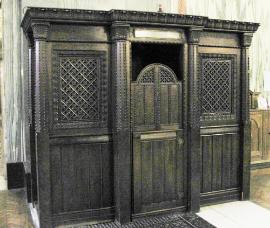
How often do we as Christians try to replace God through more convenient, less spiritually dangerous, and easy traditions?  I am not Catholic, but I am reminded of the Catholic tradition of confessionals in churches where a priest serves as an intermediary to accept confessions, essentially replacing Jesus and allowing people to obtain forgiveness for sins through indirect actions instead of the raw love of God for us even when we sin against Him. This practice replaces the altar of redemption we have in a personal relationship with Jesus with a more convenient substitute.

The preceding chapters of Joshua provided detailed descriptions of the inheritance and land boundaries of the different Israelite tribes.  Many of these boundary markers were water features such as seas, rivers, springs, and wells.  It is interesting that some of the same features that God used to provide for the Israelites have now become merely property markers.  Do we take the blessings and provisions of God and demote them into mere markers that define the boundaries of our Christian communities?

For example, the divisions and denominations that have their roots in disagreements about how we choose to welcome a new believer into a life with Christ through baptism…sprinkle, dunk, or dedication?  How crazy is it that the very practice which is intended to identify a oneness in Christ has resulted in some Christians unable to worship and share God’s love with each other!

Prayer: God help us to reject substitutes for Your love and the forgiveness we have in Jesus.

SDG
Posted in Christian Community, Following God, Forgiveness, Joshua, Life Together, Redemption | Tagged , , , , , , , , | Leave a comment