Morning Mist

Now they sin more and more; they make idols for themselves from their silver, cleverly fashioned images, all of them the work of craftsmen. It is said of these people, “They offer human sacrifices! They kiss calf-idols!” Therefore they will be like the morning mist, like the early dew that disappears, like chaff swirling from a threshing floor, like smoke escaping through a window. – Hosea 13:2‭-‬3

The subject of today’s passage is rebellion and stubbornness of the people of Israel. They seem intent upon replacing the God who wants to carry them like a son or daughter with an unruly calf they can kiss. The absurdity of this is striking, yet if I am honest I am guilty of doing the same thing. How often have I squandered my gifts and looked for a worship experience that would wow me when I should have been content with a whisper of God’s Holy Spirit.  How often have I willingly participated in “decorating the alter” with things that are are extraneous and unnecessary?

Sometimes I think we make following God much too hard. Don’t get me wrong, I think faithfully following God is one of the hardest things we can do, but it is usually hard because we make it hard not because God makes it hard. In yesterday’s passage we explored our role as “Poohsticks“, I think we are quick to install little motors on our “Poohsticks” in the hopes that we will be able to go where we want to go rather than where God, and the Holy Spirit, leads us.

The people of Israel have installed motors on their Poohsticks, and are blissfully boating around toward destinations of their own choosing. God is reminding the people of Israel of their true role and abilities as children of the Living God. They will be “like the morning mist, like the early dew that disappears”.  So they will be something ephemeral and fleeting, something that the rising sun (Son) drives away.

I think sometimes we like to think of ourselves as thunderstorms, when we are really just a dew or mist on this earth.  We bluster and bellow with all our might and only come across as a drip of dew that quickly disappears.  We could take this two ways, 1) we could decide that life is meaningless and ignore God and His commands; or 2) we could recognize that we are one very small part of a very large spiritual cycle that we often can only see a small part of.

I think the people of Israel will not understand this choice any better than many of us understand it. They will be like smoke seeping out the window on their way to who knows where. They will use the gifts that God has given them as craftsman to fashion idols that they can worship rather than the giver of the gifts, God.

Prayer: God You are the giver of gifts.  Help us to use these gifts for your glory rather than our own.

Posted in Following God, Hosea, Life Together, Obedience, Trusting God | Tagged , , , , | 2 Comments

Poohsticks

The people who live in Samaria fear for the calf-idol of Beth Aven. Its people will mourn over it, and so will its idolatrous priests, those who had rejoiced over its splendor, because it is taken from them into exile. It will be carried to Assyria as tribute for the great king. Ephraim will be disgraced; Israel will be ashamed of its foreign alliances. Samaria’s king will be destroyed, swept away like a twig on the surface of the waters. The high places of wickedness will be destroyed— it is the sin of Israel. Thorns and thistles will grow up and cover their altars. Then they will say to the mountains, “Cover us!” and to the hills, “Fall on us!” – Hosea 10:5‭-‬8

When I was a kid we used to play Poohsticks. When I share this with my students they look at me like I am crazy or deranged. I looked it up and it is actually a thing. Poohsticks is first mentioned in The House at Pooh Corner by A. A. Milne. It is a game where you select a stick then race them in a river or stream. We used to play this in the gutter after a hard rain. I guess when one grows up in Seattle one develops creative ways of coping with the rain.

In this passage it is the Samarian king who is the “Poohstick” and God is the one who tossed him in the water to be “swept away like a twig on the surface of the waters”. I am pretty sure that the Samarian king did not like being God’s Poohstick, but he was as helpless as an actual Poohstick to do anything about it. A Poohstick cannot alter it’s course or determine it’s destiny. In some ways I feel like a Poohstick in my pursuit of God. The difference is that I volunteered to “ride with the river” when I became a follower of Jesus. Ultimately God determines my destination as long as I remain in Him, the One River.

Our role as Poohsticks can take us through whitewater and doldrums and subject us to turbulence that sometimes seems too difficult to bare. God is good and provides quiet waters when we need them most. Our role as Poohsticks is not completely passive. In order to reach our destination in the undiscovered country we will need to avoid getting hung up in the “weeds” of this world.

Worldly weeds take many forms and are difficult to see coming sometimes. Health challenges, divorce, estrangement from friends or family, all of these weeds can impede our progress and challenge our faith. That is why we must place ourselves in God’s hands for help in navigating this sometimes tricky river that no one can cross on their own.

Prayer: God You are the river into which we throw ourselves. Help us to do so willingly and with confidence that you are taking us where we need to go.

SDG
Posted in Christianity, Discernment, Following God, Free Will, God's Love for Us, Hosea, Jesus, Obedience, Peace, The Earthly Realm, The Nature of God, The Spiritual Realm, Trusting God | Tagged , , , , , | 1 Comment

Swept Away

DCP_9703Hear the word of the Lord , you Israelites, because the Lord has a charge to bring against you who live in the land: “There is no faithfulness, no love, no acknowledgment of God in the land.  There is only cursing, lying and murder, stealing and adultery; they break all bounds, and bloodshed follows bloodshed.  Because of this the land dries up, and all who live in it waste away; the beasts of the field, the birds in the sky and the fish in the sea are swept away. – Hosea 4:1‭-‬3

Today’s passage contains “a charge” against the Israelites levied by God, so it is probably worth a close look as we float by.  The charge is against “you who live in the land”, which could mean the people dwelling in Israel.  Although if one were to think more broadly “the land” probably means all those who live here on earth too. This includes all past, present, and future God-followers including me.  This passage just became much deeper water for sure.

The specific charges are a lack of faithfulness, love, and acknowledgement of God “in the land”.  Certainly all three of these would apply in the land that I live in today, the United States, as well as it applies to Israel in the time of Hosea. The social and interpersonal manifestations of these three problems are cursing, lying, murdering, stealing, adultery, breaking all bounds, and bloodshed following bloodshed.  Certainly all of these things tear down the fabric of a society and harm people’s relationship with each other and God.

I want to dwell on each of the “big three” issues God calls out above in the context of what God has revealed to me so far in my float through the bible.  So the first rapid we arrive at is faithfulness.  When I think of faithfulness it means sticking by someone or something when it is hard or costly to do so.  I just finished a really interesting book by an author named Francis Chan called “Crazy Love“.  Toward the end of the book he shares that God led him to leave his very successful and comfortable church to travel through Asia with his family seeking God’s will for them.  He encountered followers of Christ in China, India, and many other countries and one of the things that struck him was how different their faith looked than the way we pursue God here in the United States.

Francis was speaking to a believer in India and said

“Every believer seems so serious about his or her commitment to Christ. Aren’t there people who just profess Christ but don’t really follow Him?” He answered by explaining that nominal Christianity doesn’t make sense in India. Calling yourself a Christian means you lose everything. Your family and friends reject you, and you lose your home, status, and job.”

That is what radical faithfulness looks like.  I was convicted by this as I reflected on what my pursuit of God looks like. I have much to learn about faithfulness.

The second charge was that the people of the land lacked love.  Now for some reason when I think of the word “love” 1 Corinthians chapter 4 is not what came to mind.  I am a bit embarrassed to admit it, but the first thing I thought of when I considered the word “love” was the 1980’s Tina Turner song “What’s love got to do with it”.  I would have been in college when this song came out and I do not think I was a Christian yet. I am pretty sure I had not yet begun my game of tag with God.  I have learned quite a bit about love along the way and I can safely say now that I disagree with Tina Turner.  Love is not a “second hand emotion”.  In fact it is not an emotion at all, but actually the very essence of God in us. God is Love.

This brings us to the third charge which is actually closely linked to the last one.  The charge is that the people do not acknowledge God. Now if we accept that God is Love then what people are doing when they fail to acknowledge God is that they reject love, God’s love for them and the love they are supposed to share with others.  These are the  two items that Jesus called out to summarize the law when asked by an “expert in the law” in Luke 10:27, “‘Love the Lord your God with all your heart and with all your soul and with all your strength and with all your mind’; and, ‘Love your neighbor as yourself.”

So that finally brings us to the water reference.  The consequences of failing to recognize the importance of faith, love, and God is that the “land dries up”; “all who live in it waste away; and “the fish in the sea are swept away”. If we fail to acknowledge our water source and disconnect ourselves from the spring we will whither and die.  We cannot thrive as self sufficient fish. Only those who can acknowledge that they are poor and needy in spirit find the water supply to satisfy their thirsty souls. If we pursue God He showers us with the Living Water that makes all things new.

Prayer: God You are love and we are to love You and others with all our being.  Help us to do this by providing guidance through your Holy Spirit. 

Posted in Covenant, Faith, Following God, God's Love for Us, Hosea, Obedience, reconciliation, Redemption, The Nature of God, The Spiritual Realm, Trusting God | Tagged , , , , , | 1 Comment

Decades of Demoralization

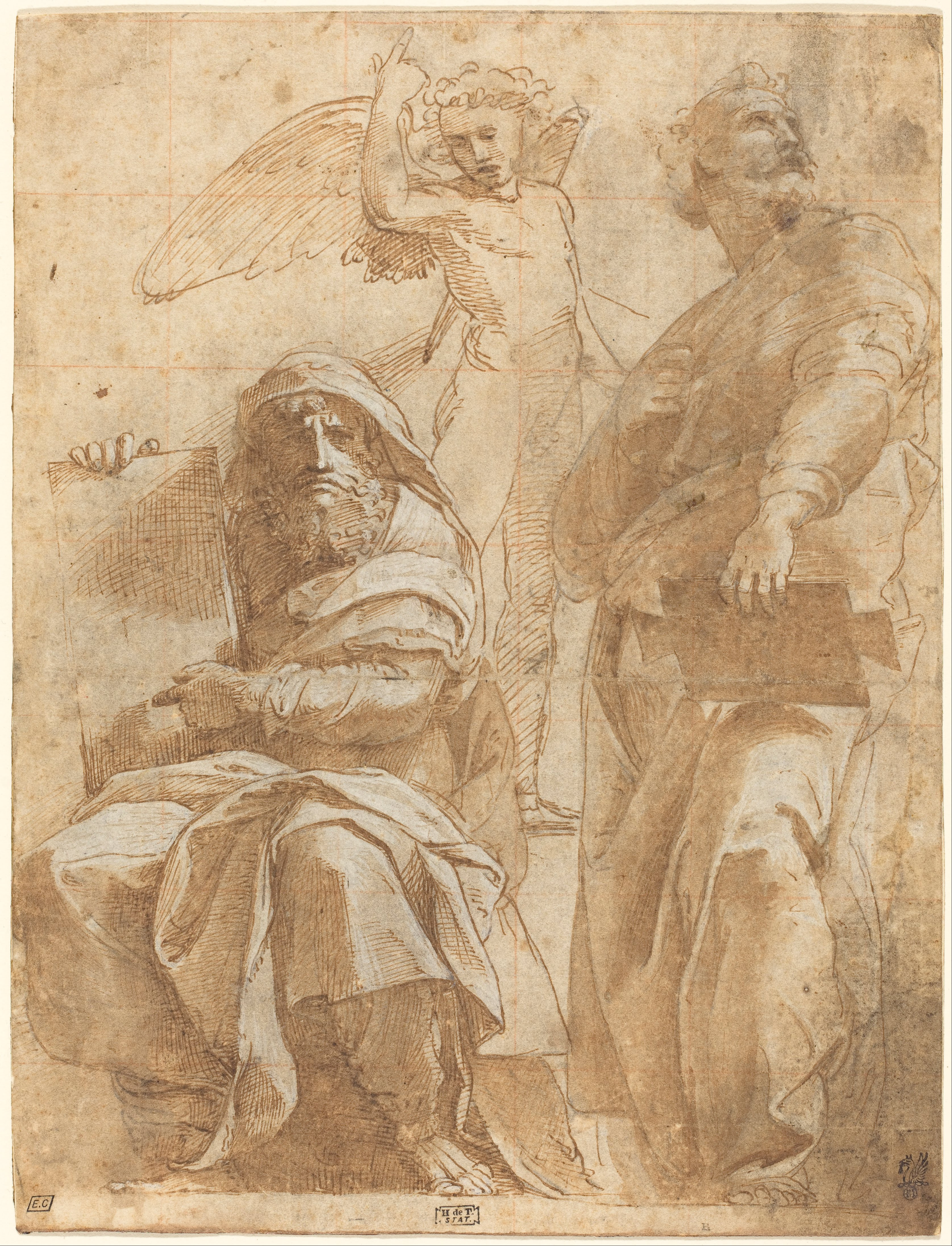
Drawing of Hosea and Jonah by Raffaello Sanzio

Rebuke your mother, rebuke her, for she is not my wife, and I am not her husband. Let her remove the adulterous look from her face and the unfaithfulness from between her breasts. Otherwise I will strip her naked and make her as bare as on the day she was born; I will make her like a desert, turn her into a parched land, and slay her with thirst. I will not show my love to her children, because they are the children of adultery. Their mother has been unfaithful and has conceived them in disgrace. She said, ‘I will go after my lovers, who give me my food and my water, my wool and my linen, my olive oil and my drink.’ Hosea 2:2-5

Wow from children of the Living God to children of adultery in one chapter. I feel like I have whiplash. I cannot imagine what Hosea is feeling. God is really messing about with Hosea’s life and family to make His points here.  I am hoping that as I prayerfully chew on this passage that God will reveal a Hidden Well.

Prior to this passage we learned that God had Hosea marry an adulterous woman named Gomer, then proceeded to have children with God-inspired names like “Lo-Ruhamah” which apparently means “not loved”. All this to serve as prophetic metaphors for the people of Israel. I have to confess this seems cruel. This is right up there with the wave upon wave of calamities that befell Job. At least job lost his family all at once. Hosea seemingly has to endure decades of demoralization and degradation. I am hoping that as I continue to read through Hosea this will all become less confusing.

The reference to water comes toward the end of the passage when Hosea’s wife, metaphorically representing Israel, says “‘I will go after my lovers, who give me my food and my water, my wool and my linen, my olive oil and my drink.” It seems like the fundamental issue God is trying to get across here is one of dependency. The people of Israel are looking to other gods, their lovers, for items that really should be provided by God, like food, water, and clothing.

God is the one to whom the people of Israel are supposed to “wed”. I think the reason that God uses Hosea and his wife to make his point is that marriage, at least God’s view of marriage, is the ultimate in intimate relationships.  It is exclusive and we are supposed to become “one flesh”. God is saying through Hosea and his marriage to Gomer that He desires this kind of intimate and exclusive relationship with the people of Israel. I think he desires that relationship with us as well, and I think he is equally disappointed in us when we look to other “lovers” for our food, water, and other needs in our lives.

God wants to be our sole (and soul) water source. He is the only one that will truly satisfy our thirsty souls. As I have pondered this perplexing passage it occurs to me that there may actually be a hidden well here. What if part of what God is trying to say here is that as terrible as it seems we may be called upon to do things similar to what Hosea has been called upon to do here to achieve God’s purposes. Hopefully it will not look exactly like Hosea and his life, but there may be things that could be equally hard that God may ask of us. Maybe part of what I will discover as I continue my float through Hosea is what this looks like for Hosea and how he navigates these turbulent waters.

Prayer: God You desire an exclusive and intimate relationship with us.  Help us to see that and respond accordingly.

Posted in Following God, God's Love for Us, Hosea, Prophecy, The Nature of God, The Spiritual Realm, Trusting God | Tagged , , , , | Leave a comment

Children of the Living God

Yet the Israelites will be like the sand on the seashore, which cannot be measured or counted. In the place where it was said to them, ‘You are not my people,’ they will be called ‘children of the living God.’ The people of Judah and the people of Israel will come together; they will appoint one leader and will come up out of the land, for great will be the day of Jezreel. – Hosea 1:10‭-‬11


This passage is the first water related passage in the book of Hosea. Apparently Hosea was a minor prophet whose message is metaphorically mixed up with his marriage. He will be called on to do some very hard, and sometimes strange things. I have never spent much time hiking the Hosea trail so I am looking forward to this part of my float through the Bible.

The water reference here is to the sea, or more specifically the seashore. The Israelites are predicted to be as numerous as grains of sand along the seashore. This is clearly meant to be hyperbole, but it is interesting none the less.

The middle of the passage contains the nugget of gold for me when Hosea says “they will be called ‘children of the living God.'” Clearly in this passage God is specifically referring to the people of Israel. but I think through adoption it refers to all those who faithfully pursue a relationship with God.

Jesus spoke many times about God’s adoption program. For example in John 1:12 Jesus says “He came to that which was his own, but his own did not receive him. Yet to all who did receive him, to those who believed in his name, he gave the right to become children of God— children born not of natural descent, nor of human decision or a husband’s will, but born of God.” What an amazing thing God has done.

As I have been chewing on this passage I am reminded of one of my favorite movies, “Meet the Robinsons“. In the movie the main character, an awkward orphan named Lewis, tries very hard to get adopted without success until a decidedly quirky couple shows up and accepts Lewis just as he is, warts and all. Lewis and his inventions go on to change the world.

From God’s perspective we are all like that quirky child Lewis and God has agreed to adopt us into his family, warts and all. This adoption is not just so we can be happy and comfortable, and it is certainly not merit-based. God wants us to do something with our new role as His Children. What that something is varies for each us. It is for God to know and us to find out.

Prayer: God help us to discover our role as part of Your adopted family.

Posted in Christianity, Covenant, Discipleship, Following God, God's Love for Us, Hosea, Love for the Lost, Peace, reconciliation, Redemption, The Nature of God | Tagged , , , , , , | 7 Comments

Daniel’s Dismount

Then I, Daniel, looked, and there before me stood two others, one on this bank of the river and one on the opposite bank. One of them said to the man clothed in linen, who was above the waters of the river, “How long will it be before these astonishing things are fulfilled?” The man clothed in linen, who was above the waters of the river, lifted his right hand and his left hand toward heaven, and I heard him swear by him who lives forever, saying, “It will be for a time, times and half a time. When the power of the holy people has been finally broken, all these things will be completed.” I heard, but I did not understand. So I asked, “My Lord, what will the outcome of all this be?” He replied, “Go your way, Daniel, because the words are rolled up and sealed until the time of the end. Many will be purified, made spotless and refined, but the wicked will continue to be wicked. None of the wicked will understand, but those who are wise will understand. “From the time that the daily sacrifice is abolished and the abomination that causes desolation is set up, there will be 1,290 days. Blessed is the one who waits for and reaches the end of the 1,335 days. “As for you, go your way till the end. You will rest, and then at the end of the days you will rise to receive your allotted inheritance. – Daniel 12:5‭-‬13

This passage is the last water-related one in the book of Daniel – Daniel’s Dismount if you will. I have been reading a book recently about Dr. Paul Farmer called Mountains beyond Mountains by Tracy Kidder. She recounts many interesting stories and anecdotes about Dr. Farmer’s work in Haiti. His passion and purpose resonate with me. One of the interesting ideas I have found in this book is the idea of a “dismount”. Dr. Farmer used this to refer to the end of a conversation or discussion.  I think this idea applies here on many levels.

I used to do gymnastics when I was still young and limber. Basically from age four until I was in college. I have always suspected that my parents got me into gymnastics to keep me out of trouble and out of their hair, but I learned many important life lessons in my years of gymnastics.  I learned that: 1) hard work and perseverance pay off in the end; 2) repetition and practice is the only way to get better at something that is hard; 3) teaching gymnastics is way harder than merely doing gymnastics; 4) If you train your body to do complicated things your body will be better at everything involving body movements; and 5) dismounts at the end of a gymnastics routine can come with either elation or exasperation depending on how one feels about their performance.

Since the topic of this passage is “Daniel’s dismount” I will focus on the last life-lesson from gymnastics and save the others for another day. One of my favorite gymnastics events was the rings.  It allowed me and my little body at the time to shine. Success on the rings came from a combination of grace and strength.  I think in this way it is like Daniel’s command in this passage to “go your own way Daniel”.  He has been given a very confusing and perplexing prophecy about the end of days.  A prophecy filled with water imagery reminiscent of previous prophecies in Ezekiel about a river that no one can cross (Ezekiel 47:1‭-‬6).

The passage starts out with a two people on the banks of a river, “Then I, Daniel, looked, and there before me stood two others, one on this bank of the river and one on the opposite bank.”  I think that the river is a metaphor for our profound separation from God that requires a pilot or navigator to cross.  I also believe God has provided that pilot in the person of Jesus.  Perhaps he is the “man clothed in linen” I do not know.  What seems clear is that the river is a real barrier to our being with God and in order to cross into God’s undiscovered country we must accept help.  We cannot cross it on our own.  No matter how good we get at swimming, finance, gymnastics, business, geology, or whatever pursuit we choose to invest our lives.

Daniel’s “dismount” is the most important part of his life. If he lives with grace and strength he will end up where he is heading.  All the wisdom and prophecies that he has shared with the king of Babylon come down to this final prophecy.  It is the one that matters.  The command is simple yet multi-layered and complex, “As for you, go your way till the end. You will rest, and then at the end of the days you will rise to receive your allotted inheritance.”  So the seemingly simple command for Daniel in the midst of the dark future that has been revealed to him is to “go your way”.  The really tricky part of this for Daniel (and us) is to figure out what “his way” should look like and how he will be sure to end up “on the banks of the river” when he is done with his life.

So how do we as God-followers make sure that we are engaged in the “routine” that God has for us and that our “dismount” is pleasing to God? How do we make sure that “our way” is God’s way? I think this is the most important question that Christians can ask themselves. In my experience the answer is not simple and it is not static.  Answering this question is a process.  It is more like a voyage of discovery than a destination. This is not to imply that our life should be spent in a frantic pursuit of the perfect dismount, but rather a realization that if we keep our eyes focused on the real goal, God, that He Himself will be our dismount.

Prayer: God You have provided us with a glimpse into awesome things to come that could make us anxious and afraid.  Give us the peace that comes from knowing that if we remain in You we have already arrived.

Posted in Daniel, Discernment, Following God, God's Love for Us, Heaven, Hell, Prophecy, The Earthly Realm, The Nature of God, The Spiritual Realm | Tagged , , , , , , | 1 Comment

The Anointed One

Know and understand this: From the time the word goes out to restore and rebuild Jerusalem until the Anointed One, the ruler, comes, there will be seven ‘sevens,’ and sixty-two ‘sevens.’ It will be rebuilt with streets and a trench, but in times of trouble. After the sixty-two ‘sevens,’ the Anointed One will be put to death and will have nothing. The people of the ruler who will come will destroy the city and the sanctuary. The end will come like a flood: War will continue until the end, and desolations have been decreed. He will confirm a covenant with many for one ‘seven.’ In the middle of the ‘seven’ he will put an end to sacrifice and offering. And at the temple he will set up an abomination that causes desolation, until the end that is decreed is poured out on him. – Daniel 9:25‭-‬27

Well this passage is a bit of “funny water” to be sure. Between the murky metaphors and perplexing prophecies I am really confused. Since the passage starts out with “Know and understand this” I guess it is worth spending a little time attempting to unpack this passage. The passage is confusing to me for two reason.  First the time periods described are foreign to me.  Perhaps they meant more to the people this book was written for, but they are confusing to me.  The second thing that is confusing to me is the description of the Anointed One and the “ruler” near the end of the passage.  Certainly the “Anointed One” could be the Messiah, but who the ruler represents is not clear.

The passage clearly talks about restoring and rebuilding Jerusalem, the City of David. One could get into a mire of mud trying to figure out exactly which sacking and rebuilding of Jerusalem this is referring to. I am not sure it is critical to what I think may be the main point of this passage – that the earthly temple and all the tangible trappings the Israelites have grown to rely upon to feel close to God are going away. They are to be replaced by the “Anointed One” who “will be put to death and will have nothing”.

It is my understanding that the “Annointed One” has always been interpreted by the Jewish people to be the coming Messiah who many Jews believe has yet to arrive, and who Christ followers believe already arrived in the form of Jesus. One detail provided here that I have never noticed is that the “Anointed One” will “have nothing” – more on this in a moment.

We finally arrive at the water reference where the passage says “The end will come like a flood: War will continue until the end”. This language is reminiscent of flood language used in Isaiah to describe the coming of a redeemer.  In other references a “flood” has been used to refer to the generic calamities that befell Job.

Who is meant by “the ruler” near the end of the passage gets a little confusing. My understanding is that “the ruler” has been understood to mean one of the many historical kings that have sacked Jerusalem or a future anti-christ figure yet to come. In a time-transcendent sense this passage may have multi-layered meaning, or in the words of Forrest Gump “I think… maybe… it’s both happening at the same time.”

What seems clear to me is that the “Anointed One” (I believe this is referring to Jesus) was put to death and “has nothing” from an earthly perspective.  From the world’s perspective He “lost”, even though from an eternal perspective in end God wins. The coming Messiah and His death is to be followed by a very long period of messy earthly conflict and “covenant” between an earthly ruler and people which will end with the temple occupied by the “abomination that causes desolation”.  I am not sure what this means and whether it is once again a verse that could have multiple layers of meaning that transcend time.  Either way it does not sound good.

So what is the take home message from this passage?  It reminds me that as a Christ follower I should not expect any earthly reward for following Christ as Christ himself “got nothing” from an earthly perspective.  It is also a caution to beware of enticing earthly rulers that are more “rewarding” to follow, but will ultimately lead to disappointment and destruction.

Prayer: God help me to be content with following your Son and the grace that he provides.

Posted in Christianity, Conflict, Covenant, Daniel, Following God, Prophecy, Redemption, The Earthly Realm, The Nature of God, The Spiritual Realm | Tagged , , , , , , | Leave a comment

Unexpected Truths

In the first year of Belshazzar king of Babylon, Daniel had a dream, and visions passed through his mind as he was lying in bed. He wrote down the substance of his dream. Daniel said: “In my vision at night I looked, and there before me were the four winds of heaven churning up the great sea. Four great beasts, each different from the others, came up out of the sea. “The first was like a lion, and it had the wings of an eagle. I watched until its wings were torn off and it was lifted from the ground so that it stood on two feet like a human being, and the mind of a human was given to it. – Daniel 7:1‭-‬4

Well this is an odd bit of water to be sure. Daniel is describing a dream that he had that involves “the great sea”. In other passages the sea has been used as a metaphor for the spiritual realm. In this passage the seas are being “churned up” by the four winds. I am reminded of the spirit of God moving over the Waters in the Genesis account of creation. I wonder if the odd event in Daniel’s dream being described here is related.

The “wind”, perhaps the Holy Spirit or the spirit of God, brings forth out of the sea four beasts. The first beast is described as being “like a lion, and it had the wings of an eagle.” A lion, “king’ of the beasts”, crossed with arguably the “king” of the air, an eagle. Why these two beasts rather than others God could choose? Perhaps the fact that these animals have dominion over their respective domains is an important detail. It may also be important that there are two very distinct realms to navigate, the “air” and the “earth”.

This mythical and metaphorical creature has its wings clipped and becomes a human, “I watched until its wings were torn off”. Wow this passage just became deep water to be sure, plumbing the depths of questions like “who are we?” and “where do we come from?”

This passage, and my understanding from previous passages would suggest we are; 1) plucked from the “great sea”, the spiritual realm, by God’s spirit; 2) we were once in some sense a composite creature built to dwell in two very different realms; 3) our wings have been clipped, i.e. we are not able to “fly” in the spiritual realm as we once could, we are separated by a river that no one could cross; and 4) we “stand on two feet” and have been given “the mind of a human”, human reason or a bit of the logos from God. Just enough to get us into trouble thinking we are all that.

I am once again in awe of the complexity and beauty of seemingly innocuous passages like this one in Daniel, a hidden well to be sure. There is so much more here than the lion’s dens and fiery furnaces I remember learning about in Sunday School.

Prayer: God thank You for guiding me on this float through the Bible and showing me unexpected truths along the way.

Posted in Daniel, God's Love for Us, The Earthly Realm, The Nature of God, The Spiritual Realm | Tagged , , , , , | Leave a comment

In His Hand Your Life

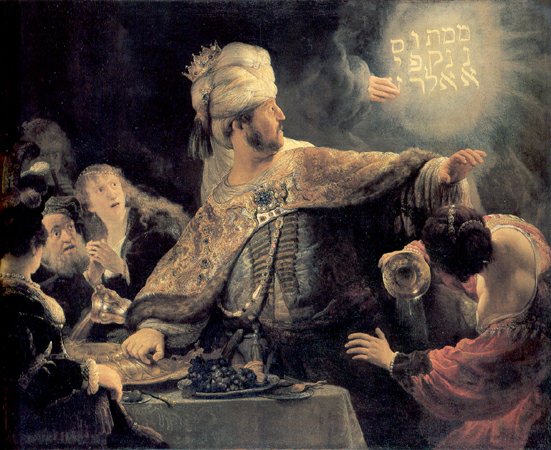
Belshazzar’s Feast by Rembrandt

“Your Majesty, the Most High God gave your father Nebuchadnezzar sovereignty and greatness and glory and splendor. Because of the high position he gave him, all the nations and peoples of every language dreaded and feared him. Those the king wanted to put to death, he put to death; those he wanted to spare, he spared; those he wanted to promote, he promoted; and those he wanted to humble, he humbled. But when his heart became arrogant and hardened with pride, he was deposed from his royal throne and stripped of his glory. He was driven away from people and given the mind of an animal; he lived with the wild donkeys and ate grass like the ox; and his body was drenched with the dew of heaven, until he acknowledged that the Most High God is sovereign over all kingdoms on earth and sets over them anyone he wishes. “But you, Belshazzar, his son, have not humbled yourself, though you knew all this. Instead, you have set yourself up against the Lord of heaven. You had the goblets from his temple brought to you, and you and your nobles, your wives and your concubines drank wine from them. You praised the gods of silver and gold, of bronze, iron, wood and stone, which cannot see or hear or understand. But you did not honor the God who holds in his hand your life and all your ways. Therefore he sent the hand that wrote the inscription. – Daniel 5:18‭-‬24

This passage hearkens back to king Nebuchadnezzar’s domestication and descent into becoming an animal. The “dew from heaven” is again described as drenching king Nebuchadnezzar. Apparently dew drenching is not hereditary because king Nebuchadnezzar’s son has totally forgotten the lesson’s that God taught his father.

The passage takes place at a feast being held by king Nebuchadnezzar’s son and immediately follows the famous passage about a disembodied hand writing a message on the wall during the party to get Belshazzar’s attention. Apparently Belshazzar is using goblets stolen from the temple in Jerusalem with no thought to the God from whose temple these goblets were stolen. I cannot help but think there is a metaphorical meaning here comparing the goblets to the people of Israel who have also been “stolen” and placed in exile in Bablyon.

God’s seems to be trying to tell Belshazzar that all the things that he believes he has accomplished and acquired are in fact resting in God’s hand and he forgets this at his own peril. He reminds Belshazzar, and all those who are reading this passage, that God “holds in his hand your life and all your ways”. We may think we are choosing our own way and forging our own destiny, but in the end God wins. King Belshazzar will find this out very soon as the very night when Daniel interprets the writing on the wall he will be killed.

So what are we to take away from this hard lesson that God is teaching Belshazzar? I guess what I take away from it is that we should hold very loosely all the achievements and acquisitions of our lives because holding onto these things can crowd God out of our lives. I am reminded of a quote from one of my favorite books call Not a Fan by Kyle Idleman. In it he says:

“The only way to be filled with the Spirit is to empty myself of me. When I empty me of me, it provides space for the Holy Spirit to fill me”

What God was asking Belshazzar to do, and by extension what he is asking us to do, is make room for God in our lives – “you did not honor God”. God wants to take center stage and be the animator of our lives. I believe God tells us this not because He wants to instill fear in us that we will be crushed by His mighty hand, but rather because he genuinely loves us and believes in us and wants to carry us through life like a son or daughter.

Belshazzar learned his lesson the hard way, by reaching the end of his life and finding a dead end. Hopefully we can learn from his mistake and make room for God now, while we are still muddling our way through this land of Oblivion.

Prayer: God you promise to fill us with your spirit if we make room. Help us to clear our the clutter keeping us from You.

Posted in Christianity, Daniel, Discernment, Faith, Following God, Free Will, God's Love for Us, Prophecy, The Nature of God, The Spiritual Realm, Wisdom | Tagged , , , , , , | 3 Comments

What Have You Done?

media-20180121Even as the words were on his lips, a voice came from heaven, “This is what is decreed for you, King Nebuchadnezzar: Your royal authority has been taken from you. You will be driven away from people and will live with the wild animals; you will eat grass like the ox. Seven times will pass by for you until you acknowledge that the Most High is sovereign over all kingdoms on earth and gives them to anyone he wishes.”  Immediately what had been said about Nebuchadnezzar was fulfilled. He was driven away from people and ate grass like the ox. His body was drenched with the dew of heaven until his hair grew like the feathers of an eagle and his nails like the claws of a bird.  At the end of that time, I, Nebuchadnezzar, raised my eyes toward heaven, and my sanity was restored. Then I praised the Most High; I honored and glorified him who lives forever. His dominion is an eternal dominion; his kingdom endures from generation to generation.  All the peoples of the earth are regarded as nothing. He does as he pleases with the powers of heaven and the peoples of the earth. No one can hold back his hand or say to him: “What have you done?” – Daniel 4:31‭-‬35

This passage retraces the prophecy from Daniel 4:4-16, where king Nebuchadnezzar will be dethroned, drenched with dew from heaven, and given the mind of an animal.   There is an added touch near the end that piqued my interest so I decided it was worth a second look even though the prophecy is very similar to the previous one.

The added detail here is king Nebuchadnezzar’s acknowledgement that no one can “hold back his hand or say to him: “What have you done?”” God has done amazing things – too amazing for us to even understand at times.  He was pierced for our transgressions and extended his Arm from heaven to hold us in the hollow of His hand. What has He done indeed!

It is to king Nebuchadnezzar’s credit, and eternal benefit, that he has understood what God has done for him, and in fact what God has done for all those who faithfully follow Him.  It is perhaps the single most important thing we can learn as humans here in this land of Oblivion.  God loves us, He believes in us, and He wants to carry us like a son or daughter as we make our way on this earth.

As I have progressed down the river on my float through the water references in the bible I am continually amazed by the depth and wisdom that God has shown me, even in the most unlikely of places. It reminds me of a field trip I was on with students a couple of months ago.  We were hiking along the dunes that rise above the shores of Lake Michigan.  We were high above the lake looking down on the waves and the beach.  One astute and observant student yelled out “look at that!”  When we all looked we saw something I never expected to see, a large salmon swimming along the shore that was clearly visible among the waves. I have looked upon the shore of Lake Michigan many times and I have never seen anything like it.  We were all amazed and delighted at the rare and unique spectacle we had seen.

I feel like God does this for me as I schlep my way through some parts of the old testament trying to understand what they mean.  He points out salmon swimming in the surf and yells out “look at this”.  I am often left as delighted and amazed as I was with my students that day along the shores of Lake Michigan.

Prayer: God thank you for leading me on this journey of discovery and pointing out new and amazing things along the way.

Posted in Daniel, Following God, God's Love for Us, Jesus, Prophecy, Uncategorized, Wisdom | Tagged , , , | 1 Comment