
Peas and Carrots

During the days of Jesus’ life on earth, he offered up prayers and petitions with fervent cries and tears to the one who could save him from death, and he was heard because of his reverent submission. Son though he was, he learned obedience from what he suffered and, once made perfect, he became the source of eternal salvation for all who obey him and was designated by God to be high priest in the order of Melchizedek. We have much to say about this, but it is hard to make it clear to you because you no longer try to understand. In fact, though by this time you ought to be teachers, you need someone to teach you the elementary truths of God’s word all over again. You need milk, not solid food! Anyone who lives on milk, being still an infant, is not acquainted with the teaching about righteousness. But solid food is for the mature, who by constant use have trained themselves to distinguish good from evil. – Hebrews 5:7‭-‬14

Welcome to the book of Hebrews.  I floated right by Titus and Philemon without any water-related passages that I could find.  The book of Hebrews is apparently a letter to Jewish believers. The author and recipients of the letter are not so clear.  It does seem there is general agreement that the author was not Paul, but some other learned early follower of Christ and the recipients were Jewish followers of Christ that were having difficulty accepting some parts of the new teachings.

The author is teaching about obedience and submission, and using Christ and His willingness to sacrifice and submit as an example.  Jesus’ tears, fervent prayers. and petitions are part of the reason He was heard by God.  Of course Jesus had a hotline to God being the Son of God and all, but in a mysterious metamorphosis He was fully God and fully man at the same time.  In the act of Jesus dying on a cross he became “the source of eternal salvation for all who obey him”.  Jesus made it clear to all those with ears to hear that He was the Living Water that we all need to live.

Then comes this a statement which has puzzled me every time I float past it reading the bible, apparently Jesus “was designated by God to be high priest in the order of Melchizedek”.  As far as I can tell this was an appeal to the Jews who were not willing to allow Jesus as their “high priest” unless he fit into the priestly order, which had historically only been descendants of Levi, Abraham’s great-grandson.  This would seem to be a clear mixing of the “old treasures” with the new.  The author seems to acknowledge that this “priesthood” of Melchizedek reference is confusing “We have much to say about this, but it is hard to make it clear to you because you no longer try to understand.”

I am not sure what is meant by they are “no longer trying to understand”.  The image it conjures in my mind is someone putting their hands over their ears and making noise so that they do not have to hear something objectionable that someone is saying to them.  The Hebrews seem to be making a conscience decision to reject parts of the new song being shared with them about Jesus.  It sounds like the author is likening them to a young child refusing to eat their dinner “You need milk, not solid food! Anyone who lives on milk, being still an infant, is not acquainted with the teaching about righteousness. But solid food is for the mature, who by constant use have trained themselves to distinguish good from evil.”

So these young and confused followers are rejecting the hard and challenging teachings in favor of the easy to digest parts.  They are not alone in their selective submission.  I think we are all guilty of reserving certain behaviors and beliefs from our old selves.  We need to learn to eat the “foods” that are good for us, and I am not talking about peas, spinach, or Brussels sprouts.  The “foods” we need to learn how to digest and consume are the hard truths of the Gospel.  God wants to shape us into new beings by teaching us to eat spiritual “food” that will help us to grow and be strong and courageous on our journey home to the undiscovered country

Prayer: God help us to learn how to grow strong in our faith through the consumption of the spiritual truths you need us to hear, even if we find them hard to swallow sometimes.


Posted in Christian Community, Christian Leadership, Christianity, Discipleship, Following God, Hebrews, Melchizedek, Obedience, religion | Tagged , , , | 1 Comment

Confused Kindling and Green Wood

I thank God, whom I serve, as my ancestors did, with a clear conscience, as night and day I constantly remember you in my prayers. Recalling your tears, I long to see you, so that I may be filled with joy. I am reminded of your sincere faith, which first lived in your grandmother Lois and in your mother Eunice and, I am persuaded, now lives in you also. For this reason I remind you to fan into flame the gift of God, which is in you through the laying on of my hands. For the Spirit God gave us does not make us timid, but gives us power, love and self-discipline. So do not be ashamed of the testimony about our Lord or of me his prisoner. Rather, join with me in suffering for the gospel, by the power of God. He has saved us and called us to a holy life—not because of anything we have done but because of his own purpose and grace. This grace was given us in Christ Jesus before the beginning of time, but it has now been revealed through the appearing of our Savior, Christ Jesus, who has destroyed death and has brought life and immortality to light through the gospel. And of this gospel I was appointed a herald and an apostle and a teacher. That is why I am suffering as I am. Yet this is no cause for shame, because I know whom I have believed, and am convinced that he is able to guard what I have entrusted to him until that day. What you heard from me, keep as the pattern of sound teaching, with faith and love in Christ Jesus. Guard the good deposit that was entrusted to you—guard it with the help of the Holy Spirit who lives in us.- 2 Timothy 1: 3‭-‬14

I am continuing to paddle against the wind here in the Pauline letters. I am not sure why they are so challenging, but in some ways they are even harder than some of the challenging old testament books and passages. I am still chewing and reflecting on this in an attempt to understand why this stretch of water is difficult. Certainly there are topics in the letters that are challenging and Paul’s bombastic style sometimes leaves little room for metaphors and water imagery, but I signed up for the entire river so I will push on despite these difficult stretches with the hope there are some quiet waters mixed in.

Paul is reaching out to the believers in Ephesus in this second letter to Timothy, whom he has sent to help the church in Ephesus. This is a letter of encouragement to encourage Timothy in his efforts to share the Gospel, and the other followers to stay faithful to their commitment to follow Christ.

Paul is “recalling tears” in this letter. It is not clear whether these tears are being shed because the people miss Paul or some other reason. The context suggests that Paul is recalling the tears that were shed when he left them. Tears are typically an outward expression of strong inward emotions, samples of our souls if you will. In this case the emotions were probably a mixture of loss, fear, and uncertainty as Paul left for an uncertain future, and the people in Ephesus faced challenges to their faith through questionable leadership.

The word picture that is forming in my head is of the believers in Ephesus as scattered embers or coals, isolated from one another and in danger of being extinguished. Paul alludes to this when he says “fan into flame the gift of God, which is in you through the laying on of my hands.” Paul is referring to the Holy Spirit which poured out and into these followers through Paul’s own teaching. The Holy fire has apparently gone dim for these followers and Paul is trying to help them rekindle it.

Fire is an interesting thing, almost as interesting as water, but with very different attributes. Fire, in order to exist, requires fuel, something to burn, and typically oxygen to allow the burning reaction to take place. We are probably most familiar with burning wood, but there are many things that burn. As anyone who has started a fire knows it is a process of creating a chain reaction in the wood so that it is self-sustaining. The heat of the fire actually makes it easier for other pieces of wood to catch fire and contribute their energy. There are several things that can making starting a fire more difficult: 1) green wood; 2) wet wood; 3) insufficient kindling. Each of these have interesting metaphorical meanings in the context of the church in Ephesus and their efforts to be self-sustaining.

The church in Ephesus was made up of very new believers, green wood. They were not seasoned by years of faithful following. Their ability to provide spiritual guidance (heat) to one another was limited, and in fact was being thwarted by misguided leaders who were not leading them toward God. The only way to make green wood burn better is time and “seasoning”. I am sure that what these followers were experiencing in Paul’s absence felt like a very dry time spiritually. Paul is encouraging them to seek out the true water source in this dry time of seasoning.

I grew up in Seattle and I have had my share of experiences attempting to build a fire using wet wood. It is usually a smoky and messy process fraught with singed fingers and stressful angst about whether the fire will actually start. This is especially true if you are out camping and have just spent the night in a wet tent and sleeping bag. It seems the believers in Ephesus feel a bit like this – wet and tired awaiting a warming fire. They are weathering all manner of spiritual squalls as they try to figure out what it means to follow Christ. Paul is reminding them that they have a helper in this process. The Holy Spirit can provide the spark they need to “get the fire started” and keep it going. Even wet wood can burn if there is enough heat.

Lack of kindling can make it really difficult for even the most seasoned fire starter to be successful. Kindling consists of small pieces of wood which by themselves would burn out rather quickly, but provide the heat to get larger pieces of wood going. The members of the church in Ephesus are the kindling at this point and the larger church body is the large piece of wood they are attempting to “get going”. The problem is that the “kindling” is confused about some of the teachings of Christ. This is the fault of some flawed followers who are leading them astray. Paul’s solution to confused kindling is to redirect them to first principles “What you heard from me, keep as the pattern of sound teaching, with faith and love in Christ Jesus. Guard the good deposit that was entrusted to you—guard it with the help of the Holy Spirit who lives in us.”

This process of “fire starting” is still alive and well in the present day believers and churches. We face the same challenges of being wet, green, and confused. The solution is the same advice Paul gave to the believers in Ephesus, return to first principles.

Prayer: God help us to trust the Holy Spirit to kindle the fires of faith both individually and as we gather together.

Posted in 2 Timothy, Christian Community, Christian Leadership, Christianity, Faith, Following God, Holy Spirit, Jesus, Life Together, Paul | Tagged , , , , , | 2 Comments

Bartenders of Blessings

Colorized low-temperature electron micro-graph of a cluster of E. coli bacteria, Microbe World.

The elders who direct the affairs of the church well are worthy of double honor, especially those whose work is preaching and teaching. For Scripture says, “Do not muzzle an ox while it is treading out the grain,” and “The worker deserves his wages.” Do not entertain an accusation against an elder unless it is brought by two or three witnesses. But those elders who are sinning you are to reprove before everyone, so that the others may take warning. I charge you, in the sight of God and Christ Jesus and the elect angels, to keep these instructions without partiality, and to do nothing out of favoritism. Do not be hasty in the laying on of hands, and do not share in the sins of others. Keep yourself pure. Stop drinking only water, and use a little wine because of your stomach and your frequent illnesses. The sins of some are obvious, reaching the place of judgment ahead of them; the sins of others trail behind them. In the same way, good deeds are obvious, and even those that are not obvious cannot remain hidden forever. – 1 Timothy 5:17‭-‬25

Reading and reflecting on this passage has been harder than many previous passages. Sort of like paddling against the wind on a stretch of flat water. I am not sure why but to be honest it felt a little like sitting in a four-hour church meeting. I have served as an elder in the past and I can attest that it is a lot of work and involves much prayer and pondering over questions large and small. I remember one issue involving the steeple on our church building that became a really big deal for many people. Eventually the sticky steeple issue was resolved but decades to resolve. I am not sure what “double honor” is but I would agree that those who lead our bodies of believers deserve it.

The main subject of this passage is elders and how they should be treated. Some of this advice is to protect the elder and other parts are intended to protect the people they are leading while following. The passage begins by lauding these leaders “Do not muzzle an ox while it is treading out the grain,” and “The worker deserves his wages.” We need to honor and support those who are serving leadership roles to guide the church. They are working hard to figure out how to put put the words of Jesus into practice in the everyday life of the followers they are leading.

Some conflict is inevitable whenever groups of people are trying to do something together. One solution would be to become a hermit and avoid groups of people, but God has instructed us to live in community with one another. If you have an issue with an elder, or a decision they have supported, you are directed to find two or three other people who agree that the issue is in need of addressing with the elder. This makes practical sense as the decisions of the elders are bound to cause tension a times. Paul’s solution seems reasonable and is probably not a bad practice outside of church leadership.

The next part gets a little more confusing, and I suspect contextual for specific issues occurring with the church in Ephesus “Do not be hasty in the laying on of hands, and do not share in the sins of others.” The first part of this would seem to be an effort to determine who to help, similar to “Love lists” that I reflected on a few days ago (1 Timothy 5:3‭-‬10). Ultimately, I think the the Holy Spirit should be guiding our healing hands, but I concede that this is way more difficult than it sounds. The second part is more perplexing. Perhaps there were elders who were hanging out with sinners and engaging in sinful behavior. I do not know. The guidance is to “Keep yourself pure.” Which brings us to the water reference in this passage.

The way to keep pure is to “Stop drinking only water, and use a little wine because of your stomach and your frequent illnesses.” On a purely pragmatic level this directive to mix alcohol (wine) with your water was a common and wise practice at this time in history. Water was often contaminated with deadly pathogens that would be killed, or at least weakened, by adding alcohol to the water. There is undoubtedly a metaphorical meaning here as well that is connected to the practices that are making people impure and spiritually “ill”. Let’s explore water contamination for a minute as see if it will shed some light on this part of the passage.

Water contamination has been around forever. Before the industrial age most of this contamination came from human and animal waste (feces) getting into water sources. The discovery of microbes would not come until the 1600’s and a curious young man named Antony Van Leeuwenhoek. He was one of the first to see microbes in water and infer that these might be causing illness. Many others followed and we eventually came to understand that organisms like cholera, E. Coli, and Giardia present in the water make people ill and sometimes kill them. This happens because our bodies are built to harbor some of these organisms in our intestinal tract. Outside of this location, and in too great a numbers, they can create toxins and responses from our bodies that can be deadly. In modern times we have all sorts of mechanisms to disinfect water like chlorine and other filtering methods. This is one of my research interests as a water scientist and I have published papers describing methods to filter water in Haiti.

Back to the passage and Paul’s directive to mix water and wine. I take the “water” to be representative of the “pure” message that the Spring of Living Water, Jesus, delivered to the disciples and others as he taught, fed, and healed people by the lake. Unfortunately this message is easily contaminated by flawed followers that sometime misunderstand the message or miss the Messiah. The “wine” may represent the traditions and practices that humans have created which can be bad or good. Some mixing of these is inevitable, and can even be good, if the proper prayerful precautions and preparations are made “The sins of some are obvious, reaching the place of judgment ahead of them; the sins of others trail behind them”. This is saying that not all sin that can ensnare us will be clear. Some will obvious and result in immediate consequences, while others may be subtle and hidden, only to become clear years after the actual sin.

Jesus turned water in wine at the wedding in Cana in Galilee, removing the distinction between these two liquids. As followers of Christ we cannot reproduce this feat. We are left with a messy mixing of the precious Living Water with worldly wine to make sure we stay spiritually healthy. Elders are on the front lines of this process of mixing the “water” and “wine” to keep us spiritually healthy and “pure”. This work is really hard and often goes on without much recognition. These “bartenders of blessings” certainly deserve a double portion of honor.

Prayer: God thank You for those who have been called to help lead. Help us to thank and acknowledge their efforts.

Posted in 1 Timothy, Christian Community, Christian Leadership, Christianity, Discernment, Discipleship, elders, Following God, Life Together, living water, religion, wine | Tagged , , , , | Leave a comment

Love and Lists

Give proper recognition to those widows who are really in need. But if a widow has children or grandchildren, these should learn first of all to put their religion into practice by caring for their own family and so repaying their parents and grandparents, for this is pleasing to God. The widow who is really in need and left all alone puts her hope in God and continues night and day to pray and to ask God for help. But the widow who lives for pleasure is dead even while she lives. Give the people these instructions, so that no one may be open to blame. Anyone who does not provide for their relatives, and especially for their own household, has denied the faith and is worse than an unbeliever. No widow may be put on the list of widows unless she is over sixty, has been faithful to her husband, and is well known for her good deeds, such as bringing up children, showing hospitality, washing the feet of the Lord’s people, helping those in trouble and devoting herself to all kinds of good deeds. – 1 Timothy 5:3‭-‬10

Well I am still tired from running the “Ephesian rapids“. That was a tricky stretch of river that required some discerning discipleship for sure. The “drought” of water passages here in the new testament continues as I floated right through 2 Thessalonians without encountering any water passages. We find ourselves in 1 Timothy today. This letter, although directed toward Timothy, was really for the church in Ephesus. So in a sense this is a circling back to rerun some of the same river covered in Ephesians.

The first four chapters of 1 Timothy contain many rapids and challenging teachings. I am not intentionally avoiding these treacherous waters, they simply did not contain references to water. Timothy was apparently a believer from the city of Lystra in Asia Minor. He had a Jewish mother who had become a Christian believer, and a Greek father. It is not clear to what extent his father was a believer, but his female relatives are mentioned in the two letters to Timothy. Their is apparently some debate about the authorship of the letters to timothy, but I will not wade into those waters.

Much of this letter has to do with Christian leaders and leadership, and in this passage specifically with caring for widows. What would seem to be inordinate details are provided about which widows are worthy of caring for and how that might happen. Presumably there was some confusion about which who should receive help and care. The approach being followed by the people of Ephesus was apparently to create a list of “worthy” recipients. It seems like if one were to ask Jesus which widows and orphans we should help he would say all of them.

The letter provides a puzzling preamble to a list of instructions about who and how to help: “Give the people these instructions, so that no one may be open to blame.” This is somewhat confusing to me. Why would helping the “wrong” people in the “wrong” way open up people to blame? I guess one possibility is that in helping some people and not others they were ultimately using their own experience and talents rather than trusting God and the Holy Spirit to guide them. I do not know. I guess I am of the opinion that we should love them all and let God sort them out. The instructions, in simplified form, are: 1) care and provide for your relatives and family; and 2) care for older widows who are actively helping and caring for others.

The first item makes sense from a pragmatic perspective. One would probably know the needs and how to help and care for one’s own relatives and family better than others who are not related. In the course of my work in Haiti over the last 14 years I have been impressed by the way the people of Haiti care for their families and extended families. This is extended globally by the Haitian diaspora that often send a significant portion of their earnings back to Haiti to help support friends and relatives. This focus on one’s family would seem to be somewhat at odds with Jesus’ redefinition of family to include anyone who needs our help or is seeking God.

The second item goes into excruciating detail about what a “good widow” is based on her actions and attributes which include: 1) over sixty years old; 2) faithful to her husband; 3) well known for her good deeds, such as bringing up children, showing hospitality, washing the feet of the Lord’s people, helping those in trouble; and 4) devoting herself to all kinds of good deeds. This is where the water reference comes in with the inclusion of foot washing which Jesus demonstrated was one way we could show our love and care for one another.

I cannot shake the sense that this list of instructions is very inwardly focused. It seems to miss the messiah that healed and cared for all comers. I cannot imagine Jesus sitting around with the disciples compiling a list of people that were worthy of his love and care. What happened between when Jesus walked the beach to provide a window between worlds and these flawed followers in Ephesus trying to figure out who to help? I am not sure I have a good answer, but I think we struggle with the same problem that the Ephesians were trying to tackle. Who and how do we help?

This is especially relevant as many cities are trying to tackle widespread homelessness and hunger problems. Should we make “a list” of which homeless to help? I do not think that is the love and care we are called to provide. I do not have any easy answers to homelessness and hunger, but I know someone who does.

Prayer: God help us to love and care for all those who need our help.

Posted in 1 Timothy, charity, Christian Community, Christian Leadership, Christianity, Following God, God's Love for Us, Holy Spirit, Love for the Lost | Tagged , , , , | 3 Comments

Confluence in the Clouds

Brothers and sisters, we do not want you to be uninformed about those who sleep in death, so that you do not grieve like the rest of mankind, who have no hope. For we believe that Jesus died and rose again, and so we believe that God will bring with Jesus those who have fallen asleep in him. According to the Lord’s word, we tell you that we who are still alive, who are left until the coming of the Lord, will certainly not precede those who have fallen asleep. For the Lord himself will come down from heaven, with a loud command, with the voice of the archangel and with the trumpet call of God, and the dead in Christ will rise first. After that, we who are still alive and are left will be caught up together with them in the clouds to meet the Lord in the air. And so we will be with the Lord forever. Therefore encourage one another with these words. – 1 Thessalonians 4:13‭-‬18

Well the water references in this reach of the bible are few and far between. I floated right through Philippians and Colossians with no water-related passages. I finally found one here in 1 Thessalonians, a letter written by Paul to the believers in Thessalonia. Apparently this group of believers was somewhat isolated and Paul was concerned about their making the entire “journey home“.

It sounds like there were some questions surrounding resurrection and when Jesus would be returning and who He would bring with him. In seem like in modern times the curiosity about resurrection has faded, but speculating about how and when Jesus will return remains a popular pastime – despite Jesus making it clear that we are not supposed to get too focused on times and numbers.

Paul seems to be reassuring the Thessalonians that it does not matter whether you are alive when Jesus returns or not as long as you , continue to faithfully follow God, “we tell you that we who are still alive, who are left until the coming of the Lord, will certainly not precede those who have fallen asleep”. This focus on priority and who will get to escape this land of oblivion first, seems a bit out step with the perspective and teaching that Jesus shared as he taught the disciples by the lake.

I am not sure why it matters the order of participation in the second coming of Christ, but Paul believes that the “the dead in Christ will rise first” then those still living and following Christ will “caught up together with them in the clouds to meet the Lord in the air. There will be a great confluence in the clouds. At some point we will be together in a place that is not the same as this earth.

I think Paul was using the word “clouds” metaphorically to refer to the undiscovered country or “Heaven” as it is typically referred to in other passages, and in popular culture. The impression I have of heaven is that it is not so much a place as a metaphysical meeting – soul soup if you will, but a soup in which the ingredients remain distinct and individual. A spiritual sea into which we are poured out when we die. I am not sure this how this image of what heaven could be like fits into the resurrection and “confluence in the clouds” Paul is talking about.

I am not convinced that some sort of reanimation of our earthly vessels is what it will be like. It seems to me that to “meet the Lord in the air” and “be with the Lord forever” we will need a different “ship” for our souls, perhaps a virtual vessel that is compatible with the spiritual sea we will be navigating. I am purely speculating here so there is plenty of room for other ideas and ways of understanding what resurrection will look like. I suspect it will be something we cannot really imagine and we will not really know until it happens.

In the meantime Paul asks the Thessalonians to “encourage one another…”. Perhaps we should encourage one another to focus on allowing God to strip away all that could ensnare us and keep us from reaching the clouds.

Prayer: God help us to encourage one another and focus on our inner souls so they are ready to join You.

Posted in 1 Thessalonians, Christian Community, Christianity, Death and Dying | Tagged , , | 1 Comment

Matrimonial Mysteries

My wife and I on God’s Thumb near Lincoln City, Oregon

Submit to one another out of reverence for Christ. Wives, submit yourselves to your own husbands as you do to the Lord. For the husband is the head of the wife as Christ is the head of the church, his body, of which he is the Savior. Now as the church submits to Christ, so also wives should submit to their husbands in everything. Husbands, love your wives, just as Christ loved the church and gave himself up for her to make her holy, cleansing her by the washing with water through the word, and to present her to himself as a radiant church, without stain or wrinkle or any other blemish, but holy and blameless. In this same way, husbands ought to love their wives as their own bodies. He who loves his wife loves himself. After all, no one ever hated their own body, but they feed and care for their body, just as Christ does the church— for we are members of his body. – Ephesians 5:21-‬30

I will have been married to the same wonderful woman for 34 years next month.  This does not make me an expert on marriage by any means, but I would say I am experienced.  This passage contains some tricky water as Paul shares his views on marriage and gender roles.  I will not wade into whether these views were affected by the patriarchal context within which Paul lived and wrote, but I will say that Jesus had plenty of early followers from both genders.  Some of the most faithful wondering souls were women.  The key sentence for me in the entire passage is the first one “Submit to one another out of reverence for Christ.”

The main subject of the passage is marital mechanics and how to make marriage work, probably one of the most written about topics ever.  This is a subject that Paul, a bachelor, has no first-hand knowledge about.  His understanding is no doubt informed by the Holy Spirit, but it may also be limited by experience.  That said, what are the matrimonial mysteries being plumbed here?

How should husbands and wives relate to one another?  What if there is a disagreement?  What are the responsibilities of both husband and wife to each other and to God?  These are all difficult questions fraught with potential pitfalls. 

Paul dives right in with the statement that “Wives, submit yourselves to your own husbands as you do to the Lord”.  This directive by itself is completely consistent with Jesus’ commands to love the Lord with all your heart mind and strength and love your neighbor as yourself.  In this case Paul is defining “neighbor” as the husband.

Then comes a class IV rapid “For the husband is the head of the wife as Christ is the head of the church, his body, of which he is the Savior.”  This rapid leads right into a class V rapid with “Now as the church submits to Christ, so also wives should submit to their husbands in everything.”  I feel like if Paul were married he may have worded this differently.  Paul’s husbandly hierarchy aside, I think the main point is mutual submission to one another and to faithfully following God together.  Phew my arms are tired after that series of rapids…

Paul continues with the other side of the submission equation.  Husbands are to love their wives “as Christ loved the church”.  This sentence contains some deep water that I skipped over as I was distracted by the rhetorical rapids we just ran.  What does Paul mean by “church”?  Presumably this means where two or more are gathered in Jesus’ name but this statement is a bit of a time bender as when Jesus walked the earth there was not really a “church” per se.  Home churches and other more formal gatherings came only after Jesus left this earth.  Jesus did much of His teaching on the beach and by the lake so it was public and experiential. So I suppose one could argue that wherever He was that was “church”.

I think another way to state what Paul was getting at here is to say husband’s and wives are to love one another as Jesus loved all those he encountered.  Jesus approached each person he encountered with great compassion and understanding.  If every husband (and wife) were capable of doing this there would probably be a lot more healthy marriages.

The water reference here is “cleansing her by the washing with water through the word”.  This has been interpreted to mean bathing your wife in the bible, which is certainly one way to understand this sentence.  Another possible way to read it is to take the meaning of “the Word” from the Gospel of John “In the beginning was the Word, and the Word was with God, and the Word was God”.  So another way to understand what Paul is saying is that we are to bathe our wives in God. 

The washing with water through the “word” is an interesting detail in that Jesus, the Word, called Himself the Well of Living Water.  Jesus also provided an amazing example of submission and servant leadership by washing the feet of His followers and ultimately sacrificing His life for us.

So what are the take home lessons for me from this raucous rapids?  Submit to God and one another.  Love God and one another.  If we do this God and the Holy Spirit will help us with the messy matrimonial details we are bound to experience.

Prayer: God help us to love and submit to You, and love and submit to one another.

Posted in Christian Community, Christianity, Discernment, Ephesians, Following God, Life Together, Marriage, Paul | Tagged , , | 2 Comments

Discerning Discipleship

Lincoln City, Oregon near God’s thumb.

Then we will no longer be infants, tossed back and forth by the waves, and blown here and there by every wind of teaching and by the cunning and craftiness of people in their deceitful scheming. Instead, speaking the truth in love, we will grow to become in every respect the mature body of him who is the head, that is, Christ. From him the whole body, joined and held together by every supporting ligament, grows and builds itself up in love, as each part does its work. Ephesians 4:14‭-‬16

Well 2 Corinthians was a one and out book, and I floated right through the book of Galatians without a single water-related passage.  Pragmatic Paul strikes again.  I wonder whether his writings would have been different, and perhaps more metaphorical, had he spent time on the beach with Jesus.

Paul in his letter to the Ephesians is addressing a common theme for his letters.  Apparently there are leaders in Ephesus who are failing the “Meribah test“.  They are ultimately leading people away from God rather than towards Him by their teachings and actions.  I think Paul’s patience for  these leaders is growing thin as he refers to their actions as “deceitful scheming”.

The passage begins with a familiar simile comparing the new converts in Ephesus to “infants”.  This is similar to language used in his first letter to the (1 Corinthians 3:1‭-‬9).  In Corinthians Paul used this idea to talk about how infants have to work their way up to eating solid food (deeper spiritual truths).  Here the analogy is a bit different with “the infants” being tossed back and forth by waves and winds of false teaching.  In some ways this seems like a logical profession.  Very young believers are focused on basic beliefs and doctrine (solid food), while older more mature believers have the luxury, and perhaps liability, of debating the finer points of beliefs and behavior.

I think Jesus’ clear command that we are to become like little children applies here.  Children have the admirable ability to become immersed in whatever activity they are doing at the moment.  Jesus wants followers who are equally immersed in Him, ultimately taking their lead from Him and the Holy Spirit rather other followers. This does not mean we should operate as lone wolves, shunning community with other believers, but our first priority should discipleship at the feet of Jesus.

When I was about 8 years we lived next to a pond and large forest behind.  My best friends Mary, Kit, and I would spend hours playing and exploring what seemed to us like a world of wonder.  We were immersed, we had fun together, and we learned many important life lessons along the way. We explored with confidence and freedom because we always knew the way home, where clean clothes, a yummy lunch, and a loving family were awaiting.

My sense is that Jesus wants us to approach our relationship with Him like we approached a day in the woods – full of wandering and wondering, but with a clear understanding of where our home really is and how we get there. We currently have only the bible, the Holy Spirit, and other faithful followers to help us along the way. Paul’s point is that we need to be careful about choosing those that we follow that are not Jesus.

This is best accomplished by understanding and uniting all of our strengths to more effectively navigate this land of oblivion together. The tricky part, that Paul is alluding to here, is discerning which contributors are helpful for our journey and which are harmful. The only sure way to do this is to understand that our destination is a “who” (Jesus) not a “where”.

Prayer: God help us to find our way to You by pursuing Your Son Jesus, with the help of fellow followers.

Posted in Christian Community, Christian Leadership, Christianity, Discernment, Discipleship, Ephesians, Following God, Jesus | Tagged , , | 2 Comments

Bombastic Boasting

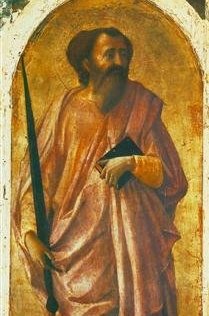
St. Paul by Masaccio

I repeat: Let no one take me for a fool. But if you do, then tolerate me just as you would a fool, so that I may do a little boasting. In this self-confident boasting I am not talking as the Lord would, but as a fool. Since many are boasting in the way the world does, I too will boast. You gladly put up with fools since you are so wise! In fact, you even put up with anyone who enslaves you or exploits you or takes advantage of you or puts on airs or slaps you in the face. To my shame I admit that we were too weak for that! Whatever anyone else dares to boast about—I am speaking as a fool—I also dare to boast about. Are they Hebrews? So am I. Are they Israelites? So am I. Are they Abraham’s descendants? So am I. Are they servants of Christ? (I am out of my mind to talk like this.) I am more. I have worked much harder, been in prison more frequently, been flogged more severely, and been exposed to death again and again. Five times I received from the Jews the forty lashes minus one. Three times I was beaten with rods, once I was pelted with stones, three times I was shipwrecked, I spent a night and a day in the open sea, I have been constantly on the move. I have been in danger from rivers, in danger from bandits, in danger from my fellow Jews, in danger from Gentiles; in danger in the city, in danger in the country, in danger at sea; and in danger from false believers. I have labored and toiled and have often gone without sleep; I have known hunger and thirst and have often gone without food; I have been cold and naked. – 2 Corinthians 11:16-‬27

Welcome to the second letter to the Corinthians. This appears to be the only water-related verse in 2 Corinthians and there were only two in 1 Corinthians (1 Corinthians 3:1‭-‬9 and 1 Corinthians 10:1‭-‬5). So far Paul definitely uses less water imagery and metaphors than much of the old testament and the gospels. His prose is generally pragmatic and to the point.

Paul is letting his ego run wild a bit here to engage in some bombastic boasting. In his defense he does admit that he is indulging in a bit of foolishness, and he makes it clear that this is the way he would talk as a fool, and not the way the Lord would talk. So why the boasting? It seems Paul is trying to make a point about what we should be boasting about should we feel the foolish need to do so.

Apparently the people of Corinth are hearing from other boasters about their credentials and curriculum vitae. It sounds like there are people trying to use their accomplishments and accolades to garner followers, without proper boasting about the One they follow. Paul apparently feels like he is being seen as a fool for his choices and some of the consequences of his actions.

Reading between the lines, it sounds like there are people who think Paul’s approach to sharing the Good News is simply too costly and hard. It also sounds like there are other “boasters” that might be leaving out important details about the sacrifices that will be required to follow the Messiah. Paul wants to make it clear that their will be difficult roads on the journey home.

Paul certainly pulls no punches with describing in detail what he has endured to share the Good News of Christ including floggings, stonings, shipwrecks, and imprisonment. This litany of what could only be described as torture by today’s standards is meant to help those reading this letter to understand to true cost of discipleship and faithfully following Jesus.

The water references come up towards the end of the passage when Paul is describing “shipwrecks”, “danger from rivers”, and “danger at sea” among a long list of other challenges that he has had to face and overcome in sharing the Good News of Christ. His trials and travels, some voluntary and some as a prisoner of Rome, have taught Paul many important lessons. He wants the believers in Corinth to know that this is a feature not a flaw for followers of Christ. It is part of God’s plan for sculpting us into the vessels that he needs us to be.

Some followers have taken this idea to unwise and unhealthy extremes through practices like self flagellation, the practice of flogging oneself with whips or other instruments that inflict pain. This practice, aside from being wrong and misguided in my opinion, completely misses Paul’s point. Pain, suffering, and trials that result from following God and sharing the Good News with others is not something to seek out or avoid. It is simply part of the new wine that Jesus is offering.

Paul has faced many dangers since his encounter with Jesus on the road to Damascus. Paul’s “boasting” about them is really just accurate reporting of events similar to trials that most followers can expect. We may not be flogged or imprisoned for our faith, but it may cost us financially, in our professional lives, or with our families. I think Paul’s main point for his “boasting” is that the reward far outweighs the costs.

Prayer: God help us to accept hardships that may come as a result of our following You.

Posted in 2 Corinthians, Christian Community, Christian Leadership, Christianity, Discipleship, Following God, Life Together, Obedience, Paul, Sharing the Gospel | Tagged , , , | 1 Comment

Canals of Connection

Canal for water released from Lake Kachess Dam, Washington

For I do not want you to be ignorant of the fact, brothers and sisters, that our ancestors were all under the cloud and that they all passed through the sea. They were all baptized into Moses in the cloud and in the sea. They all ate the same spiritual food and drank the same spiritual drink; for they drank from the spiritual rock that accompanied them, and that rock was Christ. Nevertheless, God was not pleased with most of them; their bodies were scattered in the wilderness. – 1 Corinthians 10:1‭-‬5

Paul lays all his cards on the table in today’s passage making it clear to the confused Corinthian jews that the God of the old testament and Christ are One. Those following “the cloud” and “passing through the sea” were, in a time bending sense, following Christ.

Paul connects the new practice of water baptism with the old testament ideas of being enveloped by God in a cloud and passing through the sea: “They were all baptized into Moses in the cloud and in the sea.” These conceptual “canals” were intended to span the confluence of the old and new testaments for the Corinthians stuck in the twilight time between Moses and the Messiah.

Canals are an interesting human invention that have been around for thousands of years. They serve many purposes such as water conveyance, transportation, and passage around natural barriers like rapids and waterfalls. Following this metaphorical meaning, Paul’s use of these conceptual “canals” is to overcome the barrier or obstruction that Jesus represents for some of the Jewish people in Corinth.

for The “canal” of connection between the cloud and Jesus is pretty straightforward – God was in the cloud and God was incarnate in Jesus. Those following the cloud in the wilderness were in fact following Christ. Paul is trying to convince these “cloud followers” to become Christ followers. The “Cloud” led them and provided for them in the wilderness, but they have missed the Messiah and the Holy Spirit that can do the same thing for them now.

The second “canal” connects God providing an escape from Egypt for the Israelites via Moses’ red sea parting and Christ providing a way to cross a river that no one can cross from the land of oblivion and the undiscovered country. This conceptual canal was probably the more difficult of the two for the people to understand. They were used to trying to reach God through works rather than faith and certainly wading into a river that no one can cross would, and does, require a fecundity of faith.

Paul then moves from the metaphysical to the material: “They all ate the same spiritual food and drank the same spiritual drink; for they drank from the spiritual rock that accompanied them, and that rock was Christ. It is interesting that Jesus equated himself with a Well of Living Water just like the water that emerged from the rock for Moses and Aaron.

Paul’s main point here for the Corinthians, and us, is that the same God who led, loved, and cared for the Israelites in the desert, helped them escape bondage in Egypt, and provided for their hunger and thirst is present in the person of Jesus Christ for all those who choose to follow Him.

Prayer: God you created a great canal between the spiritual realm and the earthly realm in the form of Jesus. Help us to accept this gracious gift.

Posted in 1 Corinthians, baptism, Christianity, Covenant, Discipleship, Following God, Jesus, Love for the Lost, reconciliation, Redemption, The Nature of God, The Spiritual Realm | Tagged | 1 Comment

The Master Gardener

Brothers and sisters, I could not address you as people who live by the Spirit but as people who are still worldly—mere infants in Christ. I gave you milk, not solid food, for you were not yet ready for it. Indeed, you are still not ready. You are still worldly. For since there is jealousy and quarreling among you, are you not worldly? Are you not acting like mere humans? For when one says, “I follow Paul,” and another, “I follow Apollos,” are you not mere human beings? What, after all, is Apollos? And what is Paul? Only servants, through whom you came to believe—as the Lord has assigned to each his task. I planted the seed, Apollos watered it, but God has been making it grow. So neither the one who plants nor the one who waters is anything, but only God, who makes things grow. The one who plants and the one who waters have one purpose, and they will each be rewarded according to their own labor. For we are co-workers in God’s service; you are God’s field, God’s building. – 1 Corinthians 3:1‭-‬9

Well the book of Romans may be packed full of theological deep water, but as far as I can tell there was only one water reference. Paul’s first letter to the church in Corinth looks to be equally “dry” in terms of water references, only one. Let’s run this reach and see what it has to offer.

This passage in the beginning of 1 Corinthians is about allegiances and appropriate following. Apparently the Church in Corinth has become factionalized with some following Paul and others following Apollos (and others). Of course all leaders are meant to lead while following Jesus, but in practice this can get hard, even after Paul’s lessons for leaders.

Paul equates the spiritual maturity of the followers in Corinth with children, calling them “infants in Christ”. Now on one level this is a compliment as Jesus directed all of us to be like children in our pursuit of Him. The difference here is that these spiritual “children” are pursuing the wrong person. Placing their trust in worldly leaders rather than the Holy Spirit that has been poured into them.

Paul uses an analogy to get his point across, a rare practice for Paul in my float so far through his writings. Paul uses a gardening analogy which I can relate to as a lifelong gardener. Paul says “I planted the seed, Apollos watered it, but God has been making it grow.” God is really the gardener, we merely get to play cameo roles as the Holy Spirit leads us.

Paul’s point here is that the journey home for followers of Christ is about faithfully following God rather than any fallible follower. We all have roles to play in one another’s journeys, but we cannot lose sight of the real end goal, crossing the uncrossable river with the help of Christ.

We must allow ourselves to be “watered” by other followers without losing sight of our true water source. This can be tricky as the earthly irrigators sometimes seem more real and responsive. It is up to these leaders to be constantly pointing people toward the real water source even when they are helping to provide water for our thirst.

The take home message for me is that the Christian ecosystem is intended to be full of “gardeners”. Some plant, while others water, weed, and harvest. We must never lose sight of the “Master Gardener” who makes us all grow.

Prayer: God help us to help one another while remembering it is You that really makes us grow.

Posted in 1 Corinthians, Christian Leadership, Christianity, Discernment, Following God, Holy Spirit, Jesus, Parable, religion | Tagged , , , | 5 Comments