A God who serves

The Lord appeared to Abraham near the great trees of Mamre while he was sitting at the entrance to his tent in the heat of the day. Abraham looked up and saw three men standing nearby. When he saw them, he hurried from the entrance of his tent to meet them and bowed low to the ground. He said, “If I have found favor in your eyes, my lord,[a] do not pass your servant by.  Let a little water be brought, and then you may all wash your feet and rest under this tree.  Let me get you something to eat, so you can be refreshed and then go on your way—now that you have come to your servant.” “Very well,” they answered, “do as you say.” – Genesis 18:1-5 (NIV)

The previous chapters, although very important did not refer to water so I did not focus on them.  They included important descriptions of the covenant that God made with Abraham through his sons Ishmael and Isaac. In this verse Abraham encounters God through three visitors.  It is not clear to me how he knew these three visitors were angels sent from God, but Abraham immediately calls for water to wash the visitor’s feet.

This is the first time I can remember that water to wash feet has been described. Since Jesus did this with his disciples in a very prominent and symbolic way it seems fitting to reflect upon this first instance. On one level the washing of feet in this case is merely functional, the travellers have been walking with sandals or bare feet for perhaps many days in a dry dusty desert. How better to serve them than to provide water to wash their feet. It does not appear that Abraham washed the feet of the travellers as Jesus washed the feet of his disciples.

This provides an interesting contrast between the relationship Abraham enjoyed with God and the more intimate relationship we can have with God through Jesus. Abraham was still in the mode of sacrifice and service to a relatively impersonal God.  The preceding verse describes circumcising all the male members of his household and himself. I imagine the male members of his household were a bit surprised when Abraham described what God had asked him to do.  I can almost hear them saying “you want to do what!”

Jesus clearly began a new type of relationship when he arrived in which the God of the universe does what would normally be done for oneself or by a servant. He washed the disciples feet.  What an amazing, and surprising, God we have through Jesus — A God who serves rather than a God to be served.

Prayer: Thank you God that you were willing to show us love through your son Jesus Christ.  Help me to be willing to “wash the feet” of those around me to show them the way you love us.


Posted in Genesis, God's Love for Us | Tagged , , , , , , | Leave a comment

The God who sees me

The angel of the LORD found Hagar near a spring in the desert; it was the spring that is beside the road to Shur.  And he said, “Hagar, servant of Sarai, where have you come from, and where are you going?” “I’m running away from my mistress Sarai,” she answered.  Then the angel of the LORD told her, “Go back to your mistress and submit to her.”  The angel added, “I will so increase your descendants that they will be too numerous to count.”  The angel of the LORD also said to her: “You are now with child and you will have a son. You shall name him Ishmael, for the LORD has heard of your misery.  He will be a wild donkey of a man; his hand will be against everyone and everyone’s hand against him, and he will live in hostility toward all his brothers.”  She gave this name to the LORD who spoke to her: “You are the God who sees me,” for she said, “I have now seen the One who sees me.”   That is why the well was called Beer Lahai Roi; it is still there, between Kadesh and Bered.  So Hagar bore Abram a son, and Abram gave the name Ishmael to the son she had borne.  Abram was eighty-six years old when Hagar bore him Ishmael.   – Genesis 16:7-16 (NIV)

The preceding chapters describe Abram and Sarai impatient for a child.  So Sarai gives her servant, Hagar, to Abram (who seems quite willing to sleep with her I might add). Abram get’s this Egyptian maidservant pregnant and then Sarai get’s mad and sends her away. God meets Hagar at a springs, presumably near where Abram and his wife were camped in the desert. Why did God choose to meet her at a spring.  In a sense God met Hagar at a location where she was already being cared for by God through the provision of water in the spring.  Hagar may not have realized or acknowledged this but she probably could not have survived in the desert without water from the spring. I am reminded of the vine that grew up for Jonah to protect him from the sun.

God provides many things for us which we may not realize or appreciate.  He truly knows our needs better than we do.  The name that Hagar gives God is very interesting “You are the God who sees me”.  This had to be somewhat unique and revolutionary at the time. Most religions, including Christianity and Judaism at times, are all about God seeing us for what we do.  This passage describes a God who “sees me”, sees all of me — who I am more than what I do.  The amazing part of that is that God loves what he sees, no matter how badly we fail or mess up.

Prayer: You see all of me God, thank you that you still love what you see.

Posted in Genesis, God's Love for Us | Tagged , , , , , , , , , | Leave a comment

Borders

When the sun had set and darkness had fallen, a smoking firepot with a blazing torch appeared and passed between the pieces. On that day the LORD made a covenant with Abram and said, “To your descendants I give this land, from the river of Egypt to the great river, the Euphrates – Genesis 15:17-18 (NIV)

The intervening passages between Genesis 13 and this verse are mainly about God’s interaction with Lot and Abram.  This passage is crucial in that it set forth a promise that the descendants of Abram will possess the land bounded on the southwest by the Nile (river of Egypt) to the Euphrates.  It is interesting that the geographic reference in this case is two major rivers.  Water in rivers has always been used to define boundaries between countries and adjacent lands.    The border between states that border the Mississippi River in the United States have changed many times as a result of the meandering river.  Mark Twain describes it this way in Life on the Mississippi “The Mississippi is a just and equitable river; it never tumbles one man’s farm overboard without building a new farm just like it for that man’s neighbor. This keeps down hard feelings.”

Much of the land promised to Abram is now held by Arabs, giving rise to almost constant conflict and bloodshed.  It is interesting that the Lord makes this promise to Abram before he has either Ishmael or Isaac.  We often create borders between ourselves and others.  These borders can be between individuals, families, states, and countries.  These borders divide “us” from “them”, two of the most divisive words in the english language.  There are efforts to look past borders through groups like Doctors without Borders and Engineers without Borders.  What about Christians without borders?  Am I a Christian without “borders” (not just political borders).  It seems to me that Jesus gave us an amazing example of ignoring many of the “borders” created in his day.

Prayer: Lord help me to cross borders and dissolve boundaries to share your love with others. 

Posted in Christian Community, Genesis, Love for the Lost | Tagged , , , , , , , , , | Leave a comment

Well Watered

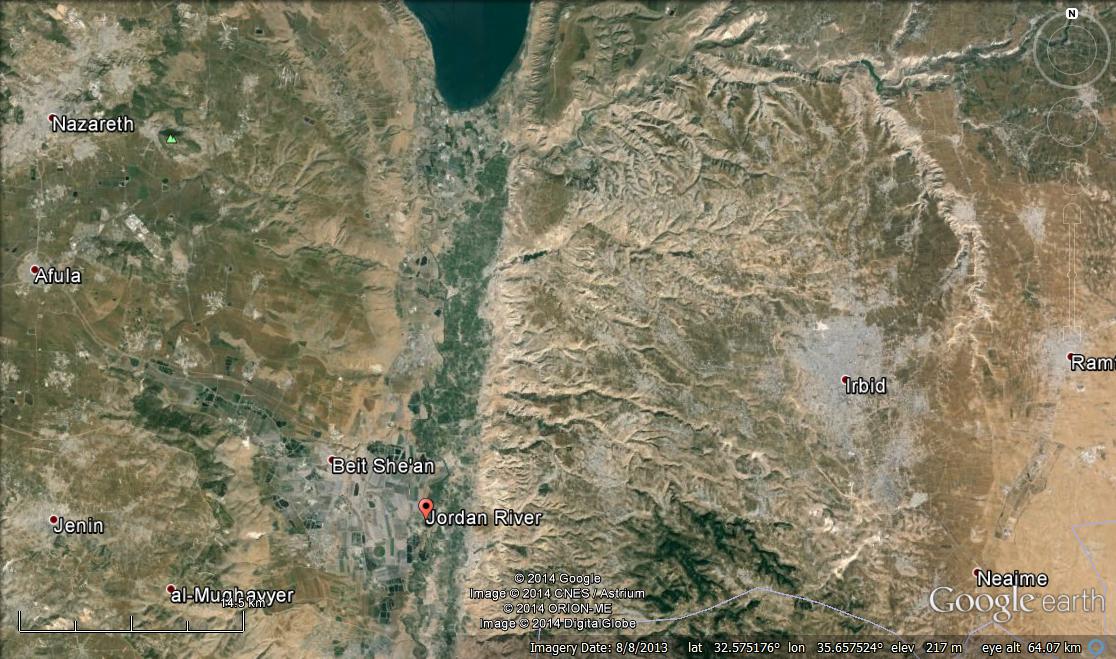
Jordon from google

Jordan River Plain (Google Earth)

Lot looked up and saw that the whole plain of the Jordan was well watered, like the garden of the LORD, like the land of Egypt, toward Zoar. (This was before the LORD destroyed Sodom and Gomorrah.) So Lot chose for himself the whole plain of the Jordan and set out toward the east. The two men parted company. – Genesis 13:10-11 (NIV)

This is the first time I have noticed where a decision in the bible was influenced by the presence or absence of water. The plain of the Jordan is compared to the Garden of Eden and to the Nile Delta in Egypt. The very presence of water influenced Lot’s decision to “go left” and part ways with Abram so that the numerous livestock and herders would not be in conflict. So, fundamentally, this was the first conflict related to resources and water that is described in the bible. The conflict was resolved in this case because Abram gave Lot the choice of locations to send his herds and people. The plain of the Jordan River remains one of the most productive locations in the region to this day.

What does it mean for the land to be “well-watered”? In this case the water comes from flooding of the low, flat, floodplain of the Jordan River.  This fertile plain contains the silt, sand, and nutrients from many floods.  What would it look like for us as followers of God to be “well-watered”, with the living water described by Jesus.  Perhaps it means our souls would be capable of producing abundant fruit.  We may also have “deposits” left behind by the life-floods we have experienced.  I think the way we view these life-floods and what they leave behind will determine whether our lives become a muddy bog that breeds mosquitoes, or a fertile floodplain that bears much fruit for God’s Kingdom.

Prayer: God help me to develope a fertile and well-watered soul that will bear much fruit.

Posted in Christian Community, Following God, Genesis | Tagged , , , , , , | Leave a comment

Catching the rainbow

JJK_6006“I now establish my covenant with you and with your descendants after you and with every living creature that was with you–the birds, the livestock and all the wild animals, all those that came out of the ark with you–every living creature on earth.  I establish my covenant with you: Never again will all life be cut off by the waters of a flood; never again will there be a flood to destroy the earth.” And God said, “This is the sign of the covenant I am making between me and you and every living creature with you, a covenant for all generations to come: I have set my rainbow in the clouds, and it will be the sign of the covenant between me and the earth. Whenever I bring clouds over the earth and the rainbow appears in the clouds, I will remember my covenant between me and you and all living creatures of every kind. Never again will the waters become a flood to destroy all life. Whenever the rainbow appears in the clouds, I will see it and remember the everlasting covenant between God and all living creatures of every kind on the earth.”  So God said to Noah, “This is the sign of the covenant I have established between me and all life on the earth.”  – Genesis 9:9-17 (NIV)

God promises to never again bring such a flood to earth. As tangible evidence God points to the rainbow, a natural sign which must have been a familiar sight after rains and storms. There are several interesting physical observations about rainbows: 1) rainbows do not always occur after a rain or flood 2) rainbows are not visible from all perspectives and for all observers, even for the same storm; 3) most rainbows are fleeting and don’t last more than a brief time; 4) many rainbows are exceedingly beautiful; 5) rainbows do not occur unless it has rained or there has been some sort of disturbance to put moisture in the atmosphere. From these physical attributes of rainbows I glean the following insights about the covenant with God that they represent: 1) There may be storms in our lives after which we do not see a rainbow; 2) Even when evidence of God’s covenant is present we may not be in the right place (spiritually) to see it; 3) We should not expect, or need, an ever present rainbow as evidence of God’s covenant with us; 4) God’s covenant with us is magical and beautiful and we should stop to marvel often; 5) We should not expect a life without storms, unless we are content to have no rainbows.

Prayer: God thank you for the reconciliation that you have made with us through the rainbow and your son Jesus Christ.  May we always be looking for rainbows…

Posted in Covenant, Genesis | Tagged , , , , , , , | 1 Comment

Everything!

1 (2)The fear and dread of you will fall upon all the beasts of the earth and all the birds of the air, upon every creature that moves along the ground, and upon all the fish of the sea; they are given into your hands. Everything that lives and moves will be food for you. Just as I gave you the green plants, I now give you everything. – Genesis 9:2-3 (NIV)

I never really noticed that this is the first time that God gave man “permission” to give up being a vegetarian. I was a vegetarian in college for two years.  Have you ever tried to survive as a vegetarian on dorm food from the 1980’s…it was not pretty.  Lots of grilled cheese sandwiches and salad.  My reasoning at the time was not from a Christian perspective as I did not become a Christian until later.

I originally became a vegetarian because 1) my vegetarian hero Mohandas Gandhi was one; and 2) I have always disliked killing things if I could help it. I guess I always assumed that the change over to a non-vegetarian diet occurred as Adam and Eve left the garden of Eden after the Fall. The only connection to water in this passage is the mention of fish in the sea, it seems that before this man was not eating fish.  That leads me to wonder what Noah and his family were eating while they were on the ark.  Were they vegetarian?  Did they bring along a few extra animals?  Did they actually eat fish?  All very interesting questions that we may not know the answer to until we can ask God face to face.

One deeper truth that may be embedded in this passage is that God “now gave us everything”, including his son Jesus Christ and forgiveness for our sins.  There are times when it is easy to take for granted the freedom we have in Christ, but it is one of the things that rang true for me about Christianity.  Most other world religions, including some forms of Christianity, seem to decrease freedom rather than increase it.

Prayer: Thank you God that you have given us everything.  Grant me the wisdom to use this freedom wisely.

Posted in Covenant, Genesis, The Nature of God | Tagged , , , , , | Leave a comment

Sending out

Then he sent out a dove to see if the water had receded from the surface of the ground. But the dove could find no place to set its feet because there was water over all the surface of the earth; so it returned to Noah in the ark. He reached out his hand and took the dove and brought it back to himself in the ark.  He waited seven more days and again sent out the dove from the ark.  When the dove returned to him in the evening, there in its beak was a freshly plucked olive leaf ! Then Noah knew that the water had receded from the earth.  He waited seven more days and sent the dove out again, but this time it did not return to him.  By the first day of the first month of Noah’s six hundred and first year, the water had dried up from the earth. Noah then removed the covering from the ark and saw that the surface of the ground was dry.  By the twenty-seventh day of the second month the earth was completely dry. – Genesis 8:8-14 (NIV)

After reading this and the previous passages it seems that the Noah account is an interwoven fabric of at least three different types of narratives: 1) an allegorical account which perhaps draws upon local legends or descriptions of great floods; 2) actual details of a regional flood which occurred as a historical event in the region of the Tigris and Euphrates Rivers; 3) numerological details, such as the references to seven days, which may have been added later. The third item seems the only explanation I can some up with to explain the excessive details regarding timing of the drying up and other events related to the flood. Some of these details read as if they are inconsistent with one another. For example, verses 8:4,5 from the previous passage seem to be making contradictory statements, i.e. the ark came to rest on the mountains or Ararat before they were in fact exposed.  It is this sort of interweaving of details which leads me to think that this narrative is an interwoven fabric of accounts.

The spiritual meaning I glean from these passages is that Noah was actively and regularly “sending out” out the Dove to determine if the flood was over.  When we are in the midst of “life-floods” it can be easy to hunker down and become self-absorbed.  Hold up in our Ark with the shutters closed if you will.  What does it look like for us to “send out doves” during these times?  Perhaps it means asking for, or accepting, help from those who care for us.  Coffee with a friend or relative to talk about the “life-flood” we are experiencing.

Prayer: God help me to actively send out, and reach out, to others during times of trial and floods in my life. 


Posted in Christian Community, Genesis | Tagged , , , , , , | Leave a comment

God Remembered

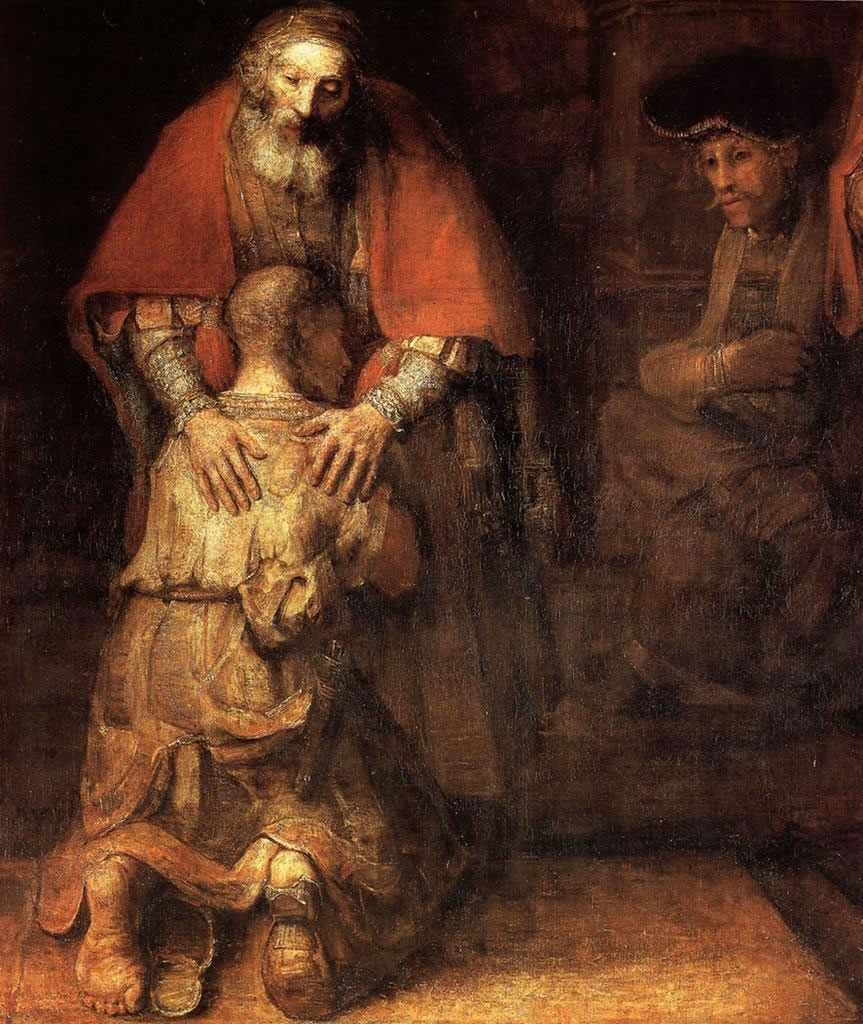
prodigalson

The Prodigal Son by Rembrandt

But God remembered Noah and all the wild animals and the livestock that were with him in the ark, and he sent a wind over the earth, and the waters receded. Now the springs of the deep and the floodgates of the heavens had been closed, and the rain had stopped falling from the sky. The water receded steadily from the earth. At the end of the hundred and fifty days the water had gone down, and on the seventeenth day of the seventh month the ark came to rest on the mountains of Ararat. The waters continued to recede until the tenth month, and on the first day of the tenth month the tops of the mountains became visible. – Genesis 8: 1-5 (NIV)

The timeline is very specific in this passage, much more specific that I realized or remembered.  What is God’s purpose in this narrative?  The part that stands out for me is that God “remembered” Noah.  I am confident that God remembers us as well when we feel like we are in the midst of an unending flood in our lives. The “floods” in our lives could be the death of a loved one, divorce, family dysfunction, illness, or many other seemingly overwhelming deluges of disappointment. It is comforting that God remembers, but from our perspective His remembering can seem to take really long. I can remember a time when, as a child , I was experiencing a “deluge”.  I remember crying out to God and wondering why God seemed to be taking so long to help me. Looking back now I can see his hand and love, even though it seemed like God had forgotten.  He remembered me then and I am confident he remembers me now.

The descriptive details of this passage are interesting.  The water’s were said to recede as a result of a wind that God sent over the earth.  I cannot help but see a connection between this wind and the Holy Spirit that will come later as a “wind” in Jesus’ disciples lives.  The “drying up” took quite a long time – more than ten months.  I suspect Noah and his family were beginning to wonder when it would end.

Prayer: Thank you God that you remember us in times of trial in our lives.  Grant us the patience and ability to wait on your wind to dry out to flood.

Posted in Covenant, Following God, Genesis, The Nature of God | Tagged , , , , , , | Leave a comment

Faith and Floods


The waters flooded the earth for a hundred and fifty days. – Genesis 7:24 (NIV)

The verses that precede this verse describe the complete annihilation of the people and creatures of earth except Noah’s family and the animals on the ark. Once again the specificity in this verse is a bit striking.  This is a very long time for a flood to persist, it would certainly start to resemble a lake or a sea rather than a flooded river.  A literal reading of this part of the narrative is also hard to reconcile with the geologic record.  A flood of this duration would certainly have left it’s mark on the sedimentary record of the region and the globe.  No such regional flood deposits exist.

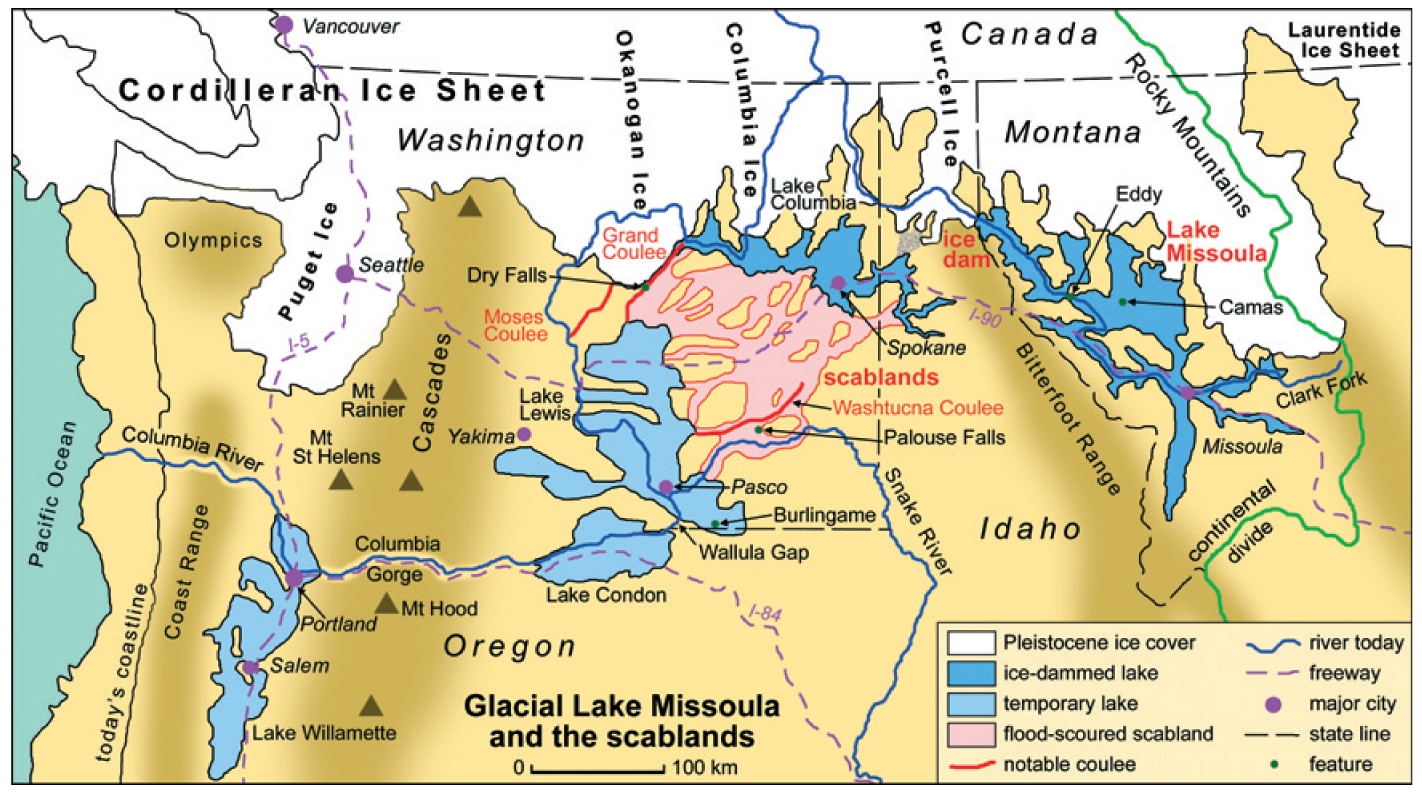
Evidence for large floods is present locally, but these deposits can almost always be linked to specific regional geologic events.  For example, the Missoula floods occurred in the Pacific Northwest of North America during the last ice age (~15,000 to 13,000 years ago).  The evidence for mega-floods in this region is overwhelming, but so is the evidence that the floods were generated by the failure of glacial dams near Missoula, Montana.  The glaciers moving from the north created a temporary lake several thousand feet deep which periodically was released when the ice dam broke.  These Missoula floods may have happened 10’s to 100’s of times.  As part of my PhD research on the Clackamas River I mapped and dated Missoula Flood deposits.  There was much rejoicing by some biblical scholars at the time these floods were described by J. Harlen Bretz in 1923.  Many were quick to point to these mega-floods as evidence for the flood of Noah.  In fact many in the science community did not accept Bretz’s theory because of the perceived link to the biblical flood.  This is a great example of how we must be careful with a literal interpretation of Noah’s flood, which I would argue is not possible from the scientific perspective.  Rigid adherence to a literal interpretation alienates many scientists who may otherwise have an earnest desire to explore their spirituality through Christianity.

Does something other than a literal interpretation change my faith in Christ?  No.  So what should we take away from the Noah account?  What does it tell us about God and his relationship to us?  I think it is saying God desires his children to behave in a certain way, when we do not behave that way there will be consequences.  Perhaps not as dramatic as Noah’s flood, but I do believe God could “unmake” us if he chooses.  In Christ we need not fear God will do this in a retributive way, he has reached out to us and clearly stated that he loves and forgives us even when we are disobedient and “strong-willed”.  This does not mean that God does not send storms and floods into our lives to get our attention.   I believe he can and will do this on occasion when we have grown complacent and lost our focus on him and Christ.

Prayer:  God grant me the grace you have given us in Christ Jesus when I am strong-willed and stubborn, wake me gently from my spiritual slumber with a gentle wind of your spirit rather than a deluge of water.


Posted in Covenant, Genesis, Miracles | Tagged , , , , , , | Leave a comment

High water mark

tour-of-mount-ararat-4

Mount Ararat

For forty days the flood kept coming on the earth, and as the waters increased they lifted the ark high above the earth.  The waters rose and increased greatly on the earth, and the ark floated on the surface of the water. They rose greatly on the earth, and all the high mountains under the entire heavens were covered. The waters rose and covered the mountains to a depth of more than twenty feet. – Genesis 7:17-20 (NIV)

A literal interpretation of this passage is problematic for many geologists because it seems to be very specific about the fact that the flood covered all the high mountains, including one of the tallest in the region, the Ararat Mountain range and Mount Ararat (5,137 m or 16,854 ft). Mount Ararat is no slouch of a mountain. There is still some debate about exactly which mountain is described as the final resting place of Noah’s Ark.

Regardless of where the ark came to rest, in order for the water to reach a depth of 15 cubits (roughly 7 meters) over Mount Ararat the water would have to be over 16,000 feet deep. From a scientific perspective, clearly this is either 1) hyperbole; 2) mistranslated; 3) allegorical; 4) a truly miraculous “magical” occurrence for which no geologic record remains. I favor the idea that this story was handed down and perhaps made into hyperbole by the people who captured the narrative. Perhaps a regional flood covered many “high hills” as the King James version puts it, but it is not possible for a geologist to believe that floodwater covered Mount Ararat without a major suspension of natural laws and an effort by God to “fool” us with the present geologic record.

The specificity of the last verse is a bit odd. Why specify that the flood waters reached a specific height above mountains when the mountains are different heights? How could flood water reach a certain height above mountains of different heights?   The last verse reads to me like it may have been grafted onto the narrative, perhaps later to describe an actual observation of a regional flood. For example, perhaps the flood reached a height of >20 feet over the “high hills” of the rivers (Tigris, Euphrates, etc.) region of area. A regional flood in large rivers of >20 feet would certainly be a very large flood and would have covered a large area of the region. Many sincere Christians have tried to make fossils scattered around the world fit with the Noah’s flood account.  I have collected fossils around the world in different places and from many different age rocks and a Noah’s flood origin for these fossils is not geologically possible.  Could God have miraculously caused these fossils to be in the rock, sure, but why would He do that?  I see no other evidence in the bible that God is interested in deceiving us into believing and following him.

I have had many conversations with both Christians and fellow scientists about this verse (and the age of the earth).  This verse (and the age of the earth) is a stumbling block for many scientists (especially geologists) who would otherwise consider the person of Jesus and what he came to accomplish. Which is more important; the veracity of a literal interpretation of the biblical account of Noah’s Flood (or the age of the earth), or the ability of spiritually curious God-seekers to find Christ and follow Him?  I will pick the second option every time.

Prayer: Lord help me to understand passages such as this in the context of your ongoing desire to know and love all of us as your children through Jesus Christ.

Posted in Genesis, Miracles | Tagged , , , , , , | Leave a comment