
Stumbling Stone

Blue Pool where the McKenzie River emerges from underground to become a river.

Isaiah cries out concerning Israel: “Though the number of the Israelites be like the sand by the sea, only the remnant will be saved. For the Lord will carry out his sentence on earth with speed and finality.” It is just as Isaiah said previously: “Unless the Lord Almighty had left us descendants, we would have become like Sodom, we would have been like Gomorrah.” What then shall we say? That the Gentiles, who did not pursue righteousness, have obtained it, a righteousness that is by faith; but the people of Israel, who pursued the law as the way of righteousness, have not attained their goal. Why not? Because they pursued it not by faith but as if it were by works. They stumbled over the stumbling stone. As it is written: “See, I lay in Zion a stone that causes people to stumble and a rock that makes them fall, and the one who believes in him will never be put to shame.” – Romans 9:27‭-‬33

Wow, I just read through the entire book of Romans and I think this is the sole water reference in the book.  Paul’s main focus in writing this letter is to provide theological and historical underpinnings for many of the practices of the early church and its members.  He also shares about his own journey and expresses a longing to return to Rome.

I suppose part of the reason for the dearth of water references is that Paul is speaking with a pragmatic purpose. I feel like Paul could have used a few more metaphors to connect with his audience at a soul to soul level. Perhaps his scholarly background, and lack of lessons by the lake with Jesus, left him with limited literary skills outside of legal matters. I do not know.

I reflected on the Isaiah reference (Isaiah 10:20-27) in this passage way back on September 5, 2015.  The post was called “Sands by the sea” and the main point was that Isaiah was predicting the very thing that Paul is describing.  A remnant of Jewish people will follow God faithfully and others will have this opportunity too. The part that Paul is adding here, after the great conjunction of Jesus’ life, death, and resurrection, is that those that are successful at this faithful following embrace a new internal relationship with God provided by the pouring out of the Holy Spirit.  This opportunity is open to Jew and gentile alike.

Paul goes on to explain why the remnant does not contain more followers from the Jewish tradition.    Paul says “Because they pursued it not by faith but as if it were by works. They stumbled over the stumbling stone.” Something about the way they were relating to God was blocking a more intimate relationship.

The “Rock in the road” on the Jewish journey home was of course Jesus the God-man who walked on water, calmed storms, and ultimately promised to help us cross the uncrossable river.  Many of the Jews Paul was addressing, and those like myself reading it now, are caught up in a spiritual tug of war for our souls.  Earthly endeavors (works) on one side and eternal events inspired and orchestrated by the Holy Spirit on the other.

We have to choose which “team” we are pulling for in this spiritual struggle and apparently many Jews are pulling for the works side.  So why are the Jews more comfortable as  “humans doing” than “humans being”.  They have allowed their searching on the great spiritual sea to be more about the boat and tackle and less about the destination in the undiscovered country.  They are not alone in this.

So how does one keep from stumbling over the “stone” that is the savior Jesus? Paul provides an answer “and the one who believes in him will never be put to shame.” So it is as simple, and as complex, as believing – allow the “stumbling stone” to be your savior and Lord.  It need not be more complicated than that.

Prayer; God help us to build You into our soul and spirit.

Posted in Christianity, Discipleship, Following God, Free Will, God's Love for Us, Jesus, Paul, Redemption, Romans, Sharing the Gospel, The Spiritual Realm | Tagged , , , , | 2 Comments

Eddying out after Acts

Well it took me way too long to float this reach of river, but I finally finished the book of acts. It was a much harder reach of river than I anticipated. I am not sure why it was so difficult to stay on the water, but I started this book back on April 4 with a post called “Easter Gift“. If I were to summarize the entire book into a few sentences I would say it was about: 1) Peter and other early followers realizing that the Good News of the gospel is for everyone; 2) Paul weathering many trials and spiritual squalls in order to “catch up” with the disciples who spent more time with Jesus; and 3) Faithful following is much more effective with the guidance and help of the Holy Spirit.

Acts begins with an assurance that the opportunity to follow the way of Jesus is open to all God-lovers (theophilus). Our baptism with the Holy Spirit is not a single act of commemoration like water baptism, but rather an immersion in a new way of being and seeing the world.  It is a partial cure for the spiritual blindness that seems to afflict us here in the land of oblivion.  It is also the fulfillment of a promise that Jesus made to give sight to the blind, in this case the spiritually blind.  All those wandering and wondering about God are invited to use this set of night vision goggles to navigate the spiritual darkness that can threaten to envelope us if we let it.  It is really a matter of making room in our hearts.

This early guidance is followed by a reality check when we learn that we are all free to follow our own path both as people and nations. Stephen and followers like Philippe learn that following Jesus can be both hard and dangerous. Peter receives some important lessons by the sea about who can follow God and then the Holy Spirit is poured out to help them find the way.

Acts moves on from Peter and the early followers instructions about inclusion to Paul and Barnabas learning that being a leader requires ongoing lessons in humility. Their efforts to heal and care for people in Jesus’ name created confusion for some followers about who they should follow and how they should lead while following.

Paul and others learn that reaching people with the Good News requires that we practice our faith in public, not in a street corner evangelist sort of way but in an open conversational way so that curious God seekers have something to be curious about. Being in places where the lost are to be found includes some pretty hard places, and sometimes Staying in Jail to Set People Free.

Ongoing conflict with the religious leaders in Jerusalem leads to much humility and tears and eventually to an extended sabbatical at sea for Paul. The trip will require much of the sailors, soldiers, and Paul as they lose their cargo and almost their lives. Paul’s faith in God and public proclamation of that faith leads to the building of some serious metaphysical muscles for Paul and eventually chains of freedom in Rome.

The take home from the book of acts for me is that God following is open to all God lovers and we need to be willing to practice our faith in public with the help and leading of the Holy Spirit. We may be called to do this in places that may seem very inconvenient or hard like a ship in the process of wrecking or in prison. Jesus certainly warned his followers that following Him would be hard and I think the book of Acts provides some excellent examples.

Prayer: God help us to be willing to go into the places that you need us to be regardless of how hard or uncomfortable they might be.

Posted in Acts, Christian Leadership, Christianity, Eddying Out, Following God, Holy Spirit, Jesus | Tagged , , , | Leave a comment

Chains of Freedom

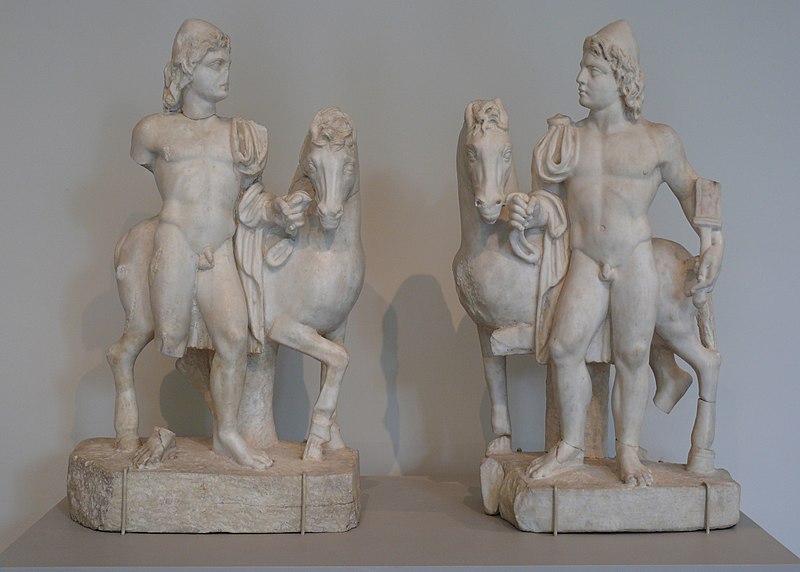
After three months we put out to sea in a ship that had wintered in the island—it was an Alexandrian ship with the figurehead of the twin gods Castor and Pollux. We put in at Syracuse and stayed there three days. From there we set sail and arrived at Rhegium. The next day the south wind came up, and on the following day we reached Puteoli. There we found some brothers and sisters who invited us to spend a week with them. And so we came to Rome. The brothers and sisters there had heard that we were coming, and they traveled as far as the Forum of Appius and the Three Taverns to meet us. At the sight of these people Paul thanked God and was encouraged. When we got to Rome, Paul was allowed to live by himself, with a soldier to guard him.  Three days later he called together the local Jewish leaders. When they had assembled, Paul said to them: “My brothers, although I have done nothing against our people or against the customs of our ancestors, I was arrested in Jerusalem and handed over to the Romans.  They examined me and wanted to release me, because I was not guilty of any crime deserving death.  The Jews objected, so I was compelled to make an appeal to Caesar. I certainly did not intend to bring any charge against my own people.  For this reason I have asked to see you and talk with you. It is because of the hope of Israel that I am bound with this chain.” – Acts 28:11‭-‬16

After his sojourn on Malta Paul is again on his way to Rome to resolve his appeal to Caesar. The mystery of the boat replacement is solved in this passage as they are described as finding passage on an “Alexandrian ship with the figurehead of the twin gods Castor and Pollux”. This is an interesting detail as these two Greek gods were considered the patrons of travelers, and of sailors in particular. Paul has clearly demonstrated to those with him that his God is bigger than storms and snakebites. God is the true patron of travelers in this land of oblivion on our journey home to the undiscovered country.

The Roman veneration and worship of Castor and Pollux may have lent new meaning to Paul’s triumphant arrival in Rome on a ship bearing their names. It was certainly not lost on the roman soldiers that were with Paul and I am sure word spread among the Roman soldiers that the God that Paul was speaking about had great power and protected those who faithfully follow Him.

Apparently word of Paul’s journey preceded him among believers. After landing and disembarking to walk along the Appian way to Rome Paul is met by believers who have traveled to meet him. They are about a day’s journey from Rome at a place called “the Forum of Appius and the Three Taverns”. Apparently the Forum of Appius was a well-known landmark along the Appian way that led from Rome to Brindisi in southern Italy.

My family lived in Italy for a year when I was in fifth grade and we visited Rome and many of the places described in this passage. I do not remember being aware of the Appian way and the history it held. Looking back I wish I would have spent more time being interested in history and less time eating pepperoni pizza and catching lizards. I did return to Italy just out of high school on a trip through Europe with my sister. We actually visited Brindisi, Italy on our way to the Greek island of Corfu. I am sure we visited historic places on that trip, but what I mainly remember was the beaches and riding scooters. But I digress, back to this interesting stretch of water.

It sounds like the believers actually travel with Paul for last part of his journey to Rome. This was probably to serve as advocates to the Roman government to help Paul get situated in Rome. Apparently their advocacy was effective as Paul is placed under what sounds like house arrest but he is free to receive many guests who are anxious to hear about the Good News he has brought.

After getting settled in Paul reaches out to the local Jewish leaders. Clearly Paul still identifies with his Jewish roots. Paul wants to explain why he has brought charges against his own people with regard to his treatment in Jerusalem by the Jewish leaders there. I sense that Paul wants to reset his relationship with these Jewish leaders before they take the same attitudes and approach as the leaders in Jerusalem. Paul makes it clear that “It is because of the hope of Israel that I am bound with this chain.”

I do not know whether the chain that Paul was bound by was a physical one, but there was certainly a metaphysical one binding him to God. He bound himself to the Messiah Jesus, and all that He stands for, no matter where he is and what is happening – storms, shipwrecks, snakebites, and prisons included.

We are called to bind ourselves to God and Jesus in a similar manner. The self-imposed chains that Paul, and all God followers, choose to wear are very different than the worldly coils that tend to ensnare us. These chains are actually a sign of freedom and they keep us close to God, and one another, when the road ahead gets difficult.

Prayer: God thank You for allowing us to bind ourselves to you. Keep us close and lead us where You need us to go.

Posted in Acts, Christian Community, Christianity, Faith, Following God, Free Will, God's Love for Us, Gospel, Jesus, Paul | Tagged , , , , | 2 Comments

Snakebites and Metaphysical Muscles

Once safely on shore, we found out that the island was called Malta. The islanders showed us unusual kindness. They built a fire and welcomed us all because it was raining and cold. Paul gathered a pile of brushwood and, as he put it on the fire, a viper, driven out by the heat, fastened itself on his hand. When the islanders saw the snake hanging from his hand, they said to each other, “This man must be a murderer; for though he escaped from the sea, the goddess Justice has not allowed him to live.” But Paul shook the snake off into the fire and suffered no ill effects. The people expected him to swell up or suddenly fall dead; but after waiting a long time and seeing nothing unusual happen to him, they changed their minds and said he was a god.  There was an estate nearby that belonged to Publius, the chief official of the island. He welcomed us to his home and showed us generous hospitality for three days.  His father was sick in bed, suffering from fever and dysentery. Paul went in to see him and, after prayer, placed his hands on him and healed him.   When this had happened, the rest of the sick on the island came and were cured.  They honored us in many ways; and when we were ready to sail, they furnished us with the supplies we needed.  Acts 28: 1‭-‬10

Paul, our “passionate prisoner with a purpose“, the other sailors, and roman soldiers have arrived on the island of Malta after their harrowing crossing in the storm. The weather sounds miserable with rain and cold. Fortunately the people of Malta seem to be very welcoming and caring as they provide the castaways with food and a fire to warm them. Everything seems to be moving in a positive direction when something unexpected happens – Paul is bitten by a snake.

I have never been bitten by a snake, but I have had my share of snake encounters. I have encountered a den of vipers emerging from their winter slumber in Idaho, jumped over a timber rattler in Nevada, and I have seen plenty of water snakes here in Michigan where I now live. I am not sure why, but I confess I have an illogical aversion to snakes. I did not have any traumatic childhood experience involving snakes that I can remember. I just don’t like snakes.

My work as an exploration geologist took me to many western states that are home to rattlesnakes and I was born in eastern Washington state where certain areas have many rattlesnakes. As venomous snakes go rattlesnakes are not the most deadly or dangerous, and they at least try to warn you to keep away with their raspy rattling. The snake that affixed itself to Paul’s hand apparently did not provide any warning. It was probably really cold and wet too and had come near the fire to get warm.

As soon as the people saw the viper hanging from Paul’s hand they attached spiritual/moral meaning to the event “This man must be a murderer; for though he escaped from the sea, the goddess Justice has not allowed him to live.” They placed the event into their own religious context. The men with Paul knew that it was not the goddess of justice but the God of the universe that saved both their lives and Paul from the storm and this snakebite.

Paul showed great poise with this viper hanging from his hand as he simply shook it off into the fire. Now that was certainly hard luck for the viper, but God has a plan for this event that apparently required sacrifice of the snake. The people of Malta, upon seeing this seemingly miraculous response to being bitten by a poisonous snake, proceed to place Paul in their own religious framework by making him a god, for only a god could survive such an event. Paul will redirect this wayward worship toward the God who saved him from the storm, the snakebite, and his own sins which included directing people to stone early God-followers to death.

Paul achieves this religious redirection by praying and healing in God’s name so that the people of the island can know the God who wants to carry each of them like a son or daughter through all of life’s storms and snakebites. The result of the snakebite miracle and healing is that many others on Malta brought their sick to be healed and the men were provided with the supplies they needed to complete their voyage. The passage does not mention where they got a new ship, but perhaps that is not the most important part of the story.

So what is the most important part of this story? I think the main point here is that Paul is getting into spiritual shape, God is preparing Paul to take the Gospel of Christ to Rome. Apparently part of the “training” required is for Paul to allow the Holy Spirit to fill him during numerous spiritual squalls. God knows that Paul’s future will involve many hardships and challenges as he shares the Gospel of Christ to Rome and beyond. These events, which seem rather challenging from an earthly perspective, are to develop metaphysical muscles. Paul will have to endure imprisonment, beatings, debates, and many other challenges to carry Christ to those who do not believe.

Many of the people he will be reaching out to will have very different religious backgrounds, just like the people of Malta. Paul’s training will make him nimble and resilient in the midst of confusing and contentious interactions, similar to those on the ship when the sailors and soldiers had lost hope and were ready to sacrifice all the prisoners. He needed to learn how to give hope to the hopeless. The leader lessons came in the form of seemingly hopeless situations that God helped Paul successfully navigate and survive with the help of the Holy Spirit.

The take home for me is that sometimes our “training” as followers of Christ will require navigating seemingly hopeless situations. It is in these situations that we are challenged to place all of our hope not in a resolution to our liking, but in God. That is what Paul is learning here. God’s will be done – regardless of the outcome from an earthly perspective.

Prayer: God help us to place our trust in You regardless of how hopeless or challenging earthly events may seem.

Posted in Acts, Christian Leadership, Christianity, Conflict, Discipleship, Following God, Gospel, Healing, Jesus, Miracles, Paul | Tagged , | 5 Comments

Passionate Prisoner with a Purpose

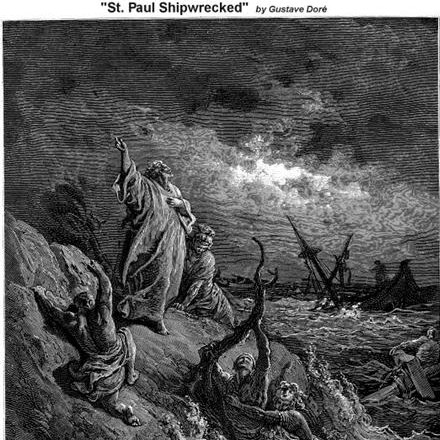
On the fourteenth night we were still being driven across the Adriatic Sea, when about midnight the sailors sensed they were approaching land. They took soundings and found that the water was a hundred and twenty feet deep. A short time later they took soundings again and found it was ninety feet deep. Fearing that we would be dashed against the rocks, they dropped four anchors from the stern and prayed for daylight. In an attempt to escape from the ship, the sailors let the lifeboat down into the sea, pretending they were going to lower some anchors from the bow. Then Paul said to the centurion and the soldiers, “Unless these men stay with the ship, you cannot be saved.” So the soldiers cut the ropes that held the lifeboat and let it drift away. Just before dawn Paul urged them all to eat. “For the last fourteen days,” he said, “you have been in constant suspense and have gone without food—you haven’t eaten anything. Now I urge you to take some food. You need it to survive. Not one of you will lose a single hair from his head.” After he said this, he took some bread and gave thanks to God in front of them all. Then he broke it and began to eat. They were all encouraged and ate some food themselves. Altogether there were 276 of us on board. When they had eaten as much as they wanted, they lightened the ship by throwing the grain into the sea. When daylight came, they did not recognize the land, but they saw a bay with a sandy beach, where they decided to run the ship aground if they could. Cutting loose the anchors, they left them in the sea and at the same time untied the ropes that held the rudders. Then they hoisted the foresail to the wind and made for the beach. But the ship struck a sandbar and ran aground. The bow stuck fast and would not move, and the stern was broken to pieces by the pounding of the surf. The soldiers planned to kill the prisoners to prevent any of them from swimming away and escaping. But the centurion wanted to spare Paul’s life and kept them from carrying out their plan. He ordered those who could swim to jump overboard first and get to land. The rest were to get there on planks or on other pieces of the ship. In this way everyone reached land safely. – Acts 27:27‭-‬44

Wow fourteen days at sea being driven by a storm. I can see why some of the sailors were ready to abandon ship and take their chances. I can only imagine the seasickness, cold, and discomfort that these sailors must have experienced over this two-week period. Losing their cargo was the least of their worries. Paul is taking on the role of being a comforter to these men who were technically his prison guards en route to Rome.

Paul must have impressed the Roman soldiers with his peace and passion amidst the storm. When some of the sailors wanted to take the lifeboat and leave the Roman soldiers did something that would seem to be either unwise or at least risky. They cut the lifeboat free and let it drift away. This was in response to Paul saying “Unless these men stay with the ship, you cannot be saved.” Paul the prisoner had gained stature and respect among these Romans. Perhaps this was in preparation for his many conversations and conversions with other Romans to come.

Paul sets a good example by caring for the sailors and the soldiers by telling them to eat. He leads them in giving thanks to God, before they eat the food. Importantly, Paul was also giving thanks before they were saved or out of danger. He was faithfully following, trusting God, and leading others to do the same.

Paul was caring for the 276 souls on board that ship in a way that many of these men had probably never seen. I imagine that many had led hard lives of labor and loneliness. The combination of the storm, and Paul’s quiet example in the midst of it, seems to have enabled them to follow this passionate prisoner with a purpose. They are about to go all in by tossing the rest of their cargo and cutting lose the anchors that had been keeping them from crashing into land.

Their landing on the island did not go well and the end result was a ship run aground still some distance off shore in pounding surf that was tearing the ship apart. At this point the Roman soldiers want to simply kill the prisoners, but their respect for Paul, and perhaps the God he served, led them to allow all aboard to swim for it to the island. In the end everyone reached the shore safely, just as Paul had prophesied. I suspect there was some kissing of the ground and sailors very happy to become landsman once again.

This may be a stretch but it strikes me that this storm is a bit like the last days of Jesus before He was crucified on the cross. The time when He was being beaten and whipped must have felt like a horrendous storm to His disciples and all those who were following Him. Through it all Jesus demonstrated radical faith and following, even to the end when He stated that God’s will should be done rather than His own. Jesus was also a prisoner with a purpose. He needed to provide a means for us to be with God and to help us cross the river that no one could cross.

Jesus found Paul on the road to Damascus and Paul helped these 276 souls find God and a safe landing. It was Paul’s spiritual squall, born of blindness and recovered sight, that gave him the faith he needed to lead these sailors to their savior.

Prayer: God thank you for leading us amidst storms and squalls. Help us to use what we learn to lead others to You.

Posted in Acts, Christian Leadership, Christianity, Discipleship, Faith, Following God, Jesus, Paul, Sharing the Gospel | Tagged | 4 Comments

Losing our Cargo

https://holylandphotos.org/

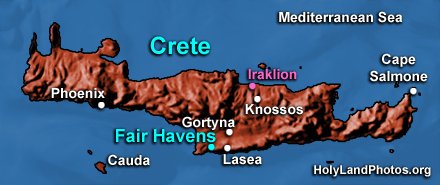
Since the harbor was unsuitable to winter in, the majority decided that we should sail on, hoping to reach Phoenix and winter there. This was a harbor in Crete, facing both southwest and northwest. When a gentle south wind began to blow, they saw their opportunity; so they weighed anchor and sailed along the shore of Crete. Before very long, a wind of hurricane force, called the Northeaster, swept down from the island. The ship was caught by the storm and could not head into the wind; so we gave way to it and were driven along. As we passed to the lee of a small island called Cauda, we were hardly able to make the lifeboat secure, so the men hoisted it aboard. Then they passed ropes under the ship itself to hold it together. Because they were afraid they would run aground on the sandbars of Syrtis, they lowered the sea anchor and let the ship be driven along. We took such a violent battering from the storm that the next day they began to throw the cargo overboard. On the third day, they threw the ship’s tackle overboard with their own hands. When neither sun nor stars appeared for many days and the storm continued raging, we finally gave up all hope of being saved. After they had gone a long time without food, Paul stood up before them and said: “Men, you should have taken my advice not to sail from Crete; then you would have spared yourselves this damage and loss. But now I urge you to keep up your courage, because not one of you will be lost; only the ship will be destroyed. Last night an angel of the God to whom I belong and whom I serve stood beside me and said, ‘Do not be afraid, Paul. You must stand trial before Caesar; and God has graciously given you the lives of all who sail with you.’ So keep up your courage, men, for I have faith in God that it will happen just as he told me. Nevertheless, we must run aground on some island.” – Acts 27:12‭-‬26

Today’s passage is about storms and casting off cargo that we do not need in exchange for something far more valuable than any cargo. Apparently the ship captain in this passage was pushing the envelope trying to get a load of grain from Alexandria to Rome. Apparently after September 15 sailing on the Mediterranean was considered dangerous and after November 11 it was considered impossible. I am not sure what was driving this captain to make the dangerous crossing, perhaps the grain would be ruined if he waited or maybe he was motivated by the money he would make if he could make the crossing. Either way it was a poor choice and the ship and cargo will be lost, but it turns out something much more valuable will be gained.

Paul and other prisoners had been transferred to this cargo ship because the other ship they were traveling on decided to stop for the winter because travel was too dangerous. They apparently succeeded in making part of the Mediterranean crossing as far as Crete, the first and last large island between this part of the Mediterranean and Malta to the west. Their goal was a harbor on Crete near a town called Phoenix. Unfortunately, their initial landing fell short of their intended destination. The bay did not afford good winter protection and the crew decided to push on to Phoenix to find a better harbor to spend the winter. Paul had recommended that they remain and take their chances rather than going on to Phoenix.

The crew thought they saw their opportunity when a gentle south wind came up which could push them along the relatively short distance west along the coast to Phoenix. Unfortunately what started out as a gentle wind became a raging storm and essentially blew them right by their intended destination on Crete and out into the Mediterranean. For many days they battled the storm trying to keep the ship from sinking. They deployed a sea anchor which as I understand it is really just a sail or some other object attached to a rope which is driven in the water to pull the boat along to provide steerage without the danger of using the wind and the sails. They also began to jettison the cargo and eventually the ship’s tackle overboard in an effort to prevent the ship from sinking.

“When neither sun nor stars appeared for many days and the storm continued raging, we finally gave up all hope of being saved. After they had gone a long time without food, Paul stood up before them and said: “Men, you should have taken my advice not to sail from Crete; then you would have spared yourselves this damage and loss.” So in essence Paul was saying “I told you so”. While true this was probably not the most sensitive time or manner to share this rebuke. Paul still has much to learn about leading while following.

I think in many ways this event was Paul’s “Meribah test“. Just as Moses and Aaron were tested at Meribah, Paul is tested to see if he will follow and trust God even in the midst of this scary storm, and perhaps more importantly will he lead others to do the same. This is Paul’s opportunity to learn some the same lessons that Peter learned when Jesus calmed the storm on the Sea of Galilee. Paul passed the test by faithfully following God through his prayers and listening when the angel came to him. Ultimately many on the ship, and in Rome, will believe and become followers of God because of his actions and choices.

Paul is reassured by an angel from God that although the ship will be lost all those on the ship will be saved. I think there’s an important spiritual metaphor here. Sometimes we may have to jettison our cargo and be ready to lose our lives to find our real purpose on the journey. Jesus said all those who lose their lives will save them and gain eternal life. The men on this voyage with Paul lost every earthly thing but escaped with their lives and something infinitely more important their eternal souls.

The take home lesson for me here is that even if we lose all earthly things in pursuit of God we can still have the most important thing – God Himself. He believes in us and our ability to find Him even in the midst of storms. If we place our lives in the hollow of His hand He will carry us like a son or daughter to exactly where we need to go. The loss of our souls is far more important than a load of Alexandrian grain or any other “cargo” we are hauling around with us.

Prayer: God help us to trust in You and the life that You promise all those who faithfully follow You.

Posted in Acts, Christian Leadership, Christianity, Death and Dying, Faith, Following God, Love for the Lost | Tagged | 8 Comments

Out to Sea for Sabbatical

Tony’s Coffee in Fairhaven, WA

When it was decided that we would sail for Italy, Paul and some other prisoners were handed over to a centurion named Julius, who belonged to the Imperial Regiment. We boarded a ship from Adramyttium about to sail for ports along the coast of the province of Asia, and we put out to sea. Aristarchus, a Macedonian from Thessalonica, was with us. The next day we landed at Sidon; and Julius, in kindness to Paul, allowed him to go to his friends so they might provide for his needs. From there we put out to sea again and passed to the lee of Cyprus because the winds were against us. When we had sailed across the open sea off the coast of Cilicia and Pamphylia, we landed at Myra in Lycia. There the centurion found an Alexandrian ship sailing for Italy and put us on board. We made slow headway for many days and had difficulty arriving off Cnidus. When the wind did not allow us to hold our course, we sailed to the lee of Crete, opposite Salmone. We moved along the coast with difficulty and came to a place called Fair Havens, near the town of Lasea. – Acts 27:1‭-‬8

I went to college at Western Washington University in Bellingham, WA. Just south of Bellingham was a town named Fair Haven, just like the final stopping place of Paul from n this passage. We lived in a rickety old house halfway between Bellingham and Fairhaven. The house hade three floors and the occupants on the third floor swore the house swayed in the wind. We lived on the ground level so thankfully we missed these windy wanderings. I was almost crushed one time attempting to help move a sleeper sofa to the third floor apartment.

Bellingham was a college town, at least near campus. The coffee shops, pizza joints, and ice cream parlors were infused with the seasonal stress induced by exams, papers, and projects. Fairhaven was far enough from campus to avoid many of these academic ailments. It was near this quiet and quant village, at a place called Post Point, that I asked a beautiful young lady to marry me and join me on life’s journey – “me” became “we”.

My future wife and I would walk down the hill to Fairhaven for ice cream, donuts, and all manner of digestive distraction. One of our favorite haunts was a place called simply Tony’s Coffee. We would spend hours nestled into a corner nursing a shared pot of Earl grey or English Breakfast tea. This was before Starbucks and Bigbys. It was a cozy place where the consumption of caffeine was secondary to the soul supercharging that occurred there. It provided a refuge and brief sabbatical from the stress and rigors of campus life.

In many ways it seems like Paul’s setting out to sea for Rome was a bit like our trips to Fairhaven. He was leaving the stressful stonings and imprisonment of the Sadducees and Pharisees for the relative reasonableness of Rome. Although a prisoner, Paul must have felt some sense of relief to escape the religious leaders and ridicule of the Sanhedrin. Paul needed a sabbatical and I think it took this sea voyage to get him there, physically and mentally.

My wife and I escaped to Fairhaven to get out of the college life and interact with “real” people. Most of the people in Fairhaven were not college students and thus not subject to final exams and homework. I think Paul’s “escape” to Rome was similar not n that most of the people he would encounter in Rome were not Jews or Christians. It gave him an opportunity to step back from his work as an apologist among religious sceptics to argue the case for Jesus among “real” people. I suspect this rejuvenated his rhetoric and kept him on his theological toes. Paul will have many opportunities to share the Good News of Jesus and plant the seeds that will one day transform the Roman empire and give rise to the Roman Catholic church.

As I reflect on this trip I think it was for Paul a bit like a sabbatical is for academic professors – a chance to slow down and reflect on what is important and take some time for self care. Of course Paul was not exactly on this trip by choice, but God clearly had a plan. It is reassuring to know that even amidst circumstances that appear from an earthly perspective to be scary and dangerous God is still at the helm of the ship and He will take us where we need to go.

Prayer: God help us to trust You – confident that You know where we are headed and will lead us there.

Posted in Acts, Christianity, Discernment, Following God, Gospel, Jesus | Tagged , , | 2 Comments

Humility and Tears

“rainbow road” to a small church in Seyðisfjörður, Iceland

Paul had decided to sail past Ephesus to avoid spending time in the province of Asia, for he was in a hurry to reach Jerusalem, if possible, by the day of Pentecost. From Miletus, Paul sent to Ephesus for the elders of the church. When they arrived, he said to them: “You know how I lived the whole time I was with you, from the first day I came into the province of Asia. I served the Lord with great humility and with tears and in the midst of severe testing by the plots of my Jewish opponents. You know that I have not hesitated to preach anything that would be helpful to you but have taught you publicly and from house to house. I have declared to both Jews and Greeks that they must turn to God in repentance and have faith in our Lord Jesus. – Acts 20:16-‬21

Quite a few things have happened since Paul and Silas were in prison and decided to stay so that the guard and his family could learn the Good News of the Gospel. There was an interesting interlude a few chapters ago when a sleepy student of Paul and Silas fell out of a window and needed to be resurrected, but this passage finds Paul in Jerusalem, the city of David.

For some reason Paul sailed past Ephesus without visiting the believers there. The explanation he provides is that he wanted to arrive in Jerusalem for the commemoration of Pentecost the day the Holy Spirit was poured into the followers. It seems like Paul wants to connect with followers in Ephesus but he does not want to go out of his way too much. Perhaps Paul and these other early Christian leaders still have some things to learn about leadership and humility.

When the believers from Ephesus arrived Paul recounts how he had served with “humility and tears” in the midst of testing. The testing is primarily coming at the hands of “Jewish opponents”. Tears often represent samples of our souls and reveal what is going on inside in a way that words can sometimes hide, especially in someone like Paul who is a trained orator.

Paul’s statement leaves me wondering what was causing his tears. Was he frustrated with the religious leaders and their stubborn resistance the Good News? Was he sad about the conflicts between early believers? Was he remorseful that he invested so much of his energy and soul fighting against the One he now loves and is representing? Is he lamenting the lack of “lessons by the lake” that all the other disciples received from Jesus personally? Sorry no great answers only questions, but let’s push on through this stretch of water and see what else God has to reveal.

Paul acknowledges that his teaching and sharing has come with a healthy dose of humility. This learned man has been required to acknowledge that he does not know everything, especially about God. He must rely on the Holy Spirit and other believers to fill in these gaps in knowledge which requires humility on his part. As an ostensibly learned man myself this realization and rebuke hits home. We all have so much to learn from one another and God as we journey through this land of Oblivion.

Prayer: God help us to approach You and one another with humility and grace.

Posted in Acts, Christian Leadership, Christianity, Following God, Holy Spirit, Paul | Tagged , , | 5 Comments

Staying in Jail to Set People Free

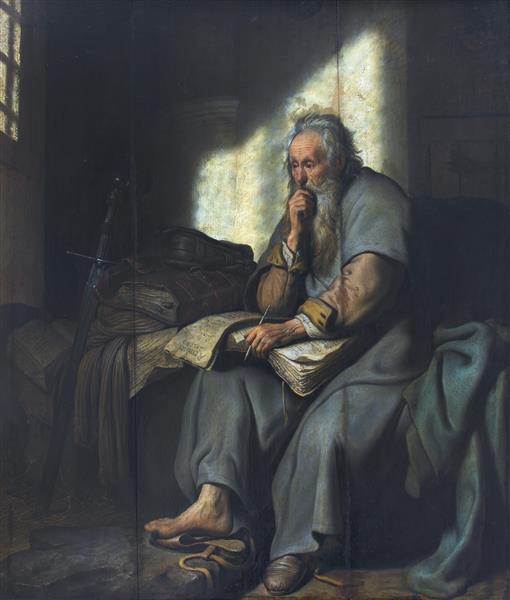
St. Paul in Prison by Rembrandt

The crowd joined in the attack against Paul and Silas, and the magistrates ordered them to be stripped and beaten with rods. After they had been severely flogged, they were thrown into prison, and the jailer was commanded to guard them carefully. When he received these orders, he put them in the inner cell and fastened their feet in the stocks. About midnight Paul and Silas were praying and singing hymns to God, and the other prisoners were listening to them. Suddenly there was such a violent earthquake that the foundations of the prison were shaken. At once all the prison doors flew open, and everyone’s chains came loose. The jailer woke up, and when he saw the prison doors open, he drew his sword and was about to kill himself because he thought the prisoners had escaped. But Paul shouted, “Don’t harm yourself! We are all here!” The jailer called for lights, rushed in and fell trembling before Paul and Silas. He then brought them out and asked, “Sirs, what must I do to be saved?” They replied, “Believe in the Lord Jesus, and you will be saved—you and your household.” Then they spoke the word of the Lord to him and to all the others in his house. At that hour of the night the jailer took them and washed their wounds; then immediately he and all his household were baptized. The jailer brought them into his house and set a meal before them; he was filled with joy because he had come to believe in God—he and his whole household. – Acts 16:22-‬34

Today’s passage is a somewhat odd story of Paul and Silas in prison. They are there in part because of the impetuousness of Paul. He had the audacity to drive out a demon from a slave woman that was a cash cow for her owners.

Apparently this woman’s demon allowed her to tell fortunes. The preceding chapters describe this woman following Paul and Silas bearing witness to the fact that that they are followers of the Living God. Paul gets annoyed and drives out the demon and the woman’s owners, and the town leaders, have him and Silas flogged and put in prison. I am wondering if this is another leader lesson for Paul and Silas.

Certainly the consequences of Paul’s driving out of the demon are initially pretty bad, beating and imprisonment. There is no mention of Paul having compassion for the woman as a reason for driving out the demon. Perhaps he did this “healing” in Jesus’ name without seeking guidance from the Holy Spirit. It is not clear. Paul’s posture and perspective do seem somewhat self-focused.

Whatever the reason for Paul’ action regarding the slave woman and the demon God and the Holy Spirit have a plan to use it to reach the prison guard and his whole family. In the middle of the night “Suddenly there was such a violent earthquake that the foundations of the prison were shaken. At once all the prison doors flew open, and everyone’s chains came loose.” The prisoners were freed but interestingly they did not flee. This event happened in response to Paul and Silas praying and singing hymns to God. I think part of the point here is that these men should have been praying about the demon-possessed woman before they acted. The outcomes could not be more different.

The guard, thinking that all the prisoners have escaped, is ready to kill himself when Paul still in his cell intervenes by shouting “Don’t harm yourself! We are all here!” I think this time Paul is listening and allowing his actions to be guided by the Holy Spirit. Had Paul and Silas fled when they were able this man and his whole family would have remained lost. Apparently sometimes one has to stay in jail to set people free.

The guard takes the men to his house and washes their wounds. They share the Gospel with his entire household and they are all baptized as new believers. The guard “was filled with joy because he had come to believe in God—he and his whole household”. The ending of the story is one of hope and redemption. The path to get their for Paul and Silas was probably more painful and difficult than they anticipated or planned.

One of the interesting aspects of this story that jumps out at me is that Paul and Silas had to remain in jail in order to save the guard. This must have been hard. I think if it were me I would want to run the second my bonds were broken and I was free. But God needed them to remain in jail for a time so that the guard and his family could be saved.

This is similar to when someone is delivered from a life without out God. There is a tendency to run from that previous life as soon as freedom is in sight. That is a good thing and ultimately God wants us to be on the journey toward Him,but I wonder if sometimes God needs us to choose to return or remain “in jail” so that we can lead people from their “old life” to find Him. This might stretching the meaning of this story beyond what is wise, but it is an interesting thing to think about. When should we choose to stay “in prison” so that others can be saved? Ultimately, I think only God can answer this question for each of us through prayer and listening to the Holy Spirit.

Prayer: God help us to discern when and how we can best reach the lost so that they can find You.

Posted in Acts, baptism, Born again, Christian Leadership, Christianity, Following God, Forgiveness, God's Love for Us, Holy Spirit, Love for the Lost, Paul, Sharing the Gospel | Tagged | 5 Comments

Public Places

Walking along Sweetwater Creek in Oregon

During the night Paul had a vision of a man of Macedonia standing and begging him, “Come over to Macedonia and help us.” After Paul had seen the vision, we got ready at once to leave for Macedonia, concluding that God had called us to preach the gospel to them. From Troas we put out to sea and sailed straight for Samothrace, and the next day we went on to Neapolis. From there we traveled to Philippi, a Roman colony and the leading city of that district of Macedonia. And we stayed there several days. On the Sabbath we went outside the city gate to the river, where we expected to find a place of prayer. We sat down and began to speak to the women who had gathered there. One of those listening was a woman from the city of Thyatira named Lydia, a dealer in purple cloth. She was a worshiper of God. The Lord opened her heart to respond to Paul’s message. When she and the members of her household were baptized, she invited us to her home. “If you consider me a believer in the Lord,” she said, “come and stay at my house.” And she persuaded us. – Acts 16:9‭-‬15

In today’s passage we find Paul on the road with Silas, Timothy, and other believers.  In a dream God called Paul to go to Macedonia. Paul parted ways with Barnabas a few chapters ago over a disagreement, and after the costly “leader lessson” they got in Iconium. The dream in which Paul is called to Macedonia involves a man begging Paul to “come over to Macedonia and help us”. Interestingly, it is not a man they will meet in this passage but a young woman named Lydia.

Reviewing the cities en-route to Philippi it appears Paul and his band of men left Troas and traveled by boat across the Aegean Sea to Neapolis on the coast, then traveled by land to Philippi. They stayed in Philippi for several days, presumably preaching the gospel and meeting with believers. While they were there they found a wondering soul, Lydia.

The encounter with Lydia begins with Paul and his travelling companions leaving the city on the sabbath to pray by the river. This may have been because there were no synagogues in this part of the world or it may have been that they just wanted a quiet “place of prayer”. I can relate to this desire to find a quiet place in nature to meet with God. As a true “river rat” myself I have affinity for rivers and the peaceful place they provide. What better place to meet with the One River, and receive the Living Water God offers than at a peaceful and life-giving river?

There were apparently several women along the river, presumably doing laundry or fetching water. I suspect this location of water was a community gathering place for local women and children in a similar way to the way a park or playground would function today. I imagine they were sharing news of their families, relatives, and the local gossip of the day, sort of like Facebook but without all the add placement.

Paul and his crew were praying and worshiping by the river. It does not seem like they were there “preaching”, but merely going about their worship in a public setting. Lydia was “listening in” to their activities. She is described as a “dealer in purple cloth” and a “worshiper of God”. She was seeking something just like the Ethiopian earlier in Acts. The Holy Spirit was hard at work in her heart long before these men decided to leave the city and worship by the river.

The Holy Spirit, Paul, and the other believers message and actions resonated in Lydia’s heart and she decides that she is ready to commit to this new way of knowing God. She and many members of her family are baptized, presumably in the river. Her seeking has led her to the only one who can help her cross the river that no on can cross. She immediately acts on her new commitment and invites Paul and the others to her house.

The take home message from this passage for me is that sometimes we should do our worshiping and praying in public near rivers, on the beach, and on the mountain tops. I think we should do this not in a grandstanding “in your face” way but in a simple and sincere way. How are curious God-seekers to find God if we are only sharing Him within the walls of a church? Seekers like Lydia may never enter a church or synagogue because of the doorkeepers and sheer intimidation of the doors. Had these men not practiced their love of God in a public place, with sensitivity to the Holy Spirit, Lydia may have missed the Messiah that they were meeting with at the river.

Prayer: God help us to worship and share our love for you in both public and private places so that those seeking to know you can see and believe.

Posted in Acts, baptism, Born again, Christianity, Discipleship, Following God, Holy Spirit, Love for the Lost, Nature, Paul, Sharing the Gospel | Tagged , , | 2 Comments